 Add to Chrome
 Add to Firefox
 Add to Edge
Rational Activation Functions
Papers and Code
Phi-Former: A Pairwise Hierarchical Approach for Compound-Protein Interactions Prediction
Feb 05, 2026
Drug discovery remains time-consuming, labor-intensive, and expensive, often requiring years and substantial investment per drug candidate. Predicting compound-protein interactions (CPIs) is a critical component in this process, enabling the identification of molecular interactions between drug candidates and target proteins. Recent deep learning methods have successfully modeled CPIs at the atomic level, achieving improved efficiency and accuracy over traditional energy-based approaches. However, these models do not always align with chemical realities, as molecular fragments (motifs or functional groups) typically serve as the primary units of biological recognition and binding. In this paper, we propose Phi-former, a pairwise hierarchical interaction representation learning method that addresses this gap by incorporating the biological role of motifs in CPIs. Phi-former represents compounds and proteins hierarchically and employs a pairwise pre-training framework to model interactions systematically across atom-atom, motif-motif, and atom-motif levels, reflecting how biological systems recognize molecular partners. We design intra-level and inter-level learning pipelines that make different interaction levels mutually beneficial. Experimental results demonstrate that Phi-former achieves superior performance on CPI-related tasks. A case study shows that our method accurately identifies specific atoms or motifs activated in CPIs, providing interpretable model explanations. These insights may guide rational drug design and support precision medicine applications.

Rational ANOVA Networks
Feb 03, 2026Deep neural networks typically treat nonlinearities as fixed primitives (e.g., ReLU), limiting both interpretability and the granularity of control over the induced function class. While recent additive models (like KANs) attempt to address this using splines, they often suffer from computational inefficiency and boundary instability. We propose the Rational-ANOVA Network (RAN), a foundational architecture grounded in functional ANOVA decomposition and Padé-style rational approximation. RAN models f(x) as a composition of main effects and sparse pairwise interactions, where each component is parameterized by a stable, learnable rational unit. Crucially, we enforce a strictly positive denominator, which avoids poles and numerical instability while capturing sharp transitions and near-singular behaviors more efficiently than polynomial bases. This ANOVA structure provides an explicit low-order interaction bias for data efficiency and interpretability, while the rational parameterization significantly improves extrapolation. Across controlled function benchmarks and vision classification tasks (e.g., CIFAR-10) under matched parameter and compute budgets, RAN matches or surpasses parameter-matched MLPs and learnable-activation baselines, with better stability and throughput. Code is available at https://github.com/jushengzhang/Rational-ANOVA-Networks.git.
Disentangling multispecific antibody function with graph neural networks
Jan 30, 2026Multispecific antibodies offer transformative therapeutic potential by engaging multiple epitopes simultaneously, yet their efficacy is an emergent property governed by complex molecular architectures. Rational design is often bottlenecked by the inability to predict how subtle changes in domain topology influence functional outcomes, a challenge exacerbated by the scarcity of comprehensive experimental data. Here, we introduce a computational framework to address part of this gap. First, we present a generative method for creating large-scale, realistic synthetic functional landscapes that capture non-linear interactions where biological activity depends on domain connectivity. Second, we propose a graph neural network architecture that explicitly encodes these topological constraints, distinguishing between format configurations that appear identical to sequence-only models. We demonstrate that this model, trained on synthetic landscapes, recapitulates complex functional properties and, via transfer learning, has the potential to achieve high predictive accuracy on limited biological datasets. We showcase the model's utility by optimizing trade-offs between efficacy and toxicity in trispecific T-cell engagers and retrieving optimal common light chains. This work provides a robust benchmarking environment for disentangling the combinatorial complexity of multispecifics, accelerating the design of next-generation therapeutics.
Don't Forget the Nonlinearity: Unlocking Activation Functions in Efficient Fine-Tuning
Sep 16, 2025Existing parameter-efficient fine-tuning (PEFT) methods primarily adapt weight matrices while keeping activation functions fixed. We introduce \textbf{NoRA}, the first PEFT framework that directly adapts nonlinear activation functions in pretrained transformer-based models. NoRA replaces fixed activations with learnable rational functions and applies structured low-rank updates to numerator and denominator coefficients, with a group-wise design that localizes adaptation and improves stability at minimal cost. On vision transformers trained on CIFAR-10 and CIFAR-100, NoRA matches or exceeds full fine-tuning while updating only 0.4\% of parameters (0.02M), achieving accuracy gains of +0.17\% and +0.27\%. When combined with LoRA (\textbf{NoRA++}), it outperforms LoRA and DoRA under matched training budgets by adding fewer trainable parameters. On LLaMA3-8B instruction tuning, NoRA++ consistently improves generation quality, yielding average MMLU gains of +0.3\%--0.8\%, including +1.6\% on STEM (Alpaca) and +1.3\% on OpenOrca. We further show that NoRA constrains adaptation to a low-dimensional functional subspace, implicitly regularizing update magnitude and direction. These results establish activation-space tuning as a complementary and highly parameter-efficient alternative to weight-based PEFT, positioning activation functions as first-class objects for model adaptation.
Erzeugunsgrad, VC-Dimension and Neural Networks with rational activation function
Apr 15, 2025The notion of Erzeugungsgrad was introduced by Joos Heintz in 1983 to bound the number of non-empty cells occurring after a process of quantifier elimination. We extend this notion and the combinatorial bounds of Theorem 2 in Heintz (1983) using the degree for constructible sets defined in Pardo-Sebasti\'an (2022). We show that the Erzeugungsgrad is the key ingredient to connect affine Intersection Theory over algebraically closed fields and the VC-Theory of Computational Learning Theory for families of classifiers given by parameterized families of constructible sets. In particular, we prove that the VC-dimension and the Krull dimension are linearly related up to logarithmic factors based on Intersection Theory. Using this relation, we study the density of correct test sequences in evasive varieties. We apply these ideas to analyze parameterized families of neural networks with rational activation function.
Dynamics of Insect Paraintelligence: How a Mindless Colony of Ants Meaningfully Moves a Beetle
Mar 24, 2025In this work, a new concept called Vector Dissipation of Randomness (VDR) is developed and formalized. It describes the mechanism by which complex multicomponent systems transition from chaos to order through the filtering of random directions, accumulation of information in the environment, and self-organization of agents. VDR explains how individual random strategies can evolve into collective goaldirected behavior, leading to the emergence of an ordered structure without centralized control. To test the proposed model, a numerical simulation of the "ant and beetle" system was conducted, in which agents (ants) randomly choose movement directions, but through feedback mechanisms and filtering of weak strategies, they form a single coordinated vector of the beetles movement. VDR is a universal mechanism applicable to a wide range of self-organizing systems, including biological populations, decentralized technological networks, sociological processes, and artificial intelligence algorithms. For the first time, an equation of the normalized emergence function in the processing of vector dissipation of randomness in the Ant and Beetle system has been formulated. The concept of paraintelligence was introduced for the first time. Insect paraintelligence is interpreted as a rational functionality that is close to or equivalent to intelligent activity in the absence of reflexive consciousness and selfawareness.
REAct: Rational Exponential Activation for Better Learning and Generalization in PINNs
Mar 04, 2025


Physics-Informed Neural Networks (PINNs) offer a promising approach to simulating physical systems. Still, their application is limited by optimization challenges, mainly due to the lack of activation functions that generalize well across several physical systems. Existing activation functions often lack such flexibility and generalization power. To address this issue, we introduce Rational Exponential Activation (REAct), a generalized form of tanh consisting of four learnable shape parameters. Experiments show that REAct outperforms many standard and benchmark activations, achieving an MSE three orders of magnitude lower than tanh on heat problems and generalizing well to finer grids and points beyond the training domain. It also excels at function approximation tasks and improves noise rejection in inverse problems, leading to more accurate parameter estimates across varying noise levels.
Generating $π$-Functional Molecules Using STGG+ with Active Learning
Feb 20, 2025Generating novel molecules with out-of-distribution properties is a major challenge in molecular discovery. While supervised learning methods generate high-quality molecules similar to those in a dataset, they struggle to generalize to out-of-distribution properties. Reinforcement learning can explore new chemical spaces but often conducts 'reward-hacking' and generates non-synthesizable molecules. In this work, we address this problem by integrating a state-of-the-art supervised learning method, STGG+, in an active learning loop. Our approach iteratively generates, evaluates, and fine-tunes STGG+ to continuously expand its knowledge. We denote this approach STGG+AL. We apply STGG+AL to the design of organic $\pi$-functional materials, specifically two challenging tasks: 1) generating highly absorptive molecules characterized by high oscillator strength and 2) designing absorptive molecules with reasonable oscillator strength in the near-infrared (NIR) range. The generated molecules are validated and rationalized in-silico with time-dependent density functional theory. Our results demonstrate that our method is highly effective in generating novel molecules with high oscillator strength, contrary to existing methods such as reinforcement learning (RL) methods. We open-source our active-learning code along with our Conjugated-xTB dataset containing 2.9 million $\pi$-conjugated molecules and the function for approximating the oscillator strength and absorption wavelength (based on sTDA-xTB).
Order Theory in the Context of Machine Learning: an application
Dec 08, 2024

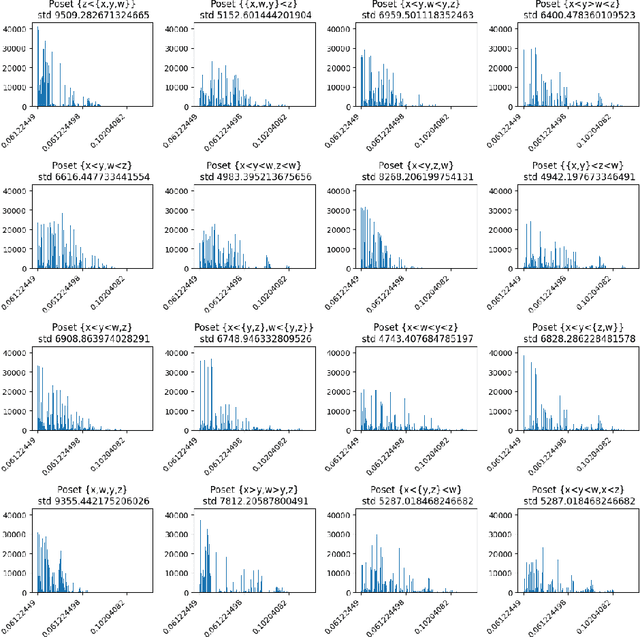
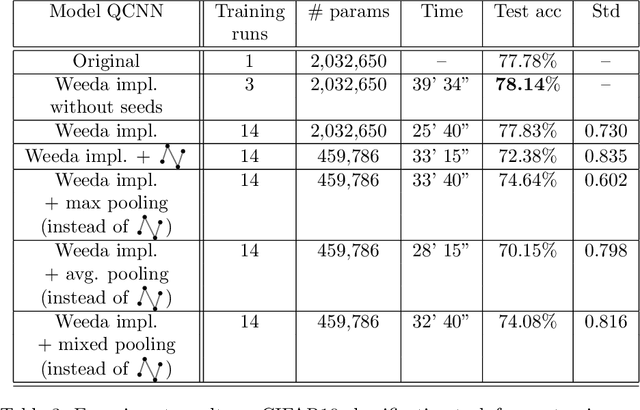
The paper ``Tropical Geometry of Deep Neural Networks'' by L. Zhang et al. introduces an equivalence between integer-valued neural networks (IVNN) with activation $\text{ReLU}_{t}$ and tropical rational functions, which come with a map to polytopes. Here, IVNN refers to a network with integer weights but real biases, and $\text{ReLU}_{t}$ is defined as $\text{ReLU}_{t}(x)=\max(x,t)$ for $t\in\mathbb{R}\cup\{-\infty\}$. For every poset with $n$ points, there exists a corresponding order polytope, i.e., a convex polytope in the unit cube $[0,1]^n$ whose coordinates obey the inequalities of the poset. We study neural networks whose associated polytope is an order polytope. We then explain how posets with four points induce neural networks that can be interpreted as $2\times 2$ convolutional filters. These poset filters can be added to any neural network, not only IVNN. Similarly to maxout, poset convolutional filters update the weights of the neural network during backpropagation with more precision than average pooling, max pooling, or mixed pooling, without the need to train extra parameters. We report experiments that support our statements. We also prove that the assignment from a poset to an order polytope (and to certain tropical polynomials) is one to one, and we define the structure of algebra over the operad of posets on tropical polynomials.
An Investigation on the Potential of KAN in Speech Enhancement
Dec 23, 2024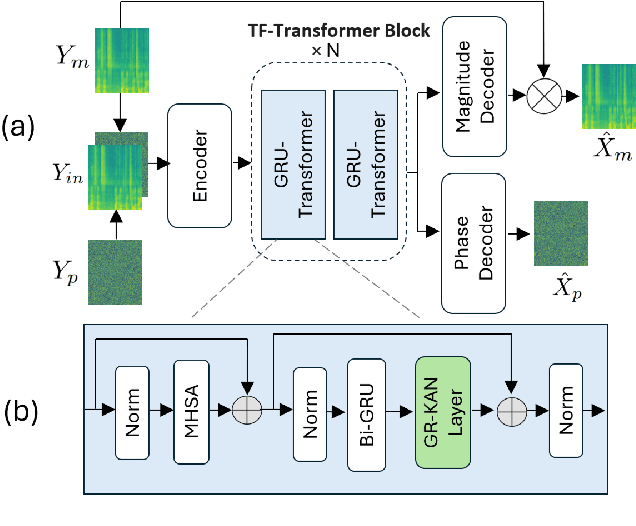
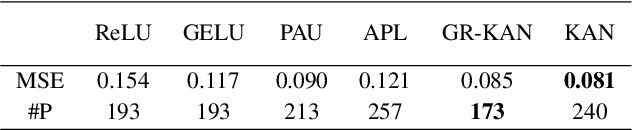
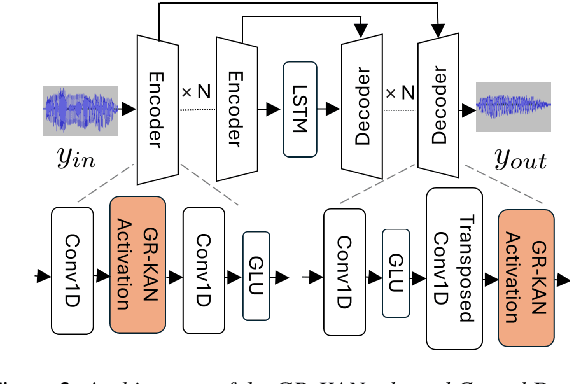
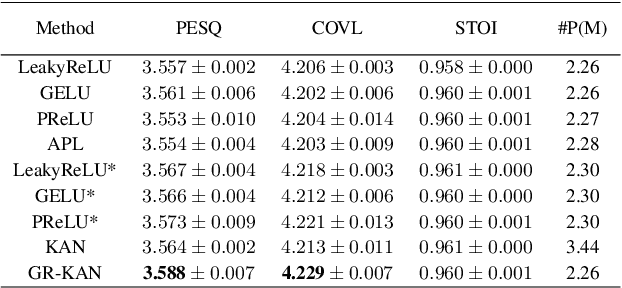
High-fidelity speech enhancement often requires sophisticated modeling to capture intricate, multiscale patterns. Standard activation functions, while introducing nonlinearity, lack the flexibility to fully address this complexity. Kolmogorov-Arnold Networks (KAN), an emerging methodology that employs learnable activation functions on graph edges, present a promising alternative. This work investigates two novel KAN variants based on rational and radial basis functions for speech enhancement. We integrate the rational variant into the 1D CNN blocks of Demucs and the GRU-Transformer blocks of MP-SENet, while the radial variant is adapted to the 2D CNN-based decoders of MP-SENet. Experiments on the VoiceBank-DEMAND dataset show that replacing standard activations with KAN-based activations improves speech quality across both the time-domain and time-frequency domain methods with minimal impact on model size and FLOP, underscoring KAN's potential to improve speech enhancement models.