 Add to Chrome
 Add to Firefox
 Add to Edge
Nba Sportvu
Papers and Code
MoFlow: One-Step Flow Matching for Human Trajectory Forecasting via Implicit Maximum Likelihood Estimation based Distillation
Mar 13, 2025
In this paper, we address the problem of human trajectory forecasting, which aims to predict the inherently multi-modal future movements of humans based on their past trajectories and other contextual cues. We propose a novel motion prediction conditional flow matching model, termed MoFlow, to predict K-shot future trajectories for all agents in a given scene. We design a novel flow matching loss function that not only ensures at least one of the $K$ sets of future trajectories is accurate but also encourages all $K$ sets of future trajectories to be diverse and plausible. Furthermore, by leveraging the implicit maximum likelihood estimation (IMLE), we propose a novel distillation method for flow models that only requires samples from the teacher model. Extensive experiments on the real-world datasets, including SportVU NBA games, ETH-UCY, and SDD, demonstrate that both our teacher flow model and the IMLE-distilled student model achieve state-of-the-art performance. These models can generate diverse trajectories that are physically and socially plausible. Moreover, our one-step student model is $\textbf{100}$ times faster than the teacher flow model during sampling. The code, model, and data are available at our project page: https://moflow-imle.github.io

Learning Group Interactions and Semantic Intentions for Multi-Object Trajectory Prediction
Dec 20, 2024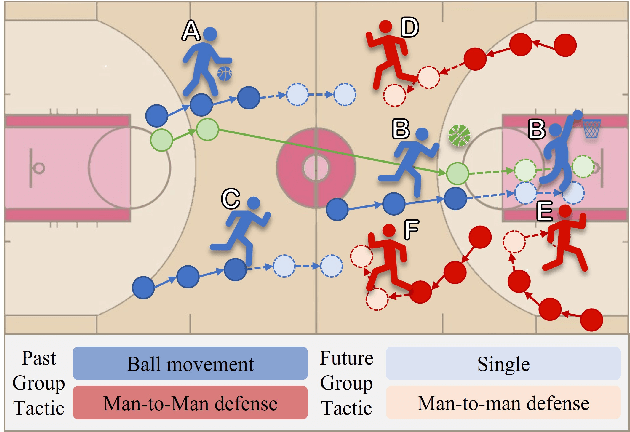

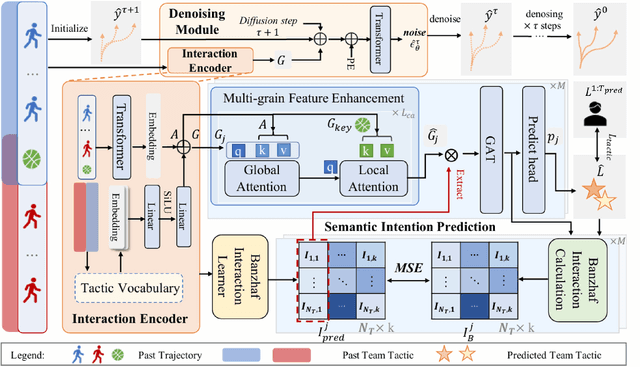

Effective modeling of group interactions and dynamic semantic intentions is crucial for forecasting behaviors like trajectories or movements. In complex scenarios like sports, agents' trajectories are influenced by group interactions and intentions, including team strategies and opponent actions. To this end, we propose a novel diffusion-based trajectory prediction framework that integrates group-level interactions into a conditional diffusion model, enabling the generation of diverse trajectories aligned with specific group activity. To capture dynamic semantic intentions, we frame group interaction prediction as a cooperative game, using Banzhaf interaction to model cooperation trends. We then fuse semantic intentions with enhanced agent embeddings, which are refined through both global and local aggregation. Furthermore, we expand the NBA SportVU dataset by adding human annotations of team-level tactics for trajectory and tactic prediction tasks. Extensive experiments on three widely-adopted datasets demonstrate that our model outperforms state-of-the-art methods. Our source code and data are available at https://github.com/aurora-xin/Group2Int-trajectory.
SocialVAE: Human Trajectory Prediction using Timewise Latents
Mar 29, 2022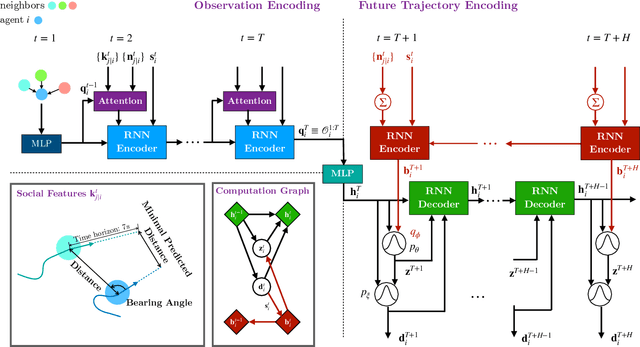
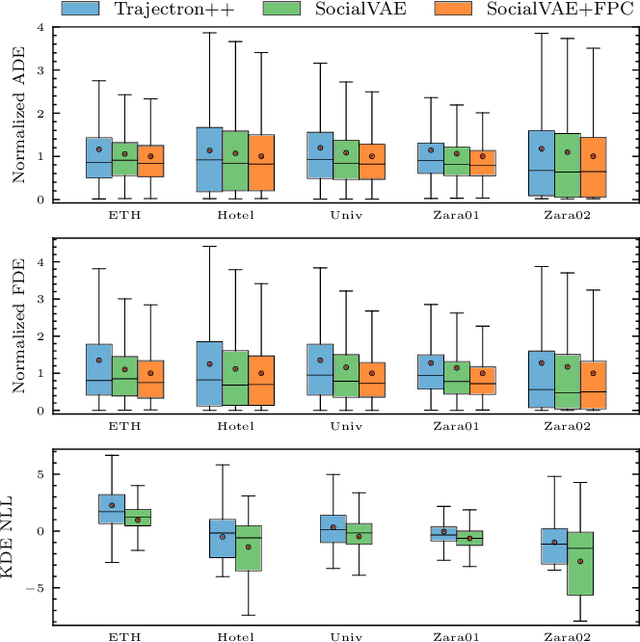
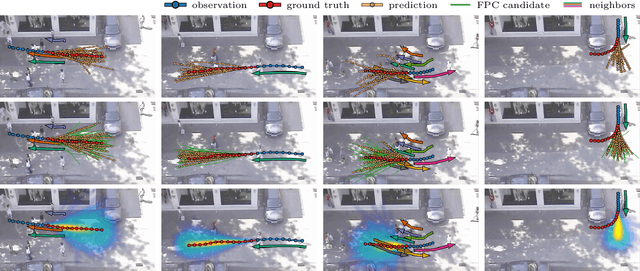
Predicting pedestrian movement is critical for human behavior analysis and also for safe and efficient human-agent interactions. However, despite significant advancements, it is still challenging for existing approaches to capture the uncertainty and multimodality of human navigation decision making. In this paper, we propose SocialVAE, a novel approach for human trajectory prediction. The core of SocialVAE is a timewise variational autoencoder architecture that exploits stochastic recurrent neural networks to perform prediction, combined with a social attention mechanism and backward posterior approximation to allow for better extraction of pedestrian navigation strategies. We show that SocialVAE improves current state-of-the-art performance on several pedestrian trajectory prediction benchmarks, including the ETH/UCY benchmark, the Stanford Drone Dataset and SportVU NBA movement dataset. Code is available at: https://github.com/xupei0610/SocialVAE.
Applying Deep Bidirectional LSTM and Mixture Density Network for Basketball Trajectory Prediction
Aug 19, 2017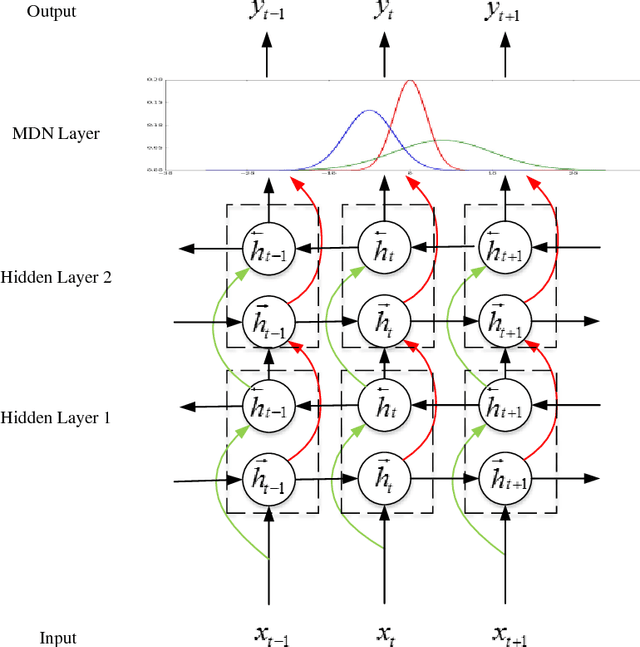
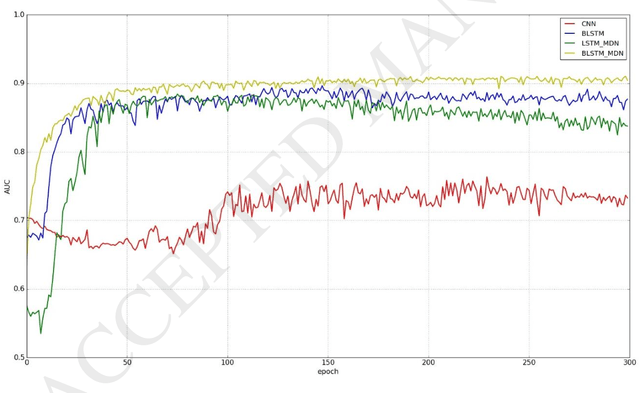
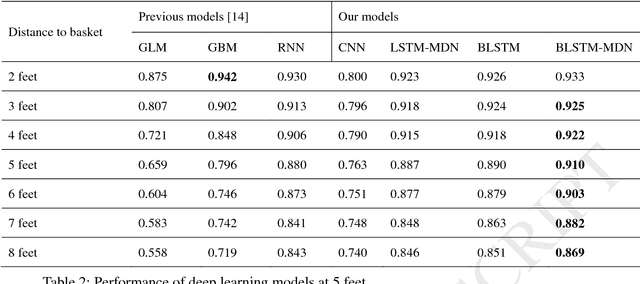
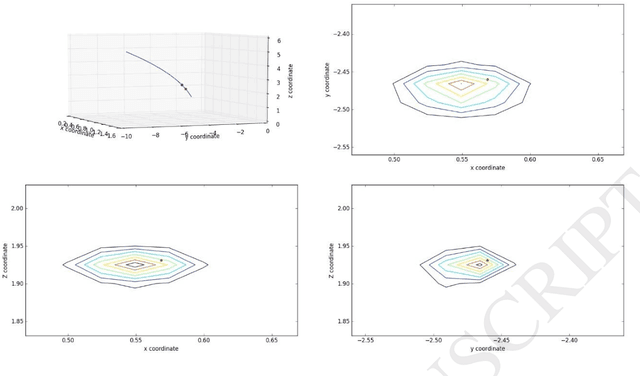
Data analytics helps basketball teams to create tactics. However, manual data collection and analytics are costly and ineffective. Therefore, we applied a deep bidirectional long short-term memory (BLSTM) and mixture density network (MDN) approach. This model is not only capable of predicting a basketball trajectory based on real data, but it also can generate new trajectory samples. It is an excellent application to help coaches and players decide when and where to shoot. Its structure is particularly suitable for dealing with time series problems. BLSTM receives forward and backward information at the same time, while stacking multiple BLSTMs further increases the learning ability of the model. Combined with BLSTMs, MDN is used to generate a multi-modal distribution of outputs. Thus, the proposed model can, in principle, represent arbitrary conditional probability distributions of output variables. We tested our model with two experiments on three-pointer datasets from NBA SportVu data. In the hit-or-miss classification experiment, the proposed model outperformed other models in terms of the convergence speed and accuracy. In the trajectory generation experiment, eight model-generated trajectories at a given time closely matched real trajectories.
Applying Deep Learning to Basketball Trajectories
Aug 16, 2016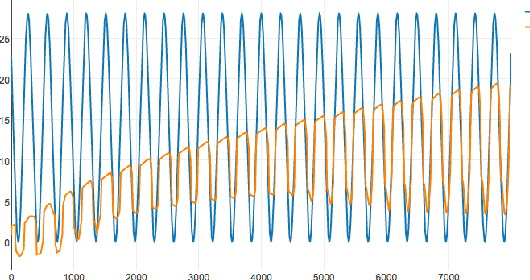
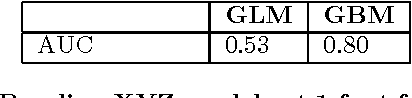
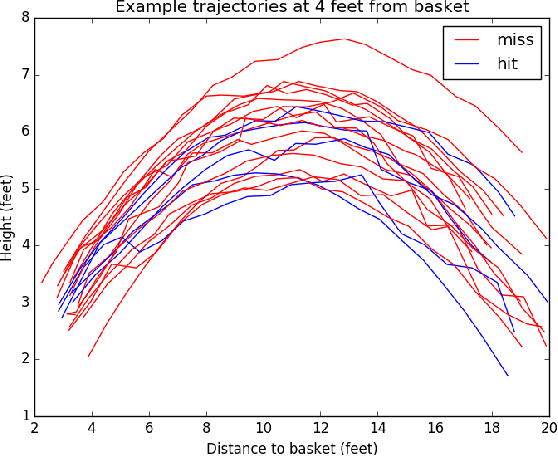
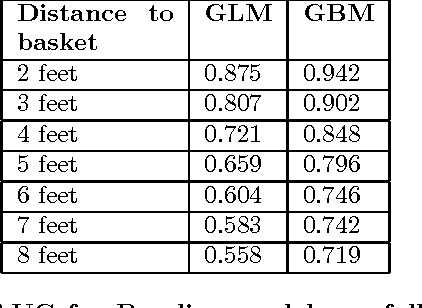
One of the emerging trends for sports analytics is the growing use of player and ball tracking data. A parallel development is deep learning predictive approaches that use vast quantities of data with less reliance on feature engineering. This paper applies recurrent neural networks in the form of sequence modeling to predict whether a three-point shot is successful. The models are capable of learning the trajectory of a basketball without any knowledge of physics. For comparison, a baseline static machine learning model with a full set of features, such as angle and velocity, in addition to the positional data is also tested. Using a dataset of over 20,000 three pointers from NBA SportVu data, the models based simply on sequential positional data outperform a static feature rich machine learning model in predicting whether a three-point shot is successful. This suggests deep learning models may offer an improvement to traditional feature based machine learning methods for tracking data.