 Add to Chrome
 Add to Firefox
 Add to Edge
Mpii Human Pose
Papers and Code
LAPX: Lightweight Hourglass Network with Global Context
Dec 18, 2025
Human pose estimation is a crucial task in computer vision. Methods that have SOTA (State-of-the-Art) accuracy, often involve a large number of parameters and incur substantial computational cost. Many lightweight variants have been proposed to reduce the model size and computational cost of them. However, several of these methods still contain components that are not well suited for efficient deployment on edge devices. Moreover, models that primarily emphasize inference speed on edge devices often suffer from limited accuracy due to their overly simplified designs. To address these limitations, we propose LAPX, an Hourglass network with self-attention that captures global contextual information, based on previous work, LAP. In addition to adopting the self-attention module, LAPX advances the stage design and refine the lightweight attention modules. It achieves competitive results on two benchmark datasets, MPII and COCO, with only 2.3M parameters, and demonstrates real-time performance, confirming its edge-device suitability.

RSPose: Ranking Based Losses for Human Pose Estimation
Nov 17, 2025While heatmap-based human pose estimation methods have shown strong performance, they suffer from three main problems: (P1) "Commonly used Mean Squared Error (MSE)" Loss may not always improve joint localization because it penalizes all pixel deviations equally, without focusing explicitly on sharpening and correctly localizing the peak corresponding to the joint; (P2) heatmaps are spatially and class-wise imbalanced; and, (P3) there is a discrepancy between the evaluation metric (i.e., mAP) and the loss functions. We propose ranking-based losses to address these issues. Both theoretically and empirically, we show that our proposed losses are superior to commonly used heatmap losses (MSE, KL-Divergence). Our losses considerably increase the correlation between confidence scores and localization qualities, which is desirable because higher correlation leads to more accurate instance selection during Non-Maximum Suppression (NMS) and better Average Precision (mAP) performance. We refer to the models trained with our losses as RSPose. We show the effectiveness of RSPose across two different modes: one-dimensional and two-dimensional heatmaps, on three different datasets (COCO, CrowdPose, MPII). To the best of our knowledge, we are the first to propose losses that align with the evaluation metric (mAP) for human pose estimation. RSPose outperforms the previous state of the art on the COCO-val set and achieves an mAP score of 79.9 with ViTPose-H, a vision transformer model for human pose estimation. We also improve SimCC Resnet-50, a coordinate classification-based pose estimation method, by 1.5 AP on the COCO-val set, achieving 73.6 AP.
PoseBH: Prototypical Multi-Dataset Training Beyond Human Pose Estimation
May 23, 2025We study multi-dataset training (MDT) for pose estimation, where skeletal heterogeneity presents a unique challenge that existing methods have yet to address. In traditional domains, \eg regression and classification, MDT typically relies on dataset merging or multi-head supervision. However, the diversity of skeleton types and limited cross-dataset supervision complicate integration in pose estimation. To address these challenges, we introduce PoseBH, a new MDT framework that tackles keypoint heterogeneity and limited supervision through two key techniques. First, we propose nonparametric keypoint prototypes that learn within a unified embedding space, enabling seamless integration across skeleton types. Second, we develop a cross-type self-supervision mechanism that aligns keypoint predictions with keypoint embedding prototypes, providing supervision without relying on teacher-student models or additional augmentations. PoseBH substantially improves generalization across whole-body and animal pose datasets, including COCO-WholeBody, AP-10K, and APT-36K, while preserving performance on standard human pose benchmarks (COCO, MPII, and AIC). Furthermore, our learned keypoint embeddings transfer effectively to hand shape estimation (InterHand2.6M) and human body shape estimation (3DPW). The code for PoseBH is available at: https://github.com/uyoung-jeong/PoseBH.
Differentially Private 2D Human Pose Estimation
Apr 15, 2025Human pose estimation (HPE) has become essential in numerous applications including healthcare, activity recognition, and human-computer interaction. However, the privacy implications of processing sensitive visual data present significant deployment barriers in critical domains. While traditional anonymization techniques offer limited protection and often compromise data utility for broader motion analysis, Differential Privacy (DP) provides formal privacy guarantees but typically degrades model performance when applied naively. In this work, we present the first differentially private 2D human pose estimation (2D-HPE) by applying Differentially Private Stochastic Gradient Descent (DP-SGD) to this task. To effectively balance privacy with performance, we adopt Projected DP-SGD (PDP-SGD), which projects the noisy gradients to a low-dimensional subspace. Additionally, we adapt TinyViT, a compact and efficient vision transformer for coordinate classification in HPE, providing a lightweight yet powerful backbone that enhances privacy-preserving deployment feasibility on resource-limited devices. Our approach is particularly valuable for multimedia interpretation tasks, enabling privacy-safe analysis and understanding of human motion across diverse visual media while preserving the semantic meaning required for downstream applications. Comprehensive experiments on the MPII Human Pose Dataset demonstrate significant performance enhancement with PDP-SGD achieving 78.48% PCKh@0.5 at a strict privacy budget ($\epsilon=0.2$), compared to 63.85% for standard DP-SGD. This work lays foundation for privacy-preserving human pose estimation in real-world, sensitive applications.
Adept: Annotation-Denoising Auxiliary Tasks with Discrete Cosine Transform Map and Keypoint for Human-Centric Pretraining
Apr 29, 2025Human-centric perception is the core of diverse computer vision tasks and has been a long-standing research focus. However, previous research studied these human-centric tasks individually, whose performance is largely limited to the size of the public task-specific datasets. Recent human-centric methods leverage the additional modalities, e.g., depth, to learn fine-grained semantic information, which limits the benefit of pretraining models due to their sensitivity to camera views and the scarcity of RGB-D data on the Internet. This paper improves the data scalability of human-centric pretraining methods by discarding depth information and exploring semantic information of RGB images in the frequency space by Discrete Cosine Transform (DCT). We further propose new annotation denoising auxiliary tasks with keypoints and DCT maps to enforce the RGB image extractor to learn fine-grained semantic information of human bodies. Our extensive experiments show that when pretrained on large-scale datasets (COCO and AIC datasets) without depth annotation, our model achieves better performance than state-of-the-art methods by +0.5 mAP on COCO, +1.4 PCKh on MPII and -0.51 EPE on Human3.6M for pose estimation, by +4.50 mIoU on Human3.6M for human parsing, by -3.14 MAE on SHA and -0.07 MAE on SHB for crowd counting, by +1.1 F1 score on SHA and +0.8 F1 score on SHA for crowd localization, and by +0.1 mAP on Market1501 and +0.8 mAP on MSMT for person ReID. We also validate the effectiveness of our method on MPII+NTURGBD datasets
LGM-Pose: A Lightweight Global Modeling Network for Real-time Human Pose Estimation
Jun 05, 2025Most of the current top-down multi-person pose estimation lightweight methods are based on multi-branch parallel pure CNN network architecture, which often struggle to capture the global context required for detecting semantically complex keypoints and are hindered by high latency due to their intricate and redundant structures. In this article, an approximate single-branch lightweight global modeling network (LGM-Pose) is proposed to address these challenges. In the network, a lightweight MobileViM Block is designed with a proposed Lightweight Attentional Representation Module (LARM), which integrates information within and between patches using the Non-Parametric Transformation Operation(NPT-Op) to extract global information. Additionally, a novel Shuffle-Integrated Fusion Module (SFusion) is introduced to effectively integrate multi-scale information, mitigating performance degradation often observed in single-branch structures. Experimental evaluations on the COCO and MPII datasets demonstrate that our approach not only reduces the number of parameters compared to existing mainstream lightweight methods but also achieves superior performance and faster processing speeds.
Refinement Module based on Parse Graph of Feature Map for Human Pose Estimation
Jan 19, 2025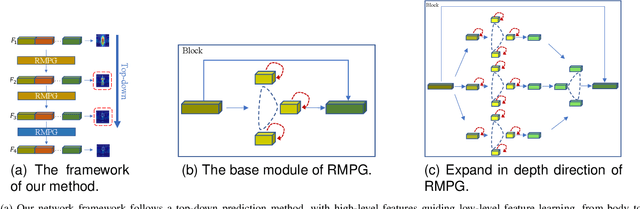
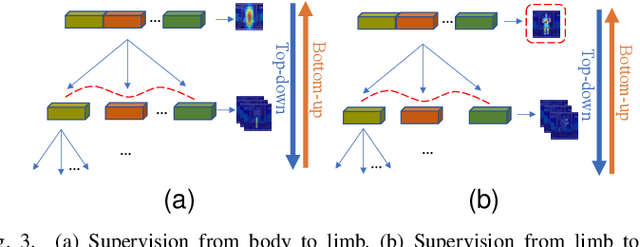
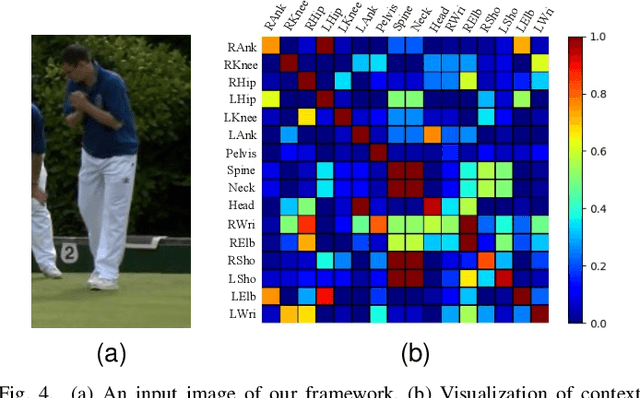
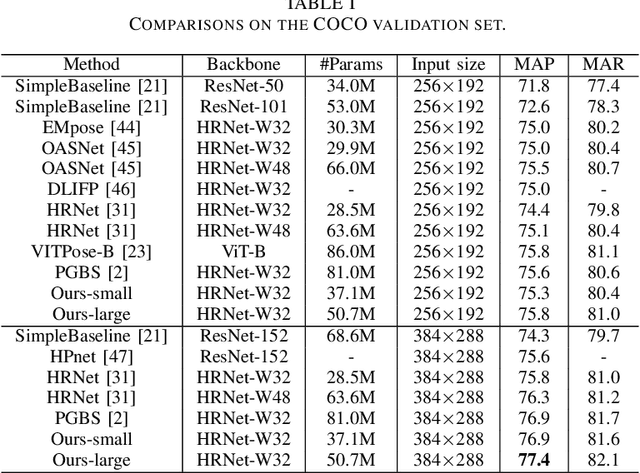
Parse graphs of the human body can be obtained in the human brain to help humans complete the human pose estimation (HPE). It contains a hierarchical structure, like a tree structure, and context relations among nodes. Many researchers pre-design the parse graph of body structure, and then design framework for HPE. However, these frameworks are difficulty adapting when encountering situations that differ from the preset human structure. Different from them, we regard the feature map as a whole, similarly to human body, so the feature map can be optimized based on parse graphs and each node feature is learned implicitly instead of explicitly, which means it can flexibly respond to different human body structure. In this paper, we design the Refinement Module based on the Parse Graph of feature map (RMPG), which includes two stages: top-down decomposition and bottom-up combination. In the top-down decomposition stage, the feature map is decomposed into multiple sub-feature maps along the channel and their context relations are calculated to obtain their respective context information. In the bottom-up combination stage, the sub-feature maps and their context information are combined to obtain refined sub-feature maps, and then these refined sub-feature maps are concatenated to obtain the refined feature map. Additionally ,we design a top-down framework by using multiple RMPG modules for HPE, some of which are supervised to obtain context relations among body parts. Our framework achieves excellent results on the COCO keypoint detection, CrowdPose and MPII human pose datasets. More importantly, our experiments also demonstrate the effectiveness of RMPG on different methods, including SimpleBaselines, Hourglass, and ViTPose.
Classroom-Inspired Multi-Mentor Distillation with Adaptive Learning Strategies
Sep 30, 2024We propose ClassroomKD, a novel multi-mentor knowledge distillation framework inspired by classroom environments to enhance knowledge transfer between student and multiple mentors. Unlike traditional methods that rely on fixed mentor-student relationships, our framework dynamically selects and adapts the teaching strategies of diverse mentors based on their effectiveness for each data sample. ClassroomKD comprises two main modules: the Knowledge Filtering (KF) Module and the Mentoring Module. The KF Module dynamically ranks mentors based on their performance for each input, activating only high-quality mentors to minimize error accumulation and prevent information loss. The Mentoring Module adjusts the distillation strategy by tuning each mentor's influence according to the performance gap between the student and mentors, effectively modulating the learning pace. Extensive experiments on image classification (CIFAR-100 and ImageNet) and 2D human pose estimation (COCO Keypoints and MPII Human Pose) demonstrate that ClassroomKD significantly outperforms existing knowledge distillation methods. Our results highlight that a dynamic and adaptive approach to mentor selection and guidance leads to more effective knowledge transfer, paving the way for enhanced model performance through distillation.
Attention-Enhanced Lightweight Hourglass Network for Human Pose Estimation
Dec 09, 2024
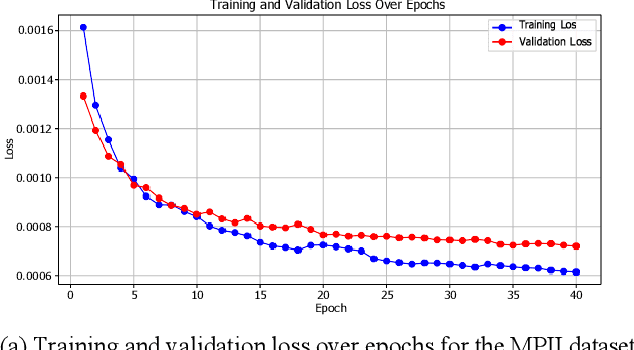


Pose estimation is a critical task in computer vision with a wide range of applications from activity monitoring to human-robot interaction. However,most of the existing methods are computationally expensive or have complex architecture. Here we propose a lightweight attention based pose estimation network that utilizes depthwise separable convolution and Convolutional Block Attention Module on an hourglass backbone. The network significantly reduces the computational complexity (floating point operations) and the model size (number of parameters) containing only about 10% of parameters of original eight stack Hourglass network.Experiments were conducted on COCO and MPII datasets using a two stack hourglass backbone. The results showed that our model performs well in comparison to six other lightweight pose estimation models with an average precision of 72.07. The model achieves this performance with only 2.3M parameters and 3.7G FLOPs.
MamKPD: A Simple Mamba Baseline for Real-Time 2D Keypoint Detection
Dec 02, 2024


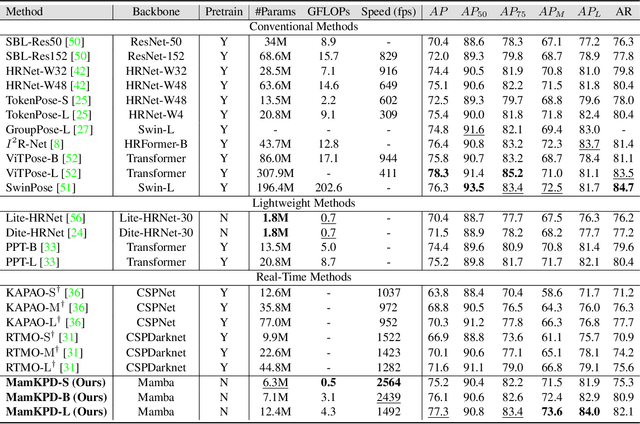
Real-time 2D keypoint detection plays an essential role in computer vision. Although CNN-based and Transformer-based methods have achieved breakthrough progress, they often fail to deliver superior performance and real-time speed. This paper introduces MamKPD, the first efficient yet effective mamba-based pose estimation framework for 2D keypoint detection. The conventional Mamba module exhibits limited information interaction between patches. To address this, we propose a lightweight contextual modeling module (CMM) that uses depth-wise convolutions to model inter-patch dependencies and linear layers to distill the pose cues within each patch. Subsequently, by combining Mamba for global modeling across all patches, MamKPD effectively extracts instances' pose information. We conduct extensive experiments on human and animal pose estimation datasets to validate the effectiveness of MamKPD. Our MamKPD-L achieves 77.3% AP on the COCO dataset with 1492 FPS on an NVIDIA GTX 4090 GPU. Moreover, MamKPD achieves state-of-the-art results on the MPII dataset and competitive results on the AP-10K dataset while saving 85% of the parameters compared to ViTPose. Our project page is available at https://mamkpd.github.io/.