 Add to Chrome
 Add to Firefox
 Add to Edge
Gtzan
Papers and Code
Constructing Composite Features for Interpretable Music-Tagging
Mar 30, 2026
Combining multiple audio features can improve the performance of music tagging, but common deep learning-based feature fusion methods often lack interpretability. To address this problem, we propose a Genetic Programming (GP) pipeline that automatically evolves composite features by mathematically combining base music features, thereby capturing synergistic interactions while preserving interpretability. This approach provides representational benefits similar to deep feature fusion without sacrificing interpretability. Experiments on the MTG-Jamendo and GTZAN datasets demonstrate consistent improvements compared to state-of-the-art systems across base feature sets at different abstraction levels. It should be noted that most of the performance gains are noticed within the first few hundred GP evaluations, indicating that effective feature combinations can be identified under modest search budgets. The top evolved expressions include linear, nonlinear, and conditional forms, with various low-complexity solutions at top performance aligned with parsimony pressure to prefer simpler expressions. Analyzing these composite features further reveals which interactions and transformations tend to be beneficial for tagging, offering insights that remain opaque in black-box deep models.

Evaluating Pretrained General-Purpose Audio Representations for Music Genre Classification
Mar 14, 2026This study investigates the use of self-supervised learning embeddings, particularly BYOL-A, in conjunction with a deep neural network classifier for Music Genre Classification. Our experiments demonstrate that BYOL-A embeddings outperform other pre-trained models, such as PANNs and VGGish, achieving an accuracy of 81.5% on the GTZAN dataset and 64.3% on FMA-Small. The proposed DNN classifier improved performance by 10-16% over linear classifiers. We explore the effects of contrastive and triplet loss and multitask training with optimized loss weights, achieving the highest accuracy. To address cross dataset challenges, we combined GTZAN and FMA-Small into a unified 18-class label space for joint training, resulting in slight performance drops on GTZAN but comparable results on FMA-Small. The scripts developed in this work are publicly available.
Large Language Models Implicitly Learn to See and Hear Just By Reading
May 20, 2025This paper presents a fascinating find: By training an auto-regressive LLM model on text tokens, the text model inherently develops internally an ability to understand images and audio, thereby developing the ability to see and hear just by reading. Popular audio and visual LLM models fine-tune text LLM models to give text output conditioned on images and audio embeddings. On the other hand, our architecture takes in patches of images, audio waveforms or tokens as input. It gives us the embeddings or category labels typical of a classification pipeline. We show the generality of text weights in aiding audio classification for datasets FSD-50K and GTZAN. Further, we show this working for image classification on CIFAR-10 and Fashion-MNIST, as well on image patches. This pushes the notion of text-LLMs learning powerful internal circuits that can be utilized by activating necessary connections for various applications rather than training models from scratch every single time.
Masked Latent Prediction and Classification for Self-Supervised Audio Representation Learning
Feb 17, 2025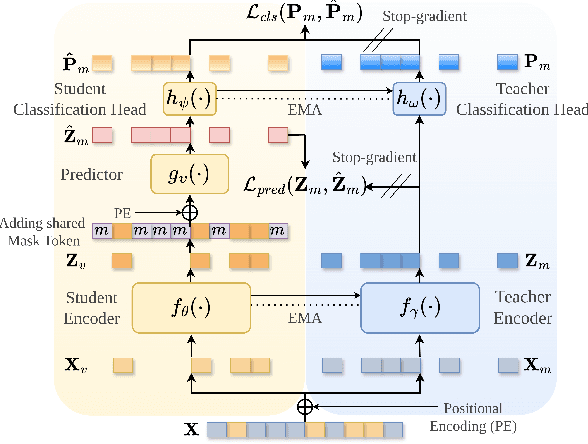
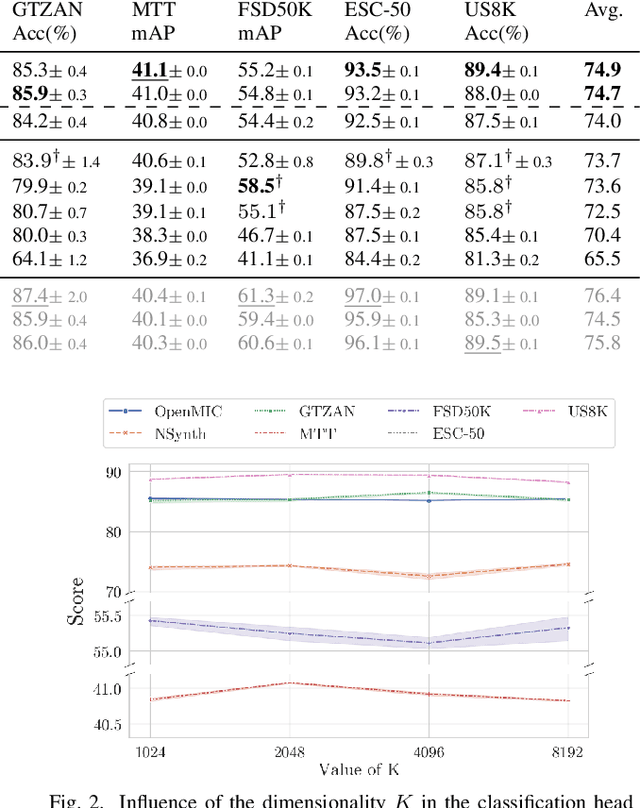
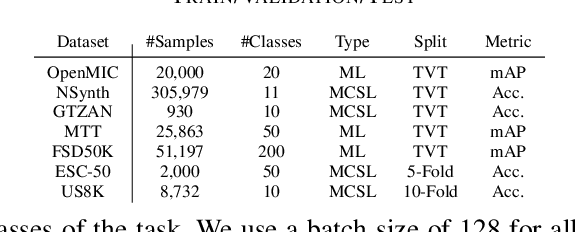
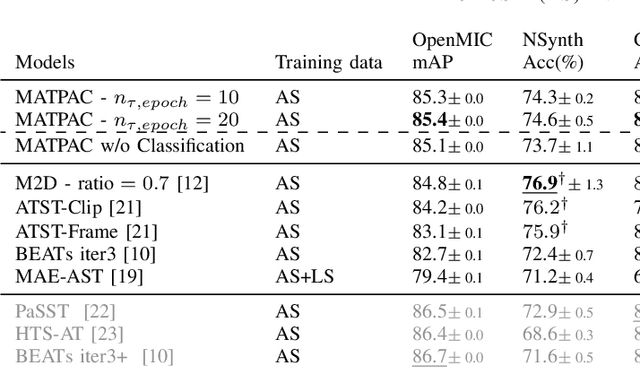
Recently, self-supervised learning methods based on masked latent prediction have proven to encode input data into powerful representations. However, during training, the learned latent space can be further transformed to extract higher-level information that could be more suited for downstream classification tasks. Therefore, we propose a new method: MAsked latenT Prediction And Classification (MATPAC), which is trained with two pretext tasks solved jointly. As in previous work, the first pretext task is a masked latent prediction task, ensuring a robust input representation in the latent space. The second one is unsupervised classification, which utilises the latent representations of the first pretext task to match probability distributions between a teacher and a student. We validate the MATPAC method by comparing it to other state-of-the-art proposals and conducting ablations studies. MATPAC reaches state-of-the-art self-supervised learning results on reference audio classification datasets such as OpenMIC, GTZAN, ESC-50 and US8K and outperforms comparable supervised methods results for musical auto-tagging on Magna-tag-a-tune.
Music Genre Classification: Ensemble Learning with Subcomponents-level Attention
Dec 20, 2024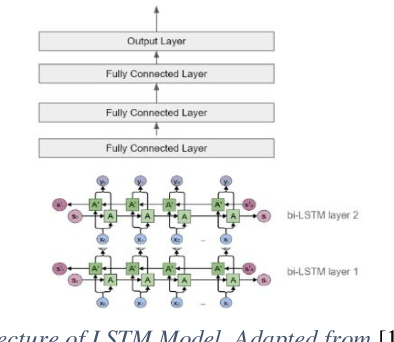
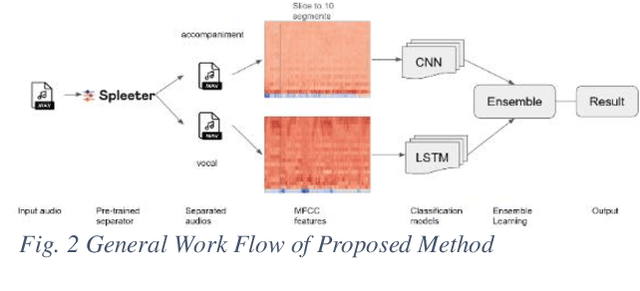
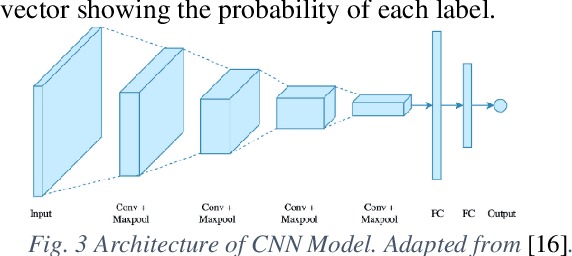
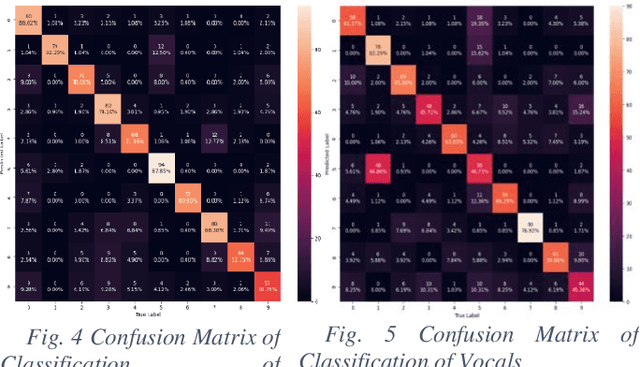
Music Genre Classification is one of the most popular topics in the fields of Music Information Retrieval (MIR) and digital signal processing. Deep Learning has emerged as the top performer for classifying music genres among various methods. The letter introduces a novel approach by combining ensemble learning with attention to sub-components, aiming to enhance the accuracy of identifying music genres. The core innovation of our work is the proposal to classify the subcomponents of the music pieces separately, allowing our model to capture distinct characteristics from those sub components. By applying ensemble learning techniques to these individual classifications, we make the final classification decision on the genre of the music. The proposed method has superior advantages in terms of accuracy compared to the other state-of-the-art techniques trained and tested on the GTZAN dataset.
Audio Processing using Pattern Recognition for Music Genre Classification
Oct 19, 2024This project explores the application of machine learning techniques for music genre classification using the GTZAN dataset, which contains 100 audio files per genre. Motivated by the growing demand for personalized music recommendations, we focused on classifying five genres-Blues, Classical, Jazz, Hip Hop, and Country-using a variety of algorithms including Logistic Regression, K-Nearest Neighbors (KNN), Random Forest, and Artificial Neural Networks (ANN) implemented via Keras. The ANN model demonstrated the best performance, achieving a validation accuracy of 92.44%. We also analyzed key audio features such as spectral roll-off, spectral centroid, and MFCCs, which helped enhance the model's accuracy. Future work will expand the model to cover all ten genres, investigate advanced methods like Long Short-Term Memory (LSTM) networks and ensemble approaches, and develop a web application for real-time genre classification and playlist generation. This research aims to contribute to improving music recommendation systems and content curation.
EAViT: External Attention Vision Transformer for Audio Classification
Aug 23, 2024This paper presents the External Attention Vision Transformer (EAViT) model, a novel approach designed to enhance audio classification accuracy. As digital audio resources proliferate, the demand for precise and efficient audio classification systems has intensified, driven by the need for improved recommendation systems and user personalization in various applications, including music streaming platforms and environmental sound recognition. Accurate audio classification is crucial for organizing vast audio libraries into coherent categories, enabling users to find and interact with their preferred audio content more effectively. In this study, we utilize the GTZAN dataset, which comprises 1,000 music excerpts spanning ten diverse genres. Each 30-second audio clip is segmented into 3-second excerpts to enhance dataset robustness and mitigate overfitting risks, allowing for more granular feature analysis. The EAViT model integrates multi-head external attention (MEA) mechanisms into the Vision Transformer (ViT) framework, effectively capturing long-range dependencies and potential correlations between samples. This external attention (EA) mechanism employs learnable memory units that enhance the network's capacity to process complex audio features efficiently. The study demonstrates that EAViT achieves a remarkable overall accuracy of 93.99%, surpassing state-of-the-art models.
Towards Training Music Taggers on Synthetic Data
Jul 02, 2024
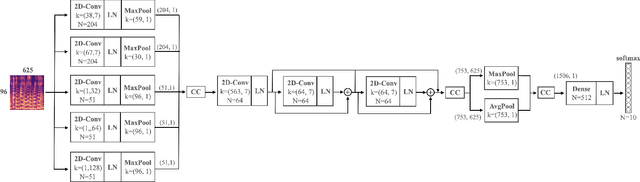
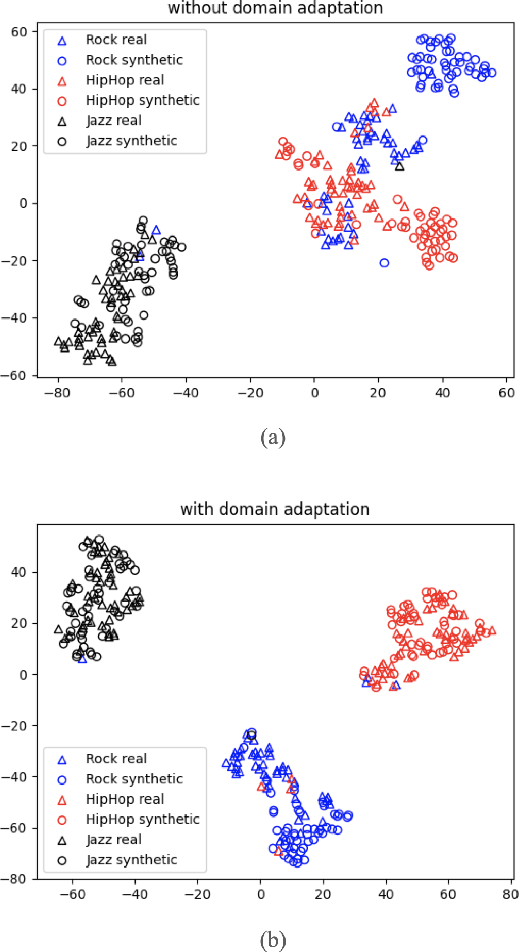
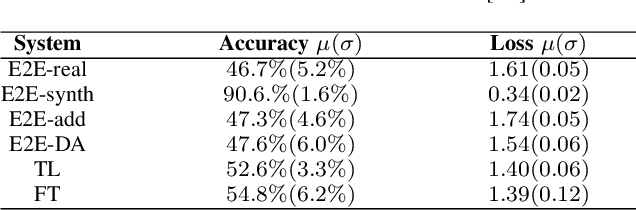
Most contemporary music tagging systems rely on large volumes of annotated data. As an alternative, we investigate the extent to which synthetically generated music excerpts can improve tagging systems when only small annotated collections are available. To this end, we release GTZAN-synth, a synthetic dataset that follows the taxonomy of the well-known GTZAN dataset while being ten times larger in data volume. We first observe that simply adding this synthetic dataset to the training split of GTZAN does not result into performance improvements. We then proceed to investigating domain adaptation, transfer learning and fine-tuning strategies for the task at hand and draw the conclusion that the last two options yield an increase in accuracy. Overall, the proposed approach can be considered as a first guide in a promising field for future research.
R&B -- Rhythm and Brain: Cross-subject Decoding of Music from Human Brain Activity
Jun 21, 2024
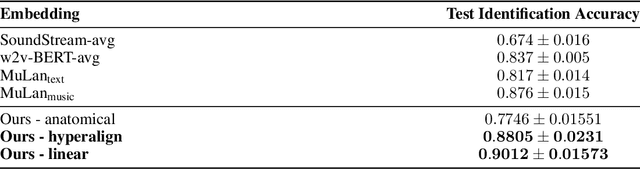

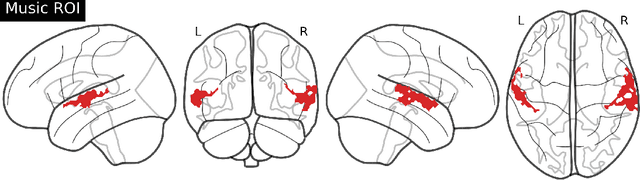
Music is a universal phenomenon that profoundly influences human experiences across cultures. This study investigates whether music can be decoded from human brain activity measured with functional MRI (fMRI) during its perception. Leveraging recent advancements in extensive datasets and pre-trained computational models, we construct mappings between neural data and latent representations of musical stimuli. Our approach integrates functional and anatomical alignment techniques to facilitate cross-subject decoding, addressing the challenges posed by the low temporal resolution and signal-to-noise ratio (SNR) in fMRI data. Starting from the GTZan fMRI dataset, where five participants listened to 540 musical stimuli from 10 different genres while their brain activity was recorded, we used the CLAP (Contrastive Language-Audio Pretraining) model to extract latent representations of the musical stimuli and developed voxel-wise encoding models to identify brain regions responsive to these stimuli. By applying a threshold to the association between predicted and actual brain activity, we identified specific regions of interest (ROIs) which can be interpreted as key players in music processing. Our decoding pipeline, primarily retrieval-based, employs a linear map to project brain activity to the corresponding CLAP features. This enables us to predict and retrieve the musical stimuli most similar to those that originated the fMRI data. Our results demonstrate state-of-the-art identification accuracy, with our methods significantly outperforming existing approaches. Our findings suggest that neural-based music retrieval systems could enable personalized recommendations and therapeutic applications. Future work could use higher temporal resolution neuroimaging and generative models to improve decoding accuracy and explore the neural underpinnings of music perception and emotion.
M2D-CLAP: Masked Modeling Duo Meets CLAP for Learning General-purpose Audio-Language Representation
Jun 04, 2024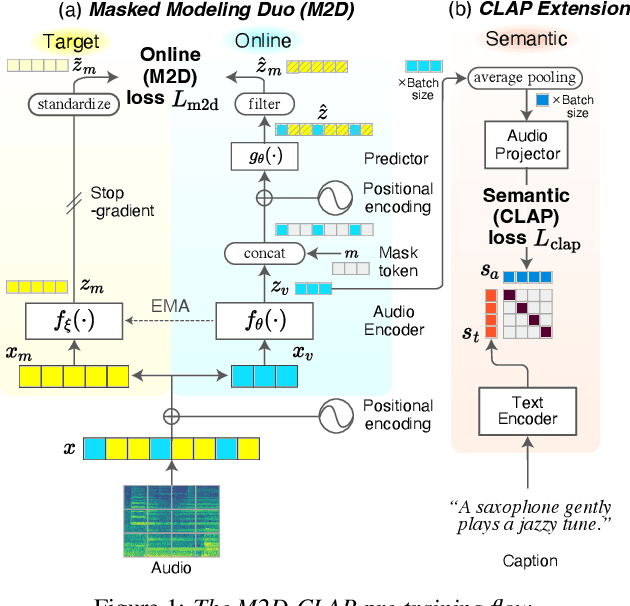

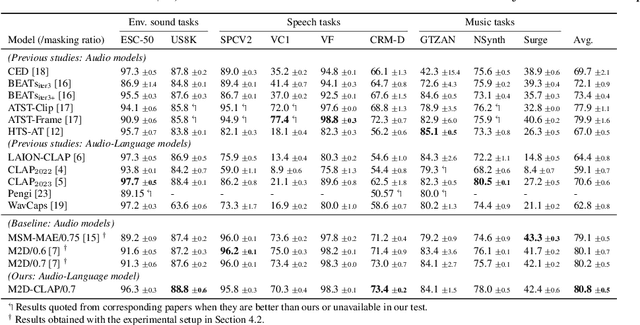
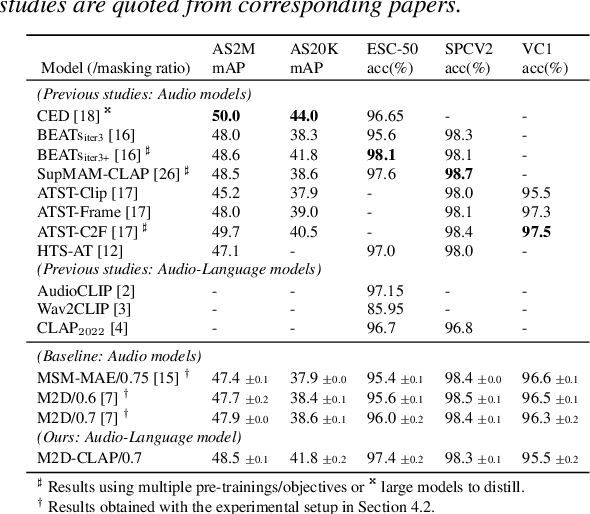
Contrastive language-audio pre-training (CLAP) enables zero-shot (ZS) inference of audio and exhibits promising performance in several classification tasks. However, conventional audio representations are still crucial for many tasks where ZS is not applicable (e.g., regression problems). Here, we explore a new representation, a general-purpose audio-language representation, that performs well in both ZS and transfer learning. To do so, we propose a new method, M2D-CLAP, which combines self-supervised learning Masked Modeling Duo (M2D) and CLAP. M2D learns an effective representation to model audio signals, and CLAP aligns the representation with text embedding. As a result, M2D-CLAP learns a versatile representation that allows for both ZS and transfer learning. Experiments show that M2D-CLAP performs well on linear evaluation, fine-tuning, and ZS classification with a GTZAN state-of-the-art of 75.17%, thus achieving a general-purpose audio-language representation.