 Add to Chrome
 Add to Firefox
 Add to Edge
S-SONDO: Self-Supervised Knowledge Distillation for General Audio Foundation Models
Apr 27, 2026
General audio foundation models have recently achieved remarkable progress, enabling strong performance across diverse tasks. However, state-of-the-art models remain extremely large, often with hundreds of millions of parameters, leading to high inference costs and limited deployability on edge devices. Knowledge distillation is a proven strategy for model compression, but prior work in audio has mostly focused on supervised settings, relying on class logits, intermediate features, or architecture-specific techniques. Such assumptions exclude models that output only embeddings, such as self-supervised or metric-learning models. We introduce S-SONDO (Self-Supervised KnOwledge DistillatioN for General AuDio FOundation Models), the first framework to distill general audio models using only their output embeddings. By avoiding the need for logits or layer-level alignment, S-SONDO is architecture-agnostic and broadly applicable to embedding-based teachers. We demonstrate its effectiveness by distilling two audio foundation models into three efficient students that are up to 61 times smaller while retaining up to 96% of teacher performance. We also provide practical insights on loss choice and clustering-based balanced data sampling. Code is available here: https://github.com/MedAliAdlouni/ssondo.

Masked Latent Prediction and Classification for Self-Supervised Audio Representation Learning
Feb 17, 2025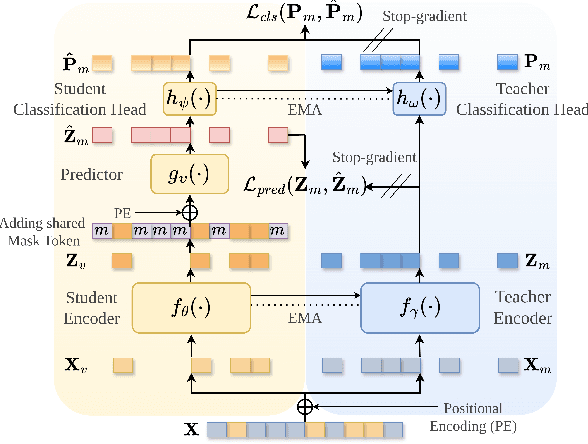
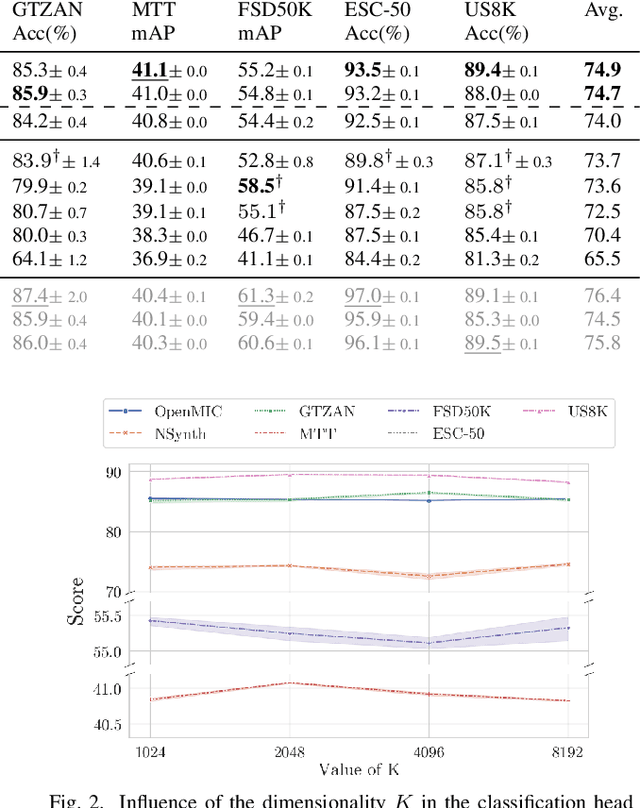
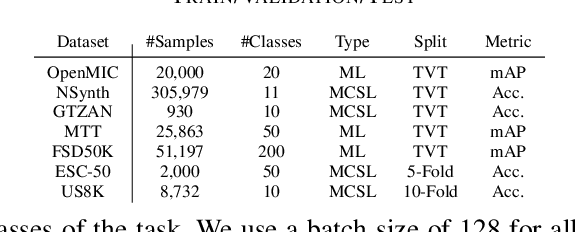
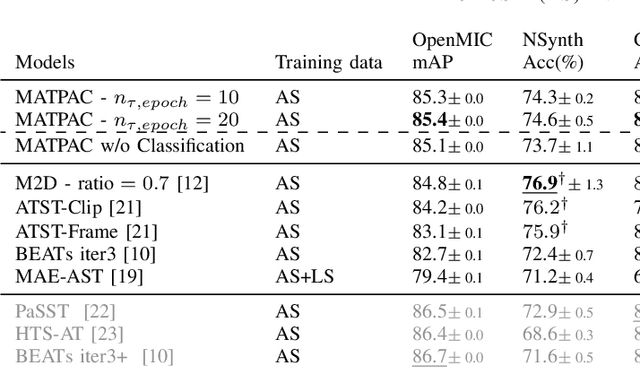
Recently, self-supervised learning methods based on masked latent prediction have proven to encode input data into powerful representations. However, during training, the learned latent space can be further transformed to extract higher-level information that could be more suited for downstream classification tasks. Therefore, we propose a new method: MAsked latenT Prediction And Classification (MATPAC), which is trained with two pretext tasks solved jointly. As in previous work, the first pretext task is a masked latent prediction task, ensuring a robust input representation in the latent space. The second one is unsupervised classification, which utilises the latent representations of the first pretext task to match probability distributions between a teacher and a student. We validate the MATPAC method by comparing it to other state-of-the-art proposals and conducting ablations studies. MATPAC reaches state-of-the-art self-supervised learning results on reference audio classification datasets such as OpenMIC, GTZAN, ESC-50 and US8K and outperforms comparable supervised methods results for musical auto-tagging on Magna-tag-a-tune.
On the choice of the optimal temporal support for audio classification with Pre-trained embeddings
Dec 21, 2023Current state-of-the-art audio analysis systems rely on pre-trained embedding models, often used off-the-shelf as (frozen) feature extractors. Choosing the best one for a set of tasks is the subject of many recent publications. However, one aspect often overlooked in these works is the influence of the duration of audio input considered to extract an embedding, which we refer to as Temporal Support (TS). In this work, we study the influence of the TS for well-established or emerging pre-trained embeddings, chosen to represent different types of architectures and learning paradigms. We conduct this evaluation using both musical instrument and environmental sound datasets, namely OpenMIC, TAU Urban Acoustic Scenes 2020 Mobile, and ESC-50. We especially highlight that Audio Spectrogram Transformer-based systems (PaSST and BEATs) remain effective with smaller TS, which therefore allows for a drastic reduction in memory and computational cost. Moreover, we show that by choosing the optimal TS we reach competitive results across all tasks. In particular, we improve the state-of-the-art results on OpenMIC, using BEATs and PaSST without any fine-tuning.