 Add to Chrome
 Add to Firefox
 Add to Edge
Graphsage
Papers and Code
Flood Risk Follows Valleys, Not Grids: Graph Neural Networks for Flash Flood Susceptibility Mapping in Himachal Pradesh with Conformal Uncertainty Quantification
Mar 15, 2026
Flash floods are the most destructive natural hazard in Himachal Pradesh (HP), India, causing over 400 fatalities and $1.2 billion in losses in the 2023 monsoon season alone. Existing risk maps treat every pixel independently, ignoring the basic fact that flooding upstream raises risk downstream. We address this with a Graph Neural Network (GraphSAGE) trained on a watershed connectivity graph (460 sub-watersheds, 1,700 directed edges), built from a six-year Sentinel-1 SAR flood inventory (2018-2023, 3,000 events) and 12 environmental variables at 30 m resolution. Four pixel-based ML models (RF, XGBoost, LightGBM, stacking ensemble) serve as baselines. All models are evaluated with leave-one-basin-out spatial cross-validation to avoid the 5-15% AUC inflation of random splits. Conformal prediction produces the first HP susceptibility maps with statistically guaranteed 90% coverage intervals. The GNN achieved AUC = 0.978 +/- 0.017, outperforming the best baseline (AUC = 0.881) and the published HP benchmark (AUC = 0.88). The +0.097 gain confirms that river connectivity carries predictive signal that pixel-based models miss. High-susceptibility zones overlap 1,457 km of highways (including 217 km of the Manali-Leh corridor), 2,759 bridges, and 4 major hydroelectric installations. Conformal intervals achieved 82.9% empirical coverage on the held-out 2023 test set; lower coverage in high-risk zones (45-59%) points to SAR label noise as a target for future work.

Geometric and Topological Deep Learning for Predicting Thermo-mechanical Performance in Cold Spray Deposition Process Modeling
Mar 15, 2026This study presents a geometric deep learning framework for predicting cold spray particle impact responses using finite element simulation data. A parametric dataset was generated through automated Abaqus simulations spanning a systematic range of particle velocity, particle temperature, and friction coefficient, yielding five output targets including maximum equivalent plastic strain, average contact plastic strain, maximum temperature, maximum von Mises stress, and deformation ratio. Four novel algorithms i.e. a GraphSAGE-style inductive graph neural network, a Chebyshev spectral graph convolution network, a topological data analysis augmented multilayer perceptron, and a geometric attention network were implemented and evaluated. Each input sample was treated as a node in a k-nearest-neighbour feature-space graph, enabling the models to exploit spatial similarity between process conditions during training. Three-dimensional feature space visualisations and two-dimensional contour projections confirmed the highly non-linear and velocity-dominated nature of the input-output relationships. Quantitative evaluation demonstrated that GraphSAGE and GAT consistently achieved R-square values exceeding 0.93 across most targets, with GAT attaining peak performance of R-square equal to 0.97 for maximum plastic strain. ChebSpectral and TDA-MLP performed considerably worse, yielding negative R-square values for several targets. These findings establish spatial graph-based neighbourhood aggregation as a robust and physically interpretable surrogate modelling strategy for cold spray process optimisation.
Normalisation and Initialisation Strategies for Graph Neural Networks in Blockchain Anomaly Detection
Feb 27, 2026Graph neural networks (GNNs) offer a principled approach to financial fraud detection by jointly learning from node features and transaction graph topology. However, their effectiveness on real-world anti-money laundering (AML) benchmarks depends critically on training practices such as specifically weight initialisation and normalisation that remain underexplored. We present a systematic ablation of initialisation and normalisation strategies across three GNN architectures (GCN, GAT, and GraphSAGE) on the Elliptic Bitcoin dataset. Our experiments reveal that initialisation and normalisation are architecture-dependent: GraphSAGE achieves the strongest performance with Xavier initialisation alone, GAT benefits most from combining GraphNorm with Xavier initialisation, while GCN shows limited sensitivity to these modifications. These findings offer practical, architecture-specific guidance for deploying GNNs in AML pipelines for datasets with severe class imbalance. We release a reproducible experimental framework with temporal data splits, seeded runs, and full ablation results.
Benchmarking GNN Models on Molecular Regression Tasks with CKA-Based Representation Analysis
Feb 24, 2026Molecules are commonly represented as SMILES strings, which can be readily converted to fixed-size molecular fingerprints. These fingerprints serve as feature vectors to train ML/DL models for molecular property prediction tasks in the field of computational chemistry, drug discovery, biochemistry, and materials science. Recent research has demonstrated that SMILES can be used to construct molecular graphs where atoms are nodes ($V$) and bonds are edges ($E$). These graphs can subsequently be used to train geometric DL models like GNN. GNN learns the inherent structural relationships within a molecule rather than depending on fixed-size fingerprints. Although GNN are powerful aggregators, their efficacy on smaller datasets and inductive biases across different architectures is less studied. In our present study, we performed a systematic benchmarking of four different GNN architectures across a diverse domain of datasets (physical chemistry, biological, and analytical). Additionally, we have also implemented a hierarchical fusion (GNN+FP) framework for target prediction. We observed that the fusion framework consistently outperforms or matches the performance of standalone GNN (RMSE improvement > $7\%$) and baseline models. Further, we investigated the representational similarity using centered kernel alignment (CKA) between GNN and fingerprint embeddings and found that they occupy highly independent latent spaces (CKA $\le0.46$). The cross-architectural CKA score suggests a high convergence between isotopic models like GCN, GraphSAGE and GIN (CKA $\geq0.88$), with GAT learning moderately independent representation (CKA $0.55-0.80$).
Enhancing Building Semantics Preservation in AI Model Training with Large Language Model Encodings
Feb 17, 2026Accurate representation of building semantics, encompassing both generic object types and specific subtypes, is essential for effective AI model training in the architecture, engineering, construction, and operation (AECO) industry. Conventional encoding methods (e.g., one-hot) often fail to convey the nuanced relationships among closely related subtypes, limiting AI's semantic comprehension. To address this limitation, this study proposes a novel training approach that employs large language model (LLM) embeddings (e.g., OpenAI GPT and Meta LLaMA) as encodings to preserve finer distinctions in building semantics. We evaluated the proposed method by training GraphSAGE models to classify 42 building object subtypes across five high-rise residential building information models (BIMs). Various embedding dimensions were tested, including original high-dimensional LLM embeddings (1,536, 3,072, or 4,096) and 1,024-dimensional compacted embeddings generated via the Matryoshka representation model. Experimental results demonstrated that LLM encodings outperformed the conventional one-hot baseline, with the llama-3 (compacted) embedding achieving a weighted average F1-score of 0.8766, compared to 0.8475 for one-hot encoding. The results underscore the promise of leveraging LLM-based encodings to enhance AI's ability to interpret complex, domain-specific building semantics. As the capabilities of LLMs and dimensionality reduction techniques continue to evolve, this approach holds considerable potential for broad application in semantic elaboration tasks throughout the AECO industry.
Sheaf Neural Networks and biomedical applications
Jan 29, 2026The purpose of this paper is to elucidate the theory and mathematical modelling behind the sheaf neural network (SNN) algorithm and then show how SNN can effectively answer to biomedical questions in a concrete case study and outperform the most popular graph neural networks (GNNs) as graph convolutional networks (GCNs), graph attention networks (GAT) and GraphSage.
Synthetic Pattern Generation and Detection of Financial Activities using Graph Autoencoders
Jan 29, 2026Illicit financial activities such as money laundering often manifest through recurrent topological patterns in transaction networks. Detecting these patterns automatically remains challenging due to the scarcity of labeled real-world data and strict privacy constraints. To address this, we investigate whether Graph Autoencoders (GAEs) can effectively learn and distinguish topological patterns that mimic money laundering operations when trained on synthetic data. The analysis consists of two phases: (i) data generation, where synthetic samples are created for seven well-known illicit activity patterns using parametrized generators that preserve structural consistency while introducing realistic variability; and (ii) model training and validation, where separate GAEs are trained on each pattern without explicit labels, relying solely on reconstruction error as an indicator of learned structure. We compare three GAE implementations based on three distinct convolutional layers: Graph Convolutional (GAE-GCN), GraphSAGE (GAE-SAGE), and Graph Attention Network (GAE-GAT). Experimental results show that GAE-GCN achieves the most consistent reconstruction performance across patterns, while GAE-SAGE and GAE-GAT exhibit competitive results only in few specific patterns. These findings suggest that graph-based representation learning on synthetic data provides a viable path toward developing AI-driven tools for detecting illicit behaviors, overcoming the limitations of financial datasets.
Relational Graph Modeling for Credit Default Prediction: Heterogeneous GNNs and Hybrid Ensemble Learning
Jan 21, 2026Credit default risk arises from complex interactions among borrowers, financial institutions, and transaction-level behaviors. While strong tabular models remain highly competitive in credit scoring, they may fail to explicitly capture cross-entity dependencies embedded in multi-table financial histories. In this work, we construct a massive-scale heterogeneous graph containing over 31 million nodes and more than 50 million edges, integrating borrower attributes with granular transaction-level entities such as installment payments, POS cash balances, and credit card histories. We evaluate heterogeneous graph neural networks (GNNs), including heterogeneous GraphSAGE and a relation-aware attentive heterogeneous GNN, against strong tabular baselines. We find that standalone GNNs provide limited lift over a competitive gradient-boosted tree baseline, while a hybrid ensemble that augments tabular features with GNN-derived customer embeddings achieves the best overall performance, improving both ROC-AUC and PR-AUC. We further observe that contrastive pretraining can improve optimization stability but yields limited downstream gains under generic graph augmentations. Finally, we conduct structured explainability and fairness analyses to characterize how relational signals affect subgroup behavior and screening-oriented outcomes.
Hyperbolic Graph Embeddings: a Survey and an Evaluation on Anomaly Detection
Dec 21, 2025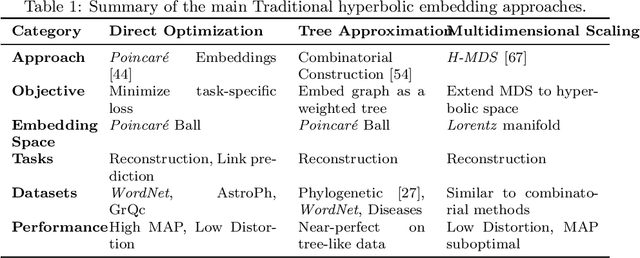
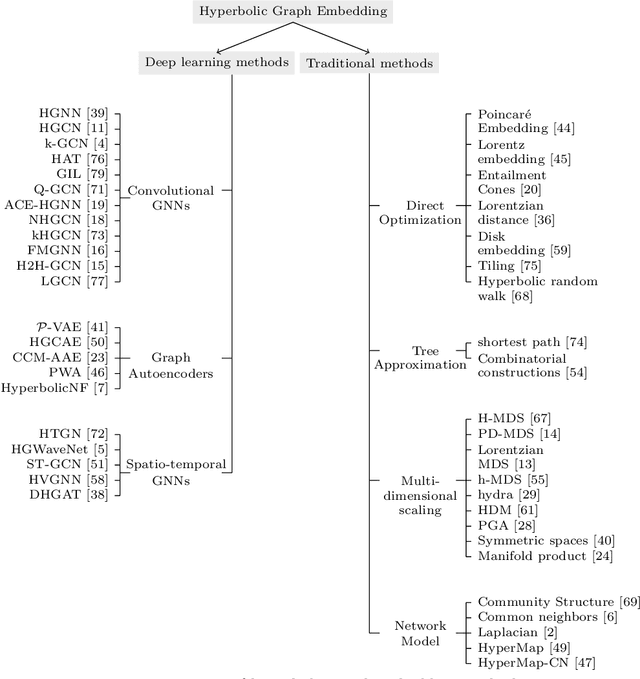
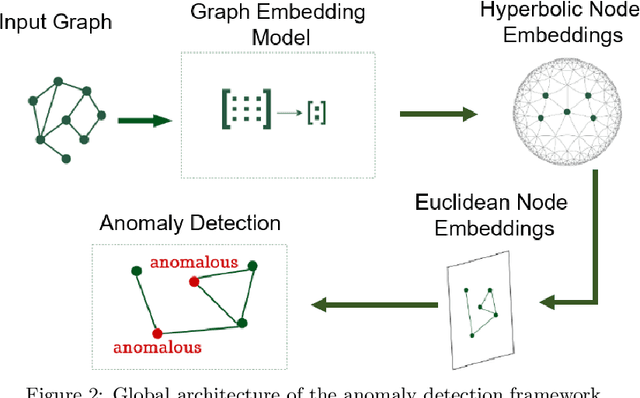
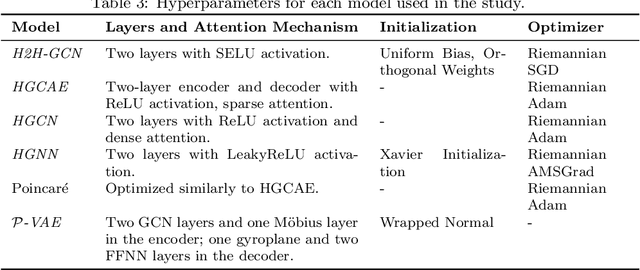
This survey reviews hyperbolic graph embedding models, and evaluate them on anomaly detection, highlighting their advantages over Euclidean methods in capturing complex structures. Evaluating models like \textit{HGCAE}, \textit{\(\mathcal{P}\)-VAE}, and \textit{HGCN} demonstrates high performance, with \textit{\(\mathcal{P}\)-VAE} achieving an F1-score of 94\% on the \textit{Elliptic} dataset and \textit{HGCAE} scoring 80\% on \textit{Cora}. In contrast, Euclidean methods like \textit{DOMINANT} and \textit{GraphSage} struggle with complex data. The study emphasizes the potential of hyperbolic spaces for improving anomaly detection, and provides an open-source library to foster further research in this field.
Feature-Enhanced Graph Neural Networks for Classification of Synthetic Graph Generative Models: A Benchmarking Study
Dec 20, 2025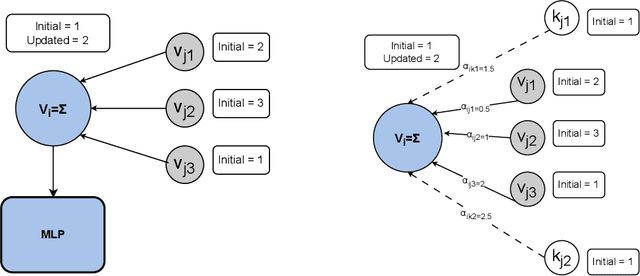

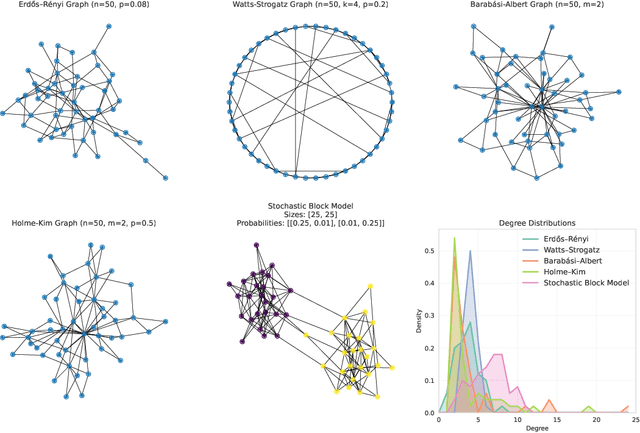
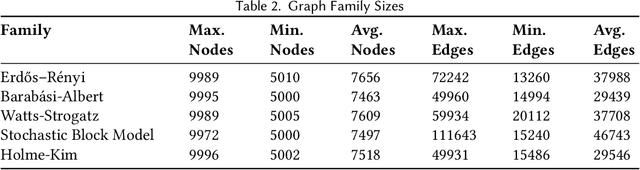
The ability to discriminate between generative graph models is critical to understanding complex structural patterns in both synthetic graphs and the real-world structures that they emulate. While Graph Neural Networks (GNNs) have seen increasing use to great effect in graph classification tasks, few studies explore their integration with interpretable graph theoretic features. This paper investigates the classification of synthetic graph families using a hybrid approach that combines GNNs with engineered graph-theoretic features. We generate a large and structurally diverse synthetic dataset comprising graphs from five representative generative families, Erdos-Renyi, Watts-Strogatz, Barab'asi-Albert, Holme-Kim, and Stochastic Block Model. These graphs range in size up to 1x10^4 nodes, containing up to 1.1x10^5 edges. A comprehensive range of node and graph level features is extracted for each graph and pruned using a Random Forest based feature selection pipeline. The features are integrated into six GNN architectures: GCN, GAT, GATv2, GIN, GraphSAGE and GTN. Each architecture is optimised for hyperparameter selection using Optuna. Finally, models were compared against a baseline Support Vector Machine (SVM) trained solely on the handcrafted features. Our evaluation demonstrates that GraphSAGE and GTN achieve the highest classification performance, with 98.5% accuracy, and strong class separation evidenced by t-SNE and UMAP visualisations. GCN and GIN also performed well, while GAT-based models lagged due to limitations in their ability to capture global structures. The SVM baseline confirmed the importance of the message passing functionality for performance gains and meaningful class separation.