 Add to Chrome
 Add to Firefox
 Add to Edge
Enhancing Building Semantics Preservation in AI Model Training with Large Language Model Encodings
Feb 17, 2026
Accurate representation of building semantics, encompassing both generic object types and specific subtypes, is essential for effective AI model training in the architecture, engineering, construction, and operation (AECO) industry. Conventional encoding methods (e.g., one-hot) often fail to convey the nuanced relationships among closely related subtypes, limiting AI's semantic comprehension. To address this limitation, this study proposes a novel training approach that employs large language model (LLM) embeddings (e.g., OpenAI GPT and Meta LLaMA) as encodings to preserve finer distinctions in building semantics. We evaluated the proposed method by training GraphSAGE models to classify 42 building object subtypes across five high-rise residential building information models (BIMs). Various embedding dimensions were tested, including original high-dimensional LLM embeddings (1,536, 3,072, or 4,096) and 1,024-dimensional compacted embeddings generated via the Matryoshka representation model. Experimental results demonstrated that LLM encodings outperformed the conventional one-hot baseline, with the llama-3 (compacted) embedding achieving a weighted average F1-score of 0.8766, compared to 0.8475 for one-hot encoding. The results underscore the promise of leveraging LLM-based encodings to enhance AI's ability to interpret complex, domain-specific building semantics. As the capabilities of LLMs and dimensionality reduction techniques continue to evolve, this approach holds considerable potential for broad application in semantic elaboration tasks throughout the AECO industry.

SyncSDE: A Probabilistic Framework for Diffusion Synchronization
Mar 27, 2025There have been many attempts to leverage multiple diffusion models for collaborative generation, extending beyond the original domain. A prominent approach involves synchronizing multiple diffusion trajectories by mixing the estimated scores to artificially correlate the generation processes. However, existing methods rely on naive heuristics, such as averaging, without considering task specificity. These approaches do not clarify why such methods work and often fail when a heuristic suitable for one task is blindly applied to others. In this paper, we present a probabilistic framework for analyzing why diffusion synchronization works and reveal where heuristics should be focused - modeling correlations between multiple trajectories and adapting them to each specific task. We further identify optimal correlation models per task, achieving better results than previous approaches that apply a single heuristic across all tasks without justification.
Towards Flexible Time-to-event Modeling: Optimizing Neural Networks via Rank Regression
Jul 22, 2023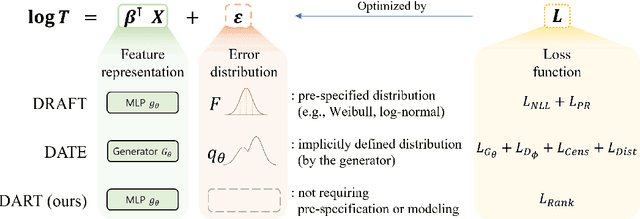
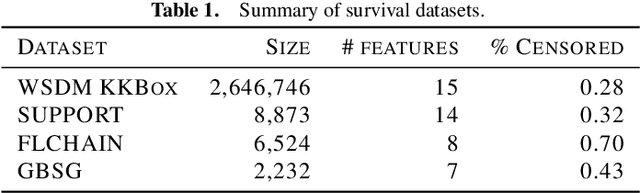

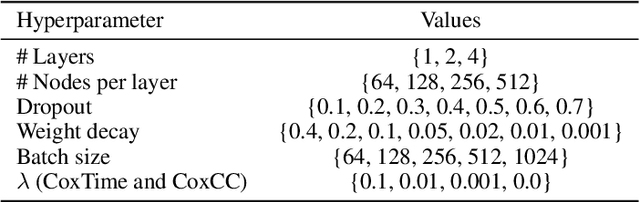
Time-to-event analysis, also known as survival analysis, aims to predict the time of occurrence of an event, given a set of features. One of the major challenges in this area is dealing with censored data, which can make learning algorithms more complex. Traditional methods such as Cox's proportional hazards model and the accelerated failure time (AFT) model have been popular in this field, but they often require assumptions such as proportional hazards and linearity. In particular, the AFT models often require pre-specified parametric distributional assumptions. To improve predictive performance and alleviate strict assumptions, there have been many deep learning approaches for hazard-based models in recent years. However, representation learning for AFT has not been widely explored in the neural network literature, despite its simplicity and interpretability in comparison to hazard-focused methods. In this work, we introduce the Deep AFT Rank-regression model for Time-to-event prediction (DART). This model uses an objective function based on Gehan's rank statistic, which is efficient and reliable for representation learning. On top of eliminating the requirement to establish a baseline event time distribution, DART retains the advantages of directly predicting event time in standard AFT models. The proposed method is a semiparametric approach to AFT modeling that does not impose any distributional assumptions on the survival time distribution. This also eliminates the need for additional hyperparameters or complex model architectures, unlike existing neural network-based AFT models. Through quantitative analysis on various benchmark datasets, we have shown that DART has significant potential for modeling high-throughput censored time-to-event data.