 Add to Chrome
 Add to Firefox
 Add to Edge
BIM Information Extraction Through LLM-based Adaptive Exploration
May 03, 2026
BIM models provide structured representations of building geometry, semantics, and topology, yet extracting specific information from them remains remarkably difficult. Current approaches translate natural language into structured queries by assuming a fixed data organization (static approach), which BIM heterogeneity eventually invalidates. We address this with a new paradigm, adaptive exploration, where an LLM-based agent iteratively executes code to extract information from a BIM model, discovering its structure at runtime instead of assuming it. We evaluate this approach on ifc-bench v2, an open-source BIM question-answering benchmark introduced alongside this work, comprising 1,027 tasks across 37 IFC models from 21 projects. A factorial ablation across two LLM capability levels and four augmentation strategies shows that adaptive exploration significantly outperforms static query generation across all configurations, regardless of the augmentation strategy. These results indicate that BIM heterogeneity is best addressed at the paradigm level, not by further optimizing static approaches.

Enhancing Building Semantics Preservation in AI Model Training with Large Language Model Encodings
Feb 17, 2026Accurate representation of building semantics, encompassing both generic object types and specific subtypes, is essential for effective AI model training in the architecture, engineering, construction, and operation (AECO) industry. Conventional encoding methods (e.g., one-hot) often fail to convey the nuanced relationships among closely related subtypes, limiting AI's semantic comprehension. To address this limitation, this study proposes a novel training approach that employs large language model (LLM) embeddings (e.g., OpenAI GPT and Meta LLaMA) as encodings to preserve finer distinctions in building semantics. We evaluated the proposed method by training GraphSAGE models to classify 42 building object subtypes across five high-rise residential building information models (BIMs). Various embedding dimensions were tested, including original high-dimensional LLM embeddings (1,536, 3,072, or 4,096) and 1,024-dimensional compacted embeddings generated via the Matryoshka representation model. Experimental results demonstrated that LLM encodings outperformed the conventional one-hot baseline, with the llama-3 (compacted) embedding achieving a weighted average F1-score of 0.8766, compared to 0.8475 for one-hot encoding. The results underscore the promise of leveraging LLM-based encodings to enhance AI's ability to interpret complex, domain-specific building semantics. As the capabilities of LLMs and dimensionality reduction techniques continue to evolve, this approach holds considerable potential for broad application in semantic elaboration tasks throughout the AECO industry.
A Generalized LLM-Augmented BIM Framework: Application to a Speech-to-BIM system
Sep 26, 2024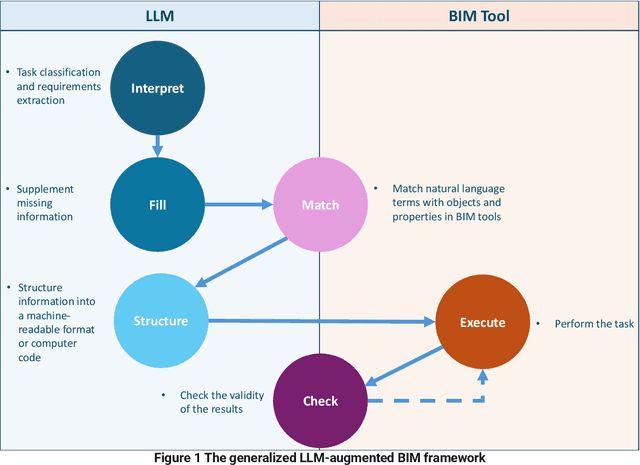
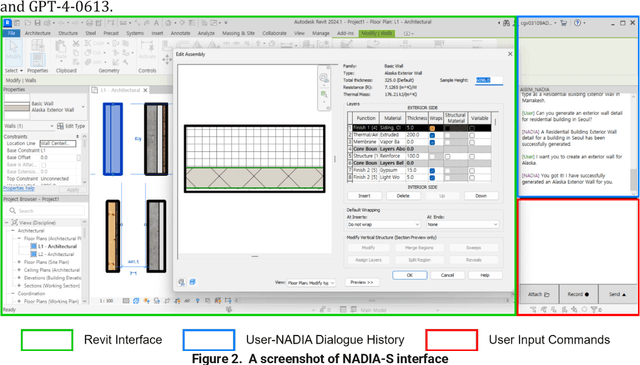
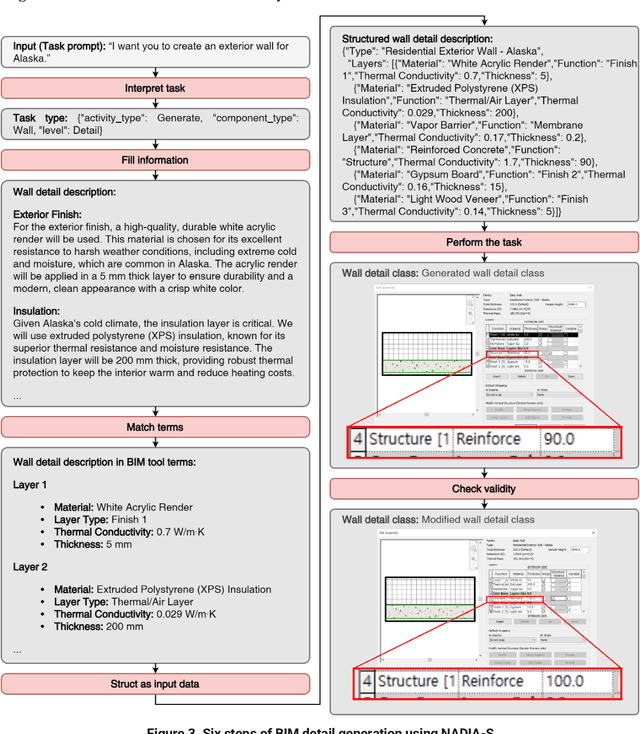
Performing building information modeling (BIM) tasks is a complex process that imposes a steep learning curve and a heavy cognitive load due to the necessity of remembering sequences of numerous commands. With the rapid advancement of large language models (LLMs), it is foreseeable that BIM tasks, including querying and managing BIM data, 4D and 5D BIM, design compliance checking, or authoring a design, using written or spoken natural language (i.e., text-to-BIM or speech-to-BIM), will soon supplant traditional graphical user interfaces. This paper proposes a generalized LLM-augmented BIM framework to expedite the development of LLM-enhanced BIM applications by providing a step-by-step development process. The proposed framework consists of six steps: interpret-fill-match-structure-execute-check. The paper demonstrates the applicability of the proposed framework through implementing a speech-to-BIM application, NADIA-S (Natural-language-based Architectural Detailing through Interaction with Artificial Intelligence via Speech), using exterior wall detailing as an example.
Interactive Design by Integrating a Large Pre-Trained Language Model and Building Information Modeling
Jun 25, 2023This study explores the potential of generative artificial intelligence (AI) models, specifically OpenAI's generative pre-trained transformer (GPT) series, when integrated with building information modeling (BIM) tools as an interactive design assistant for architectural design. The research involves the development and implementation of three key components: 1) BIM2XML, a component that translates BIM data into extensible markup language (XML) format; 2) Generative AI-enabled Interactive Architectural design (GAIA), a component that refines the input design in XML by identifying designer intent, relevant objects, and their attributes, using pre-trained language models; and 3) XML2BIM, a component that converts AI-generated XML data back into a BIM tool. This study validated the proposed approach through a case study involving design detailing, using the GPT series and Revit. Our findings demonstrate the effectiveness of state-of-the-art language models in facilitating dynamic collaboration between architects and AI systems, highlighting the potential for further advancements.