 Add to Chrome
 Add to Firefox
 Add to Edge
Gen_scale_class
Papers and Code
EUGens: Efficient, Unified, and General Dense Layers
Jan 30, 2026
Efficient neural networks are essential for scaling machine learning models to real-time applications and resource-constrained environments. Fully-connected feedforward layers (FFLs) introduce computation and parameter count bottlenecks within neural network architectures. To address this challenge, in this work, we propose a new class of dense layers that generalize standard fully-connected feedforward layers, \textbf{E}fficient, \textbf{U}nified and \textbf{Gen}eral dense layers (EUGens). EUGens leverage random features to approximate standard FFLs and go beyond them by incorporating a direct dependence on the input norms in their computations. The proposed layers unify existing efficient FFL extensions and improve efficiency by reducing inference complexity from quadratic to linear time. They also lead to \textbf{the first} unbiased algorithms approximating FFLs with arbitrary polynomial activation functions. Furthermore, EuGens reduce the parameter count and computational overhead while preserving the expressive power and adaptability of FFLs. We also present a layer-wise knowledge transfer technique that bypasses backpropagation, enabling efficient adaptation of EUGens to pre-trained models. Empirically, we observe that integrating EUGens into Transformers and MLPs yields substantial improvements in inference speed (up to \textbf{27}\%) and memory efficiency (up to \textbf{30}\%) across a range of tasks, including image classification, language model pre-training, and 3D scene reconstruction. Overall, our results highlight the potential of EUGens for the scalable deployment of large-scale neural networks in real-world scenarios.

AdaptPrompt: Parameter-Efficient Adaptation of VLMs for Generalizable Deepfake Detection
Dec 19, 2025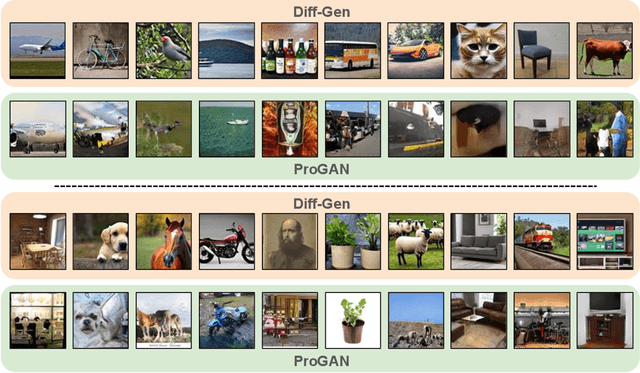
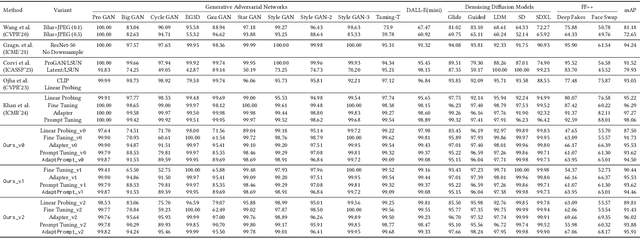
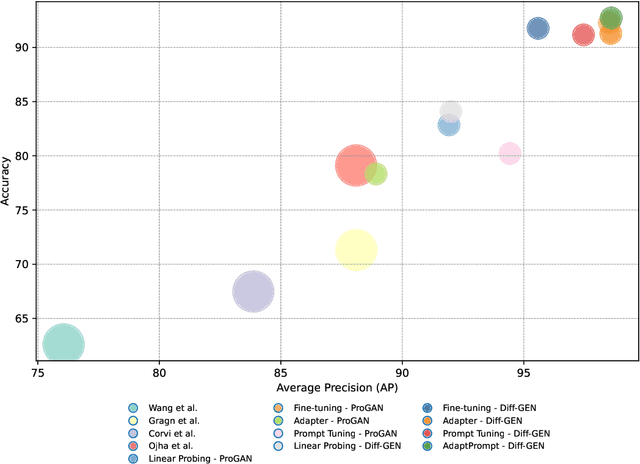
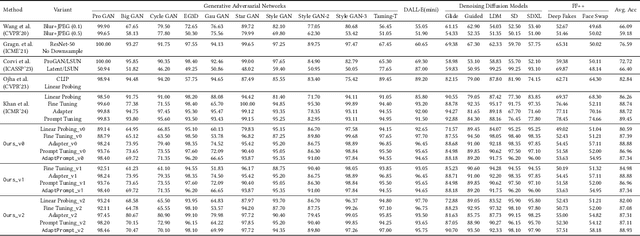
Recent advances in image generation have led to the widespread availability of highly realistic synthetic media, increasing the difficulty of reliable deepfake detection. A key challenge is generalization, as detectors trained on a narrow class of generators often fail when confronted with unseen models. In this work, we address the pressing need for generalizable detection by leveraging large vision-language models, specifically CLIP, to identify synthetic content across diverse generative techniques. First, we introduce Diff-Gen, a large-scale benchmark dataset comprising 100k diffusion-generated fakes that capture broad spectral artifacts unlike traditional GAN datasets. Models trained on Diff-Gen demonstrate stronger cross-domain generalization, particularly on previously unseen image generators. Second, we propose AdaptPrompt, a parameter-efficient transfer learning framework that jointly learns task-specific textual prompts and visual adapters while keeping the CLIP backbone frozen. We further show via layer ablation that pruning the final transformer block of the vision encoder enhances the retention of high-frequency generative artifacts, significantly boosting detection accuracy. Our evaluation spans 25 challenging test sets, covering synthetic content generated by GANs, diffusion models, and commercial tools, establishing a new state-of-the-art in both standard and cross-domain scenarios. We further demonstrate the framework's versatility through few-shot generalization (using as few as 320 images) and source attribution, enabling the precise identification of generator architectures in closed-set settings.
Continuous Monitoring of Large-Scale Generative AI via Deterministic Knowledge Graph Structures
Sep 04, 2025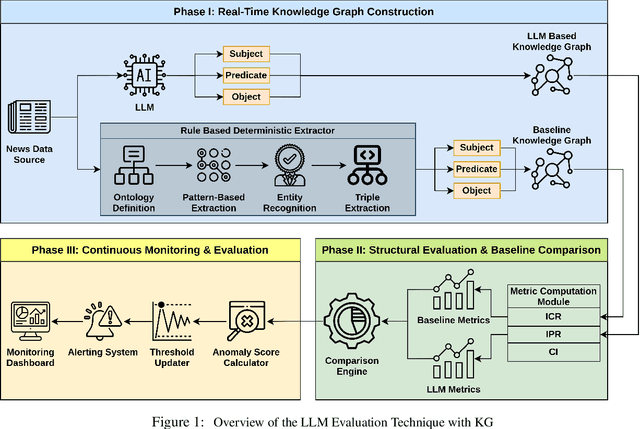
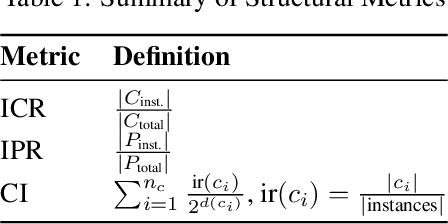
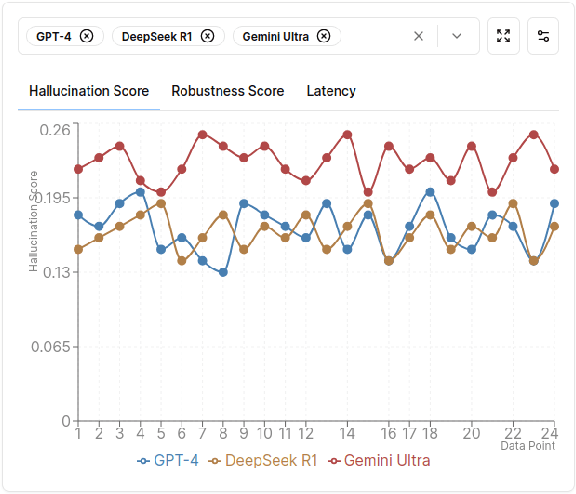
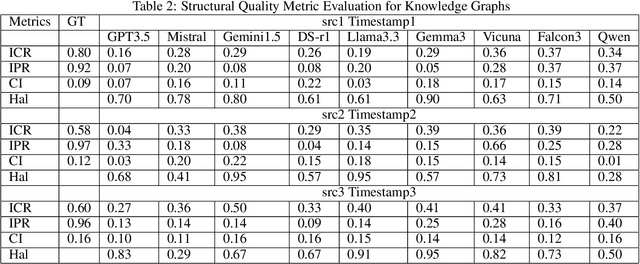
Generative AI (GEN AI) models have revolutionized diverse application domains but present substantial challenges due to reliability concerns, including hallucinations, semantic drift, and inherent biases. These models typically operate as black-boxes, complicating transparent and objective evaluation. Current evaluation methods primarily depend on subjective human assessment, limiting scalability, transparency, and effectiveness. This research proposes a systematic methodology using deterministic and Large Language Model (LLM)-generated Knowledge Graphs (KGs) to continuously monitor and evaluate GEN AI reliability. We construct two parallel KGs: (i) a deterministic KG built using explicit rule-based methods, predefined ontologies, domain-specific dictionaries, and structured entity-relation extraction rules, and (ii) an LLM-generated KG dynamically derived from real-time textual data streams such as live news articles. Utilizing real-time news streams ensures authenticity, mitigates biases from repetitive training, and prevents adaptive LLMs from bypassing predefined benchmarks through feedback memorization. To quantify structural deviations and semantic discrepancies, we employ several established KG metrics, including Instantiated Class Ratio (ICR), Instantiated Property Ratio (IPR), and Class Instantiation (CI). An automated real-time monitoring framework continuously computes deviations between deterministic and LLM-generated KGs. By establishing dynamic anomaly thresholds based on historical structural metric distributions, our method proactively identifies and flags significant deviations, thus promptly detecting semantic anomalies or hallucinations. This structured, metric-driven comparison between deterministic and dynamically generated KGs delivers a robust and scalable evaluation framework.
Model Selection with Near Optimal Rates for Reinforcement Learning with General Model Classes
Jul 13, 2021We address the problem of model selection for the finite horizon episodic Reinforcement Learning (RL) problem where the transition kernel $P^*$ belongs to a family of models $\mathcal{P}^*$ with finite metric entropy. In the model selection framework, instead of $\mathcal{P}^*$, we are given $M$ nested families of transition kernels $\cP_1 \subset \cP_2 \subset \ldots \subset \cP_M$. We propose and analyze a novel algorithm, namely \emph{Adaptive Reinforcement Learning (General)} (\texttt{ARL-GEN}) that adapts to the smallest such family where the true transition kernel $P^*$ lies. \texttt{ARL-GEN} uses the Upper Confidence Reinforcement Learning (\texttt{UCRL}) algorithm with value targeted regression as a blackbox and puts a model selection module at the beginning of each epoch. Under a mild separability assumption on the model classes, we show that \texttt{ARL-GEN} obtains a regret of $\Tilde{\mathcal{O}}(d_{\mathcal{E}}^*H^2+\sqrt{d_{\mathcal{E}}^* \mathbb{M}^* H^2 T})$, with high probability, where $H$ is the horizon length, $T$ is the total number of steps, $d_{\mathcal{E}}^*$ is the Eluder dimension and $\mathbb{M}^*$ is the metric entropy corresponding to $\mathcal{P}^*$. Note that this regret scaling matches that of an oracle that knows $\mathcal{P}^*$ in advance. We show that the cost of model selection for \texttt{ARL-GEN} is an additive term in the regret having a weak dependence on $T$. Subsequently, we remove the separability assumption and consider the setup of linear mixture MDPs, where the transition kernel $P^*$ has a linear function approximation. With this low rank structure, we propose novel adaptive algorithms for model selection, and obtain (order-wise) regret identical to that of an oracle with knowledge of the true model class.