 Add to Chrome
 Add to Firefox
 Add to Edge
Aspp
Papers and Code
RepSFNet : A Single Fusion Network with Structural Reparameterization for Crowd Counting
Jan 28, 2026
Crowd counting remains challenging in variable-density scenes due to scale variations, occlusions, and the high computational cost of existing models. To address these issues, we propose RepSFNet (Reparameterized Single Fusion Network), a lightweight architecture designed for accurate and real-time crowd estimation. RepSFNet leverages a RepLK-ViT backbone with large reparameterized kernels for efficient multi-scale feature extraction. It further integrates a Feature Fusion module combining Atrous Spatial Pyramid Pooling (ASPP) and Context-Aware Network (CAN) to achieve robust, density-adaptive context modeling. A Concatenate Fusion module is employed to preserve spatial resolution and generate high-quality density maps. By avoiding attention mechanisms and multi-branch designs, RepSFNet significantly reduces parameters and computational complexity. The training objective combines Mean Squared Error and Optimal Transport loss to improve both count accuracy and spatial distribution alignment. Experiments conducted on ShanghaiTech, NWPU, and UCF-QNRF datasets demonstrate that RepSFNet achieves competitive accuracy while reducing inference latency by up to 34 percent compared to recent state-of-the-art methods, making it suitable for real-time and low-power edge computing applications.
* 6 pages. Published in Proceedings of the IEEE International Conference on Advanced Video and Signal-Based Surveillance (AVSS) 2025

WeedRepFormer: Reparameterizable Vision Transformers for Real-Time Waterhemp Segmentation and Gender Classification
Jan 06, 2026We present WeedRepFormer, a lightweight multi-task Vision Transformer designed for simultaneous waterhemp segmentation and gender classification. Existing agricultural models often struggle to balance the fine-grained feature extraction required for biological attribute classification with the efficiency needed for real-time deployment. To address this, WeedRepFormer systematically integrates structural reparameterization across the entire architecture - comprising a Vision Transformer backbone, a Lite R-ASPP decoder, and a novel reparameterizable classification head - to decouple training-time capacity from inference-time latency. We also introduce a comprehensive waterhemp dataset containing 10,264 annotated frames from 23 plants. On this benchmark, WeedRepFormer achieves 92.18% mIoU for segmentation and 81.91% accuracy for gender classification using only 3.59M parameters and 3.80 GFLOPs. At 108.95 FPS, our model outperforms the state-of-the-art iFormer-T by 4.40% in classification accuracy while maintaining competitive segmentation performance and significantly reducing parameter count by 1.9x.
AURASeg: Attention Guided Upsampling with Residual Boundary-Assistive Refinement for Drivable-Area Segmentation
Oct 24, 2025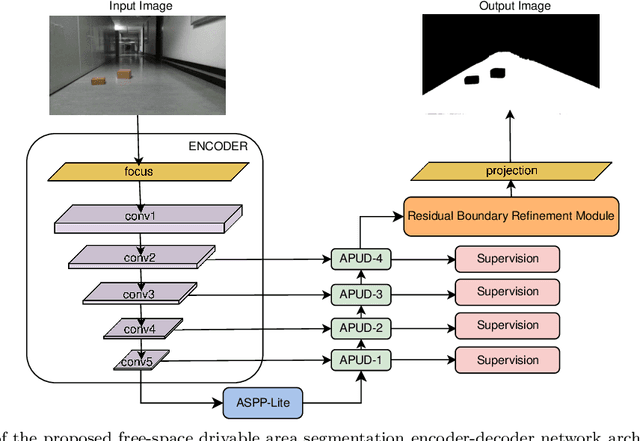
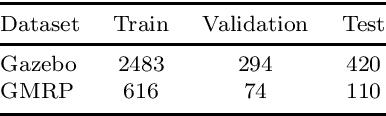
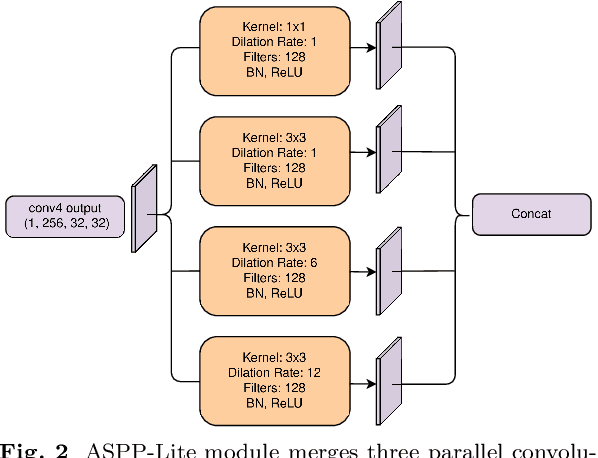
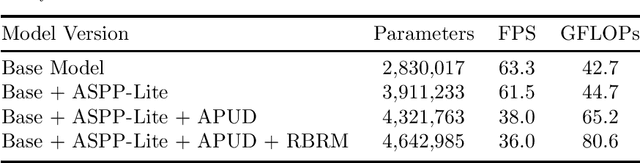
Free space ground segmentation is essential to navigate robots and autonomous vehicles, recognize drivable zones, and traverse efficiently. Fine-grained features remain challenging for existing segmentation models, particularly for robots in indoor and structured environments. These difficulties arise from ineffective multi-scale processing, suboptimal boundary refinement, and limited feature representation. In order to overcome these limitations, we propose Attention-Guided Upsampling with Residual Boundary-Assistive Refinement (AURASeg), a ground-plane semantic segmentation model that maintains high segmentation accuracy while improving border precision. Our method uses CSP-Darknet backbone by adding a Residual Border Refinement Module (RBRM) for accurate edge delineation and an Attention Progressive Upsampling Decoder (APUD) for strong feature integration. We also incorporate a lightweight Atrous Spatial Pyramid Pooling (ASPP-Lite) module to ensure multi-scale context extraction without compromising real-time performance. The proposed model beats benchmark segmentation architectures in mIoU and F1 metrics when tested on the Ground Mobile Robot Perception (GMRP) Dataset and a custom Gazebo indoor dataset. Our approach achieves an improvement in mean Intersection-over-Union (mIoU) of +1.26% and segmentation precision of +1.65% compared to state-of-the-art models. These results show that our technique is feasible for autonomous perception in both indoor and outdoor environments, enabling precise border refinement with minimal effect on inference speed.
GasTwinFormer: A Hybrid Vision Transformer for Livestock Methane Emission Segmentation and Dietary Classification in Optical Gas Imaging
Aug 20, 2025Livestock methane emissions represent 32% of human-caused methane production, making automated monitoring critical for climate mitigation strategies. We introduce GasTwinFormer, a hybrid vision transformer for real-time methane emission segmentation and dietary classification in optical gas imaging through a novel Mix Twin encoder alternating between spatially-reduced global attention and locally-grouped attention mechanisms. Our architecture incorporates a lightweight LR-ASPP decoder for multi-scale feature aggregation and enables simultaneous methane segmentation and dietary classification in a unified framework. We contribute the first comprehensive beef cattle methane emission dataset using OGI, containing 11,694 annotated frames across three dietary treatments. GasTwinFormer achieves 74.47% mIoU and 83.63% mF1 for segmentation while maintaining exceptional efficiency with only 3.348M parameters, 3.428G FLOPs, and 114.9 FPS inference speed. Additionally, our method achieves perfect dietary classification accuracy (100%), demonstrating the effectiveness of leveraging diet-emission correlations. Extensive ablation studies validate each architectural component, establishing GasTwinFormer as a practical solution for real-time livestock emission monitoring. Please see our project page at gastwinformer.github.io.
DCD: A Semantic Segmentation Model for Fetal Ultrasound Four-Chamber View
Jun 10, 2025Accurate segmentation of anatomical structures in the apical four-chamber (A4C) view of fetal echocardiography is essential for early diagnosis and prenatal evaluation of congenital heart disease (CHD). However, precise segmentation remains challenging due to ultrasound artifacts, speckle noise, anatomical variability, and boundary ambiguity across different gestational stages. To reduce the workload of sonographers and enhance segmentation accuracy, we propose DCD, an advanced deep learning-based model for automatic segmentation of key anatomical structures in the fetal A4C view. Our model incorporates a Dense Atrous Spatial Pyramid Pooling (Dense ASPP) module, enabling superior multi-scale feature extraction, and a Convolutional Block Attention Module (CBAM) to enhance adaptive feature representation. By effectively capturing both local and global contextual information, DCD achieves precise and robust segmentation, contributing to improved prenatal cardiac assessment.
DynSegNet:Dynamic Architecture Adjustment for Adversarial Learning in Segmenting Hemorrhagic Lesions from Fundus Images
Feb 13, 2025The hemorrhagic lesion segmentation plays a critical role in ophthalmic diagnosis, directly influencing early disease detection, treatment planning, and therapeutic efficacy evaluation. However, the task faces significant challenges due to lesion morphological variability, indistinct boundaries, and low contrast with background tissues. To improve diagnostic accuracy and treatment outcomes, developing advanced segmentation techniques remains imperative. This paper proposes an adversarial learning-based dynamic architecture adjustment approach that integrates hierarchical U-shaped encoder-decoder, residual blocks, attention mechanisms, and ASPP modules. By dynamically optimizing feature fusion, our method enhances segmentation performance. Experimental results demonstrate a Dice coefficient of 0.6802, IoU of 0.5602, Recall of 0.766, Precision of 0.6525, and Accuracy of 0.9955, effectively addressing the challenges in fundus image hemorrhage segmentation.[* Corresponding author.]
Enhancing Brain Tumor Segmentation Using Channel Attention and Transfer learning
Jan 19, 2025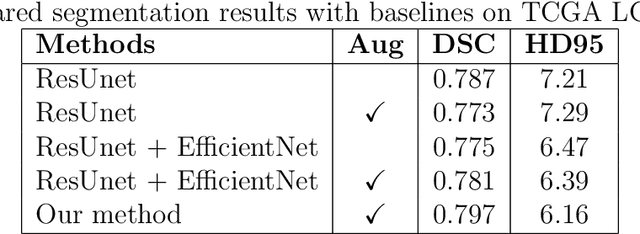
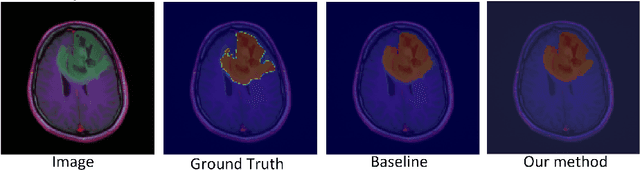
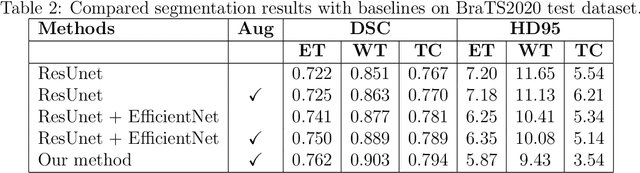

Accurate and efficient segmentation of brain tumors is critical for diagnosis, treatment planning, and monitoring in clinical practice. In this study, we present an enhanced ResUNet architecture for automatic brain tumor segmentation, integrating an EfficientNetB0 encoder, a channel attention mechanism, and an Atrous Spatial Pyramid Pooling (ASPP) module. The EfficientNetB0 encoder leverages pre-trained features to improve feature extraction efficiency, while the channel attention mechanism enhances the model's focus on tumor-relevant features. ASPP enables multiscale contextual learning, crucial for handling tumors of varying sizes and shapes. The proposed model was evaluated on two benchmark datasets: TCGA LGG and BraTS 2020. Experimental results demonstrate that our method consistently outperforms the baseline ResUNet and its EfficientNet variant, achieving Dice coefficients of 0.903 and 0.851 and HD95 scores of 9.43 and 3.54 for whole tumor and tumor core regions on the BraTS 2020 dataset, respectively. compared with state-of-the-art methods, our approach shows competitive performance, particularly in whole tumor and tumor core segmentation. These results indicate that combining a powerful encoder with attention mechanisms and ASPP can significantly enhance brain tumor segmentation performance. The proposed approach holds promise for further optimization and application in other medical image segmentation tasks.
MNet-SAt: A Multiscale Network with Spatial-enhanced Attention for Segmentation of Polyps in Colonoscopy
Dec 27, 2024Objective: To develop a novel deep learning framework for the automated segmentation of colonic polyps in colonoscopy images, overcoming the limitations of current approaches in preserving precise polyp boundaries, incorporating multi-scale features, and modeling spatial dependencies that accurately reflect the intricate and diverse morphology of polyps. Methods: To address these limitations, we propose a novel Multiscale Network with Spatial-enhanced Attention (MNet-SAt) for polyp segmentation in colonoscopy images. This framework incorporates four key modules: Edge-Guided Feature Enrichment (EGFE) preserves edge information for improved boundary quality; Multi-Scale Feature Aggregator (MSFA) extracts and aggregates multi-scale features across channel spatial dimensions, focusing on salient regions; Spatial-Enhanced Attention (SEAt) captures spatial-aware global dependencies within the multi-scale aggregated features, emphasizing the region of interest; and Channel-Enhanced Atrous Spatial Pyramid Pooling (CE-ASPP) resamples and recalibrates attentive features across scales. Results: We evaluated MNet-SAt on the Kvasir-SEG and CVC-ClinicDB datasets, achieving Dice Similarity Coefficients of 96.61% and 98.60%, respectively. Conclusion: Both quantitative (DSC) and qualitative assessments highlight MNet-SAt's superior performance and generalization capabilities compared to existing methods. Significance: MNet-SAt's high accuracy in polyp segmentation holds promise for improving clinical workflows in early polyp detection and more effective treatment, contributing to reduced colorectal cancer mortality rates.
CASCRNet: An Atrous Spatial Pyramid Pooling and Shared Channel Residual based Network for Capsule Endoscopy
Oct 23, 2024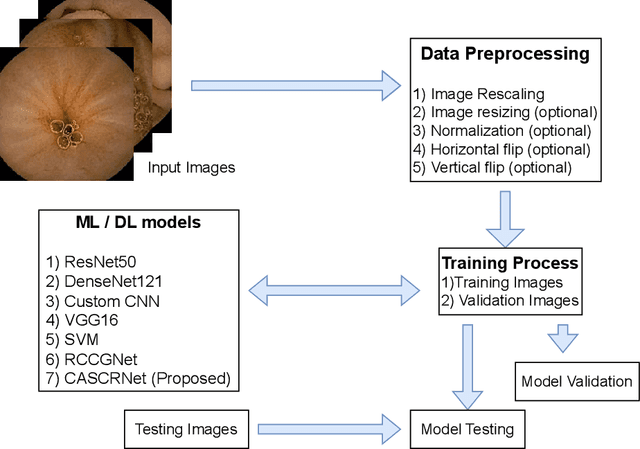
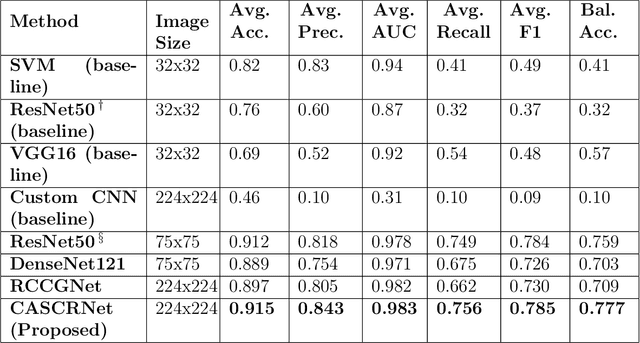
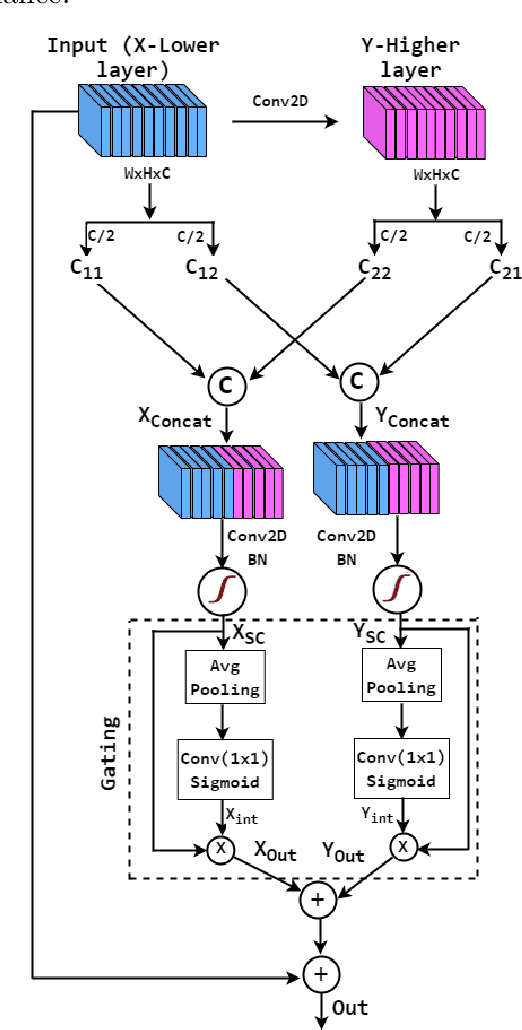
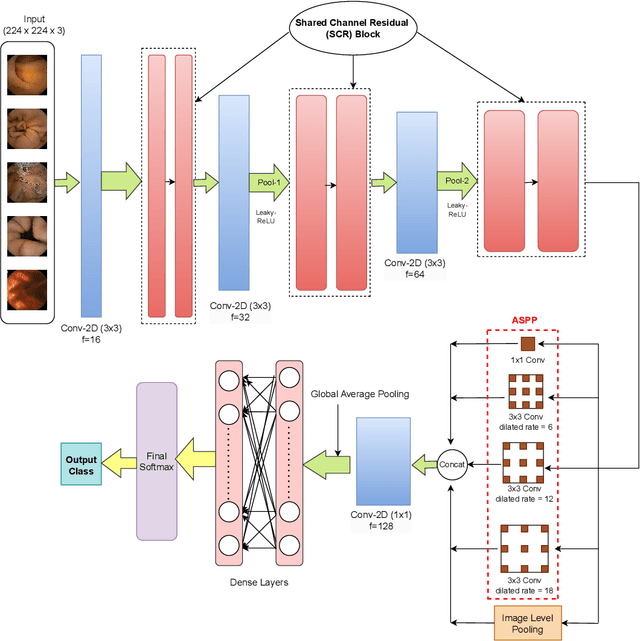
This manuscript summarizes work on the Capsule Vision Challenge 2024 by MISAHUB. To address the multi-class disease classification task, which is challenging due to the complexity and imbalance in the Capsule Vision challenge dataset, this paper proposes CASCRNet (Capsule endoscopy-Aspp-SCR-Network), a parameter-efficient and novel model that uses Shared Channel Residual (SCR) blocks and Atrous Spatial Pyramid Pooling (ASPP) blocks. Further, the performance of the proposed model is compared with other well-known approaches. The experimental results yield that proposed model provides better disease classification results. The proposed model was successful in classifying diseases with an F1 Score of 78.5% and a Mean AUC of 98.3%, which is promising given its compact architecture.
Automated Road Extraction from Satellite Imagery Integrating Dense Depthwise Dilated Separable Spatial Pyramid Pooling with DeepLabV3+
Oct 18, 2024Road Extraction is a sub-domain of Remote Sensing applications; it is a subject of extensive and ongoing research. The procedure of automatically extracting roads from satellite imagery encounters significant challenges due to the multi-scale and diverse structures of roads; improvement in this field is needed. The DeepLab series, known for its proficiency in semantic segmentation due to its efficiency in interpreting multi-scale objects' features, addresses some of these challenges caused by the varying nature of roads. The present work proposes the utilization of DeepLabV3+, the latest version of the DeepLab series, by introducing an innovative Dense Depthwise Dilated Separable Spatial Pyramid Pooling (DenseDDSSPP) module and integrating it in place of the conventional Atrous Spatial Pyramid Pooling (ASPP) module. This modification enhances the extraction of complex road structures from satellite images. This study hypothesizes that the integration of DenseDDSSPP, combined with an appropriately selected backbone network and a Squeeze-and-Excitation block, will generate an efficient dense feature map by focusing on relevant features, leading to more precise and accurate road extraction from Remote Sensing images. The results section presents a comparison of our model's performance against state-of-the-art models, demonstrating better results that highlight the effectiveness and success of the proposed approach.