 Add to Chrome
 Add to Firefox
 Add to Edge
Albef
Papers and Code
Learning to Fuse: Modality-Aware Adaptive Scheduling for Robust Multimodal Foundation Models
Jun 15, 2025
Multimodal foundation models have achieved impressive progress across a wide range of vision-language tasks. However, existing approaches often adopt fixed or task-specific fusion strategies, neglecting the intrinsic variability of modality reliability and sample complexity. In this paper, we propose Modality-Aware Adaptive Fusion Scheduling (MA-AFS), a general framework that learns to dynamically modulate the contribution of each modality on a per-instance basis. MA-AFS introduces a lightweight neural scheduler that predicts modality fusion weights by integrating visual and textual entropy signals along with cross-modal agreement cues. This enables the model to adaptively emphasize more reliable modalities, especially under noisy, missing, or misaligned inputs. We formulate the fusion process as a differentiable scheduling mechanism, analyze its theoretical consistency and regularization effect, and demonstrate that it improves robustness without increasing model capacity significantly. Extensive experiments on image-text retrieval, captioning, and visual question answering show that MA-AFS achieves consistent performance gains over strong baselines such as CLIP, ALBEF, and BLIP. Moreover, MA-AFS exhibits improved robustness under modality corruption and enhanced generalization under domain shifts. Our work highlights the importance of adaptive fusion and opens a promising direction toward reliable and uncertainty-aware multimodal learning.

FALCON: False-Negative Aware Learning of Contrastive Negatives in Vision-Language Pretraining
May 19, 2025False negatives pose a critical challenge in vision-language pretraining (VLP) due to the many-to-many correspondence between images and texts in large-scale datasets. These false negatives introduce conflicting supervision signals that degrade the learned embedding space and diminish the effectiveness of hard negative sampling. In this paper, we propose FALCON (False-negative Aware Learning of COntrastive Negatives), a learning-based mini-batch construction strategy that adaptively balances the trade-off between hard and false negatives during VLP. Rather than relying on fixed heuristics, FALCON employs a negative mining scheduler that dynamically selects negative samples of appropriate hardness for each anchor instance during mini-batch construction, guided by a proxy for cross-modal alignment improvement. Experimental results demonstrate that FALCON significantly improves performance across two widely adopted VLP frameworks (ALBEF, BLIP-2) and a broad range of downstream tasks and evaluation settings, underscoring its effectiveness and robustness in mitigating the impact of false negatives.
Barking Up The Syntactic Tree: Enhancing VLM Training with Syntactic Losses
Dec 11, 2024Vision-Language Models (VLMs) achieved strong performance on a variety of tasks (e.g., image-text retrieval, visual question answering). However, most VLMs rely on coarse-grained image-caption pairs for alignment, relying on data volume to resolve ambiguities and ground linguistic concepts in images. The richer semantic and syntactic structure within text is largely overlooked. To address this, we propose HIerarchically STructured Learning (HIST) that enhances VLM training without any additional supervision, by hierarchically decomposing captions into the constituent Subject, Noun Phrases, and Composite Phrases. Entailment between these constituent components allows us to formulate additional regularization constraints on the VLM attention maps. Specifically, we introduce two novel loss functions: (1) Subject Loss, which aligns image content with the subject of corresponding phrase, acting as an entailment of standard contrastive/matching losses at the Phrase level; (2) Addition Loss, to balance attention across multiple objects. HIST is general, and can be applied to any VLM for which attention between vision and language can be computed; we illustrate its efficacy on BLIP and ALBEF. HIST outperforms baseline VLMs, achieving up to +9.8% improvement in visual grounding, +6.3% in multi-object referring segmentation, +1.1% in image-text retrieval, and +0.2% in visual question answering, underscoring the value of structuring learning in VLMs.
Nearest Neighbor Normalization Improves Multimodal Retrieval
Oct 31, 2024
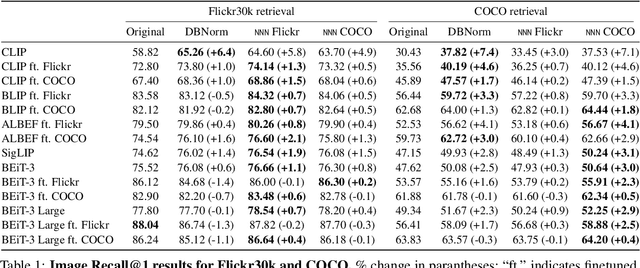
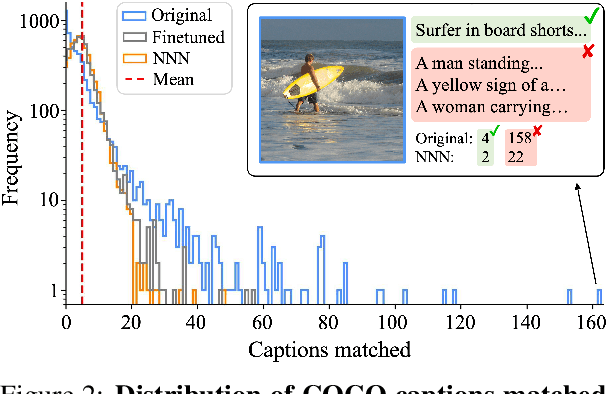
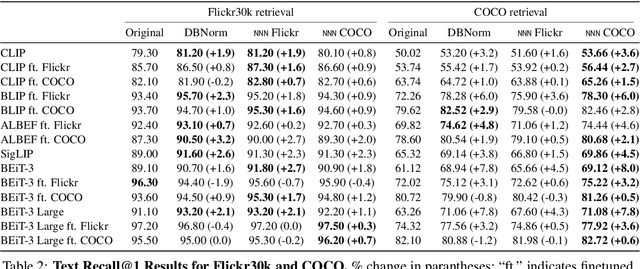
Multimodal models leverage large-scale pre-training to achieve strong but still imperfect performance on tasks such as image captioning, visual question answering, and cross-modal retrieval. In this paper, we present a simple and efficient method for correcting errors in trained contrastive image-text retrieval models with no additional training, called Nearest Neighbor Normalization (NNN). We show an improvement on retrieval metrics in both text retrieval and image retrieval for all of the contrastive models that we tested (CLIP, BLIP, ALBEF, SigLIP, BEiT) and for both of the datasets that we used (MS-COCO and Flickr30k). NNN requires a reference database, but does not require any training on this database, and can even increase the retrieval accuracy of a model after finetuning.
Knowledge-grounded Adaptation Strategy for Vision-language Models: Building Unique Case-set for Screening Mammograms for Residents Training
May 30, 2024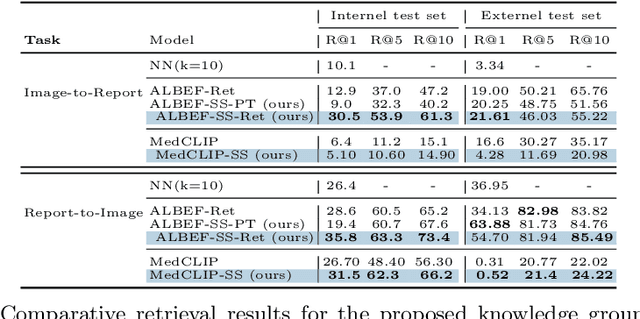
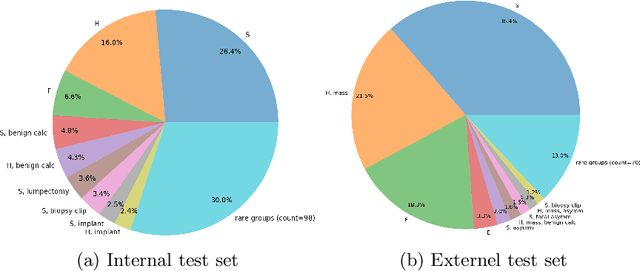
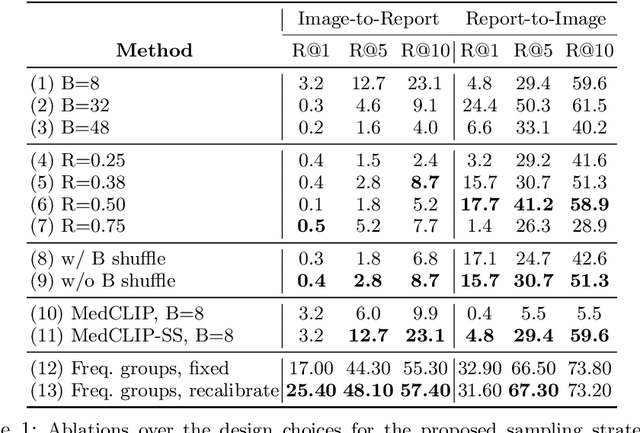
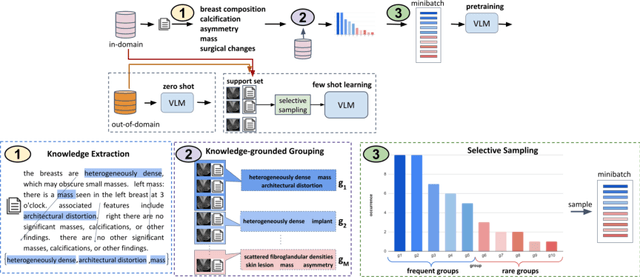
A visual-language model (VLM) pre-trained on natural images and text pairs poses a significant barrier when applied to medical contexts due to domain shift. Yet, adapting or fine-tuning these VLMs for medical use presents considerable hurdles, including domain misalignment, limited access to extensive datasets, and high-class imbalances. Hence, there is a pressing need for strategies to effectively adapt these VLMs to the medical domain, as such adaptations would prove immensely valuable in healthcare applications. In this study, we propose a framework designed to adeptly tailor VLMs to the medical domain, employing selective sampling and hard-negative mining techniques for enhanced performance in retrieval tasks. We validate the efficacy of our proposed approach by implementing it across two distinct VLMs: the in-domain VLM (MedCLIP) and out-of-domain VLMs (ALBEF). We assess the performance of these models both in their original off-the-shelf state and after undergoing our proposed training strategies, using two extensive datasets containing mammograms and their corresponding reports. Our evaluation spans zero-shot, few-shot, and supervised scenarios. Through our approach, we observe a notable enhancement in Recall@K performance for the image-text retrieval task.
Q-GroundCAM: Quantifying Grounding in Vision Language Models via GradCAM
Apr 29, 2024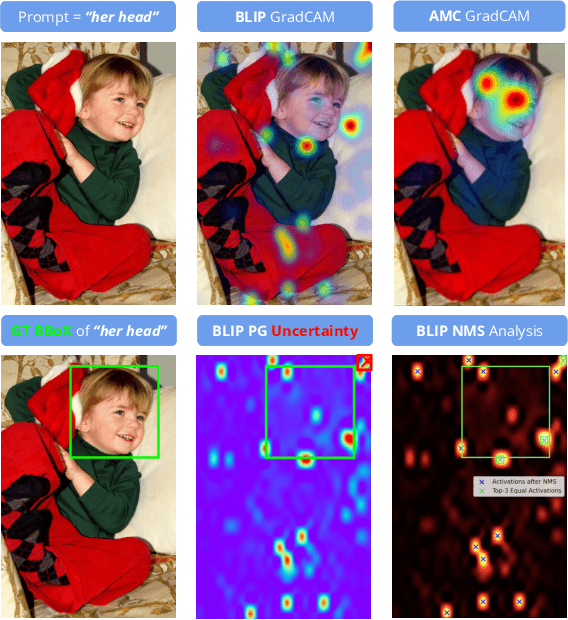
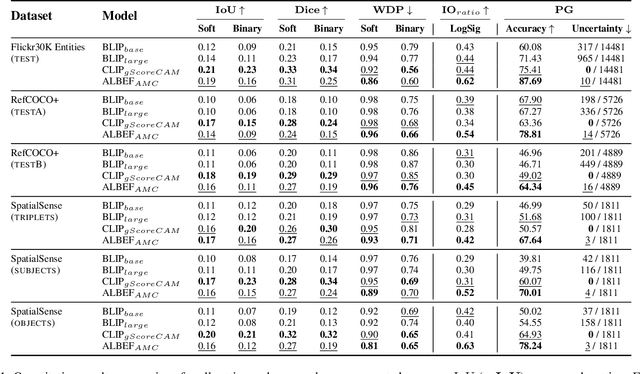
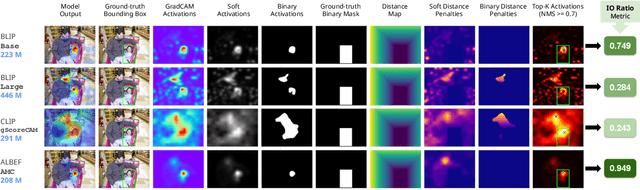
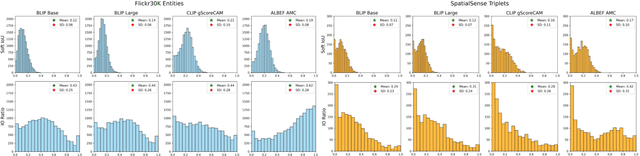
Vision and Language Models (VLMs) continue to demonstrate remarkable zero-shot (ZS) performance across various tasks. However, many probing studies have revealed that even the best-performing VLMs struggle to capture aspects of compositional scene understanding, lacking the ability to properly ground and localize linguistic phrases in images. Recent VLM advancements include scaling up both model and dataset sizes, additional training objectives and levels of supervision, and variations in the model architectures. To characterize the grounding ability of VLMs, such as phrase grounding, referring expressions comprehension, and relationship understanding, Pointing Game has been used as an evaluation metric for datasets with bounding box annotations. In this paper, we introduce a novel suite of quantitative metrics that utilize GradCAM activations to rigorously evaluate the grounding capabilities of pre-trained VLMs like CLIP, BLIP, and ALBEF. These metrics offer an explainable and quantifiable approach for a more detailed comparison of the zero-shot capabilities of VLMs and enable measuring models' grounding uncertainty. This characterization reveals interesting tradeoffs between the size of the model, the dataset size, and their performance.
Learning from Models and Data for Visual Grounding
Mar 20, 2024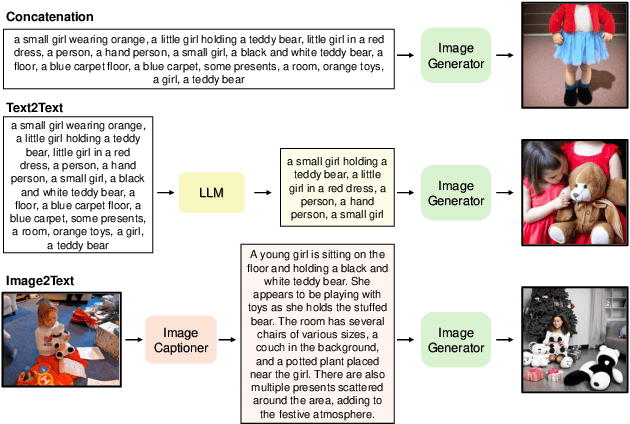
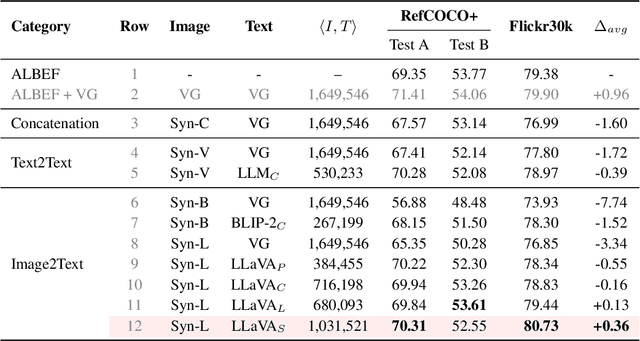
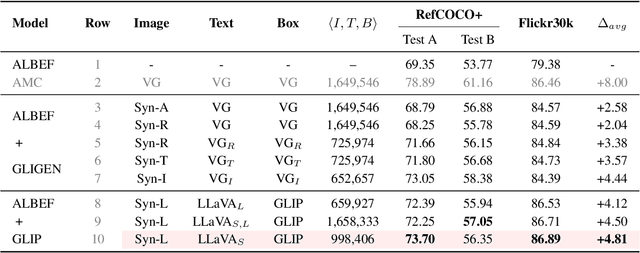
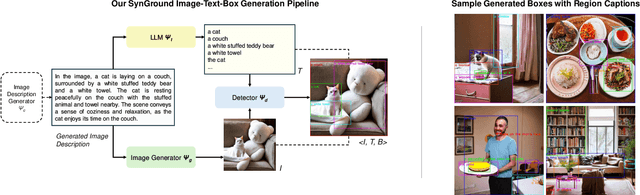
We introduce SynGround, a novel framework that combines data-driven learning and knowledge transfer from various large-scale pretrained models to enhance the visual grounding capabilities of a pretrained vision-and-language model. The knowledge transfer from the models initiates the generation of image descriptions through an image description generator. These descriptions serve dual purposes: they act as prompts for synthesizing images through a text-to-image generator, and as queries for synthesizing text, from which phrases are extracted using a large language model. Finally, we leverage an open-vocabulary object detector to generate synthetic bounding boxes for the synthetic images and texts. We finetune a pretrained vision-and-language model on this dataset by optimizing a mask-attention consistency objective that aligns region annotations with gradient-based model explanations. The resulting model improves the grounding capabilities of an off-the-shelf vision-and-language model. Particularly, SynGround improves the pointing game accuracy of ALBEF on the Flickr30k dataset from 79.38% to 87.26%, and on RefCOCO+ Test A from 69.35% to 79.06% and on RefCOCO+ Test B from 53.77% to 63.67%.
LuoJiaHOG: A Hierarchy Oriented Geo-aware Image Caption Dataset for Remote Sensing Image-Text Retrival
Mar 16, 2024Image-text retrieval (ITR) plays a significant role in making informed decisions for various remote sensing (RS) applications. Nonetheless, creating ITR datasets containing vision and language modalities not only requires significant geo-spatial sampling area but also varing categories and detailed descriptions. To this end, we introduce an image caption dataset LuojiaHOG, which is geospatial-aware, label-extension-friendly and comprehensive-captioned. LuojiaHOG involves the hierarchical spatial sampling, extensible classification system to Open Geospatial Consortium (OGC) standards, and detailed caption generation. In addition, we propose a CLIP-based Image Semantic Enhancement Network (CISEN) to promote sophisticated ITR. CISEN consists of two components, namely dual-path knowledge transfer and progressive cross-modal feature fusion. Comprehensive statistics on LuojiaHOG reveal the richness in sampling diversity, labels quantity and descriptions granularity. The evaluation on LuojiaHOG is conducted across various state-of-the-art ITR models, including ALBEF, ALIGN, CLIP, FILIP, Wukong, GeoRSCLIP and CISEN. We use second- and third-level labels to evaluate these vision-language models through adapter-tuning and CISEN demonstrates superior performance. For instance, it achieves the highest scores with WMAP@5 of 88.47\% and 87.28\% on third-level ITR tasks, respectively. In particular, CISEN exhibits an improvement of approximately 1.3\% and 0.9\% in terms of WMAP@5 compared to its baseline. These findings highlight CISEN advancements accurately retrieving pertinent information across image and text. LuojiaHOG and CISEN can serve as a foundational resource for future RS image-text alignment research, facilitating a wide range of vision-language applications.
Improving Adversarial Transferability of Visual-Language Pre-training Models through Collaborative Multimodal Interaction
Mar 16, 2024Despite the substantial advancements in Vision-Language Pre-training (VLP) models, their susceptibility to adversarial attacks poses a significant challenge. Existing work rarely studies the transferability of attacks on VLP models, resulting in a substantial performance gap from white-box attacks. We observe that prior work overlooks the interaction mechanisms between modalities, which plays a crucial role in understanding the intricacies of VLP models. In response, we propose a novel attack, called Collaborative Multimodal Interaction Attack (CMI-Attack), leveraging modality interaction through embedding guidance and interaction enhancement. Specifically, attacking text at the embedding level while preserving semantics, as well as utilizing interaction image gradients to enhance constraints on perturbations of texts and images. Significantly, in the image-text retrieval task on Flickr30K dataset, CMI-Attack raises the transfer success rates from ALBEF to TCL, $\text{CLIP}_{\text{ViT}}$ and $\text{CLIP}_{\text{CNN}}$ by 8.11%-16.75% over state-of-the-art methods. Moreover, CMI-Attack also demonstrates superior performance in cross-task generalization scenarios. Our work addresses the underexplored realm of transfer attacks on VLP models, shedding light on the importance of modality interaction for enhanced adversarial robustness.
Multimodal Learned Sparse Retrieval with Probabilistic Expansion Control
Feb 27, 2024Learned sparse retrieval (LSR) is a family of neural methods that encode queries and documents into sparse lexical vectors that can be indexed and retrieved efficiently with an inverted index. We explore the application of LSR to the multi-modal domain, with a focus on text-image retrieval. While LSR has seen success in text retrieval, its application in multimodal retrieval remains underexplored. Current approaches like LexLIP and STAIR require complex multi-step training on massive datasets. Our proposed approach efficiently transforms dense vectors from a frozen dense model into sparse lexical vectors. We address issues of high dimension co-activation and semantic deviation through a new training algorithm, using Bernoulli random variables to control query expansion. Experiments with two dense models (BLIP, ALBEF) and two datasets (MSCOCO, Flickr30k) show that our proposed algorithm effectively reduces co-activation and semantic deviation. Our best-performing sparsified model outperforms state-of-the-art text-image LSR models with a shorter training time and lower GPU memory requirements. Our approach offers an effective solution for training LSR retrieval models in multimodal settings. Our code and model checkpoints are available at github.com/thongnt99/lsr-multimodal