 Add to Chrome
 Add to Firefox
 Add to Edge
Acute Stroke Lesion Segmentation
Papers and Code
ISLA: A U-Net for MRI-based acute ischemic stroke lesion segmentation with deep supervision, attention, domain adaptation, and ensemble learning
Jan 13, 2026
Accurate delineation of acute ischemic stroke lesions in MRI is a key component of stroke diagnosis and management. In recent years, deep learning models have been successfully applied to the automatic segmentation of such lesions. While most proposed architectures are based on the U-Net framework, they primarily differ in their choice of loss functions and in the use of deep supervision, residual connections, and attention mechanisms. Moreover, many implementations are not publicly available, and the optimal configuration for acute ischemic stroke (AIS) lesion segmentation remains unclear. In this work, we introduce ISLA (Ischemic Stroke Lesion Analyzer), a new deep learning model for AIS lesion segmentation from diffusion MRI, trained on three multicenter databases totaling more than 1500 AIS participants. Through systematic optimization of the loss function, convolutional architecture, deep supervision, and attention mechanisms, we developed a robust segmentation framework. We further investigated unsupervised domain adaptation to improve generalization to an external clinical dataset. ISLA outperformed two state-of-the-art approaches for AIS lesion segmentation on an external test set. Codes and trained models will be made publicly available to facilitate reuse and reproducibility.

Automated Lesion Segmentation of Stroke MRI Using nnU-Net: A Comprehensive External Validation Across Acute and Chronic Lesions
Jan 13, 2026Accurate and generalisable segmentation of stroke lesions from magnetic resonance imaging (MRI) is essential for advancing clinical research, prognostic modelling, and personalised interventions. Although deep learning has improved automated lesion delineation, many existing models are optimised for narrow imaging contexts and generalise poorly to independent datasets, modalities, and stroke stages. Here, we systematically evaluated stroke lesion segmentation using the nnU-Net framework across multiple heterogeneous, publicly available MRI datasets spanning acute and chronic stroke. Models were trained and tested on diffusion-weighted imaging (DWI), fluid-attenuated inversion recovery (FLAIR), and T1-weighted MRI, and evaluated on independent datasets. Across stroke stages, models showed robust generalisation, with segmentation accuracy approaching reported inter-rater reliability. Performance varied with imaging modality and training data characteristics. In acute stroke, DWI-trained models consistently outperformed FLAIR-based models, with only modest gains from multimodal combinations. In chronic stroke, increasing training set size improved performance, with diminishing returns beyond several hundred cases. Lesion volume was a key determinant of accuracy: smaller lesions were harder to segment, and models trained on restricted volume ranges generalised poorly. MRI image quality further constrained generalisability: models trained on lower-quality scans transferred poorly, whereas those trained on higher-quality data generalised well to noisier images. Discrepancies between predictions and reference masks were often attributable to limitations in manual annotations. Together, these findings show that automated lesion segmentation can approach human-level performance while identifying key factors governing generalisability and informing the development of lesion segmentation tools.
An Explainable Agentic AI Framework for Uncertainty-Aware and Abstention-Enabled Acute Ischemic Stroke Imaging Decisions
Jan 03, 2026Artificial intelligence models have shown strong potential in acute ischemic stroke imaging, particularly for lesion detection and segmentation using computed tomography and magnetic resonance imaging. However, most existing approaches operate as black box predictors, producing deterministic outputs without explicit uncertainty awareness or structured mechanisms to abstain under ambiguous conditions. This limitation raises serious safety and trust concerns in high risk emergency radiology settings. In this paper, we propose an explainable agentic AI framework for uncertainty aware and abstention enabled decision support in acute ischemic stroke imaging. The framework follows a modular agentic pipeline in which a perception agent performs lesion aware image analysis, an uncertainty estimation agent computes slice level predictive reliability, and a decision agent determines whether to issue a prediction or abstain based on predefined uncertainty thresholds. Unlike prior stroke imaging systems that primarily focus on improving segmentation or classification accuracy, the proposed framework explicitly prioritizes clinical safety, transparency, and clinician aligned decision behavior. Qualitative and case based analyses across representative stroke imaging scenarios demonstrate that uncertainty driven abstention naturally emerges in diagnostically ambiguous regions and low information slices. The framework further integrates visual explanation mechanisms to support both predictive and abstention decisions, addressing a key limitation of existing uncertainty aware medical imaging systems. Rather than introducing a new performance benchmark, this work presents agentic control, uncertainty awareness, and selective abstention as essential design principles for developing safe and trustworthy medical imaging AI systems.
Dual-Encoder Transformer-Based Multimodal Learning for Ischemic Stroke Lesion Segmentation Using Diffusion MRI
Dec 23, 2025Accurate segmentation of ischemic stroke lesions from diffusion magnetic resonance imaging (MRI) is essential for clinical decision-making and outcome assessment. Diffusion-Weighted Imaging (DWI) and Apparent Diffusion Coefficient (ADC) scans provide complementary information on acute and sub-acute ischemic changes; however, automated lesion delineation remains challenging due to variability in lesion appearance. In this work, we study ischemic stroke lesion segmentation using multimodal diffusion MRI from the ISLES 2022 dataset. Several state-of-the-art convolutional and transformer-based architectures, including U-Net variants, Swin-UNet, and TransUNet, are benchmarked. Based on performance, a dual-encoder TransUNet architecture is proposed to learn modality-specific representations from DWI and ADC inputs. To incorporate spatial context, adjacent slice information is integrated using a three-slice input configuration. All models are trained under a unified framework and evaluated using the Dice Similarity Coefficient (DSC). Results show that transformer-based models outperform convolutional baselines, and the proposed dual-encoder TransUNet achieves the best performance, reaching a Dice score of 85.4% on the test set. The proposed framework offers a robust solution for automated ischemic stroke lesion segmentation from diffusion MRI.
Segmentation of Ischemic Stroke Lesions using Transfer Learning on Multi-sequence MRI
Nov 10, 2025The accurate understanding of ischemic stroke lesions is critical for efficient therapy and prognosis of stroke patients. Magnetic resonance imaging (MRI) is sensitive to acute ischemic stroke and is a common diagnostic method for stroke. However, manual lesion segmentation performed by experts is tedious, time-consuming, and prone to observer inconsistency. Automatic medical image analysis methods have been proposed to overcome this challenge. However, previous approaches have relied on hand-crafted features that may not capture the irregular and physiologically complex shapes of ischemic stroke lesions. In this study, we present a novel framework for quickly and automatically segmenting ischemic stroke lesions on various MRI sequences, including T1-weighted, T2-weighted, DWI, and FLAIR. The proposed methodology is validated on the ISLES 2015 Brain Stroke sequence dataset, where we trained our model using the Res-Unet architecture twice: first, with pre-existing weights, and then without, to explore the benefits of transfer learning. Evaluation metrics, including the Dice score and sensitivity, were computed across 3D volumes. Finally, a Majority Voting Classifier was integrated to amalgamate the outcomes from each axis, resulting in a comprehensive segmentation method. Our efforts culminated in achieving a Dice score of 80.5\% and an accuracy of 74.03\%, showcasing the efficacy of our segmentation approach.
ISLES 2024: The first longitudinal multimodal multi-center real-world dataset in (sub-)acute stroke
Aug 20, 2024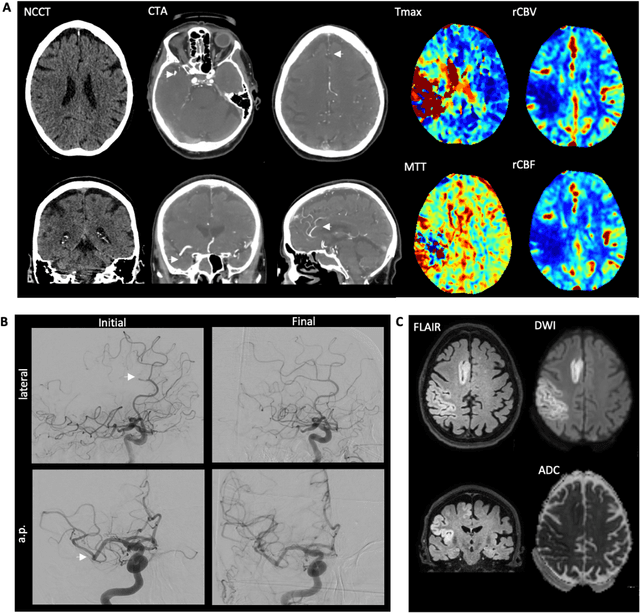
Stroke remains a leading cause of global morbidity and mortality, placing a heavy socioeconomic burden. Over the past decade, advances in endovascular reperfusion therapy and the use of CT and MRI imaging for treatment guidance have significantly improved patient outcomes and are now standard in clinical practice. To develop machine learning algorithms that can extract meaningful and reproducible models of brain function for both clinical and research purposes from stroke images - particularly for lesion identification, brain health quantification, and prognosis - large, diverse, and well-annotated public datasets are essential. While only a few datasets with (sub-)acute stroke data were previously available, several large, high-quality datasets have recently been made publicly accessible. However, these existing datasets include only MRI data. In contrast, our dataset is the first to offer comprehensive longitudinal stroke data, including acute CT imaging with angiography and perfusion, follow-up MRI at 2-9 days, as well as acute and longitudinal clinical data up to a three-month outcome. The dataset includes a training dataset of n = 150 and a test dataset of n = 100 scans. Training data is publicly available, while test data will be used exclusively for model validation. We are making this dataset available as part of the 2024 edition of the Ischemic Stroke Lesion Segmentation (ISLES) challenge (https://www.isles-challenge.org/), which continuously aims to establish benchmark methods for acute and sub-acute ischemic stroke lesion segmentation, aiding in creating open stroke imaging datasets and evaluating cutting-edge image processing algorithms.
Input Data Adaptive Learning for Sub-acute Ischemic Stroke Lesion Segmentation
Mar 12, 2024In machine learning larger databases are usually associated with higher classification accuracy due to better generalization. This generalization may lead to non-optimal classifiers in some medical applications with highly variable expressions of pathologies. This paper presents a method for learning from a large training base by adaptively selecting optimal training samples for given input data. In this way heterogeneous databases are supported two-fold. First, by being able to deal with sparsely annotated data allows a quick inclusion of new data set and second, by training an input-dependent classifier. The proposed approach is evaluated using the SISS challenge. The proposed algorithm leads to a significant improvement of the classification accuracy.
Acute ischemic stroke lesion segmentation in non-contrast CT images using 3D convolutional neural networks
Jan 17, 2023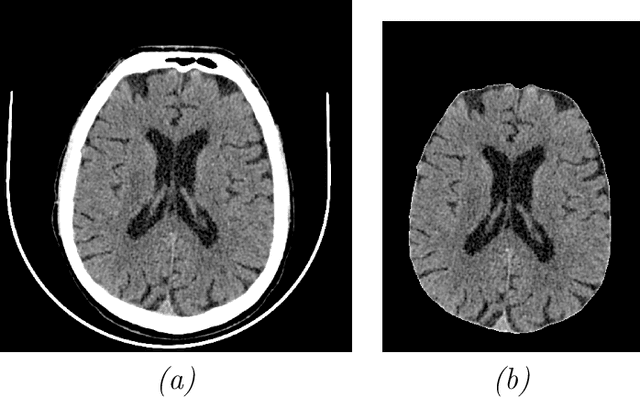
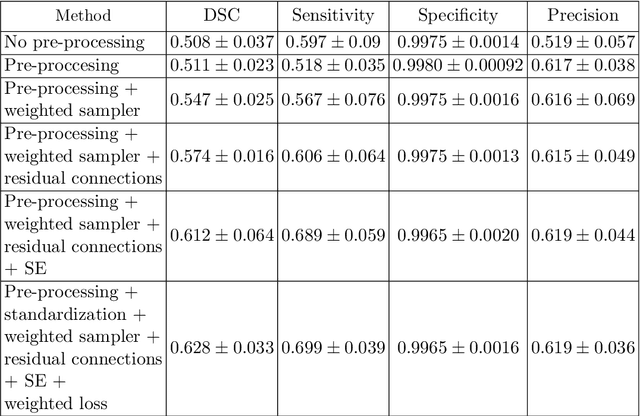
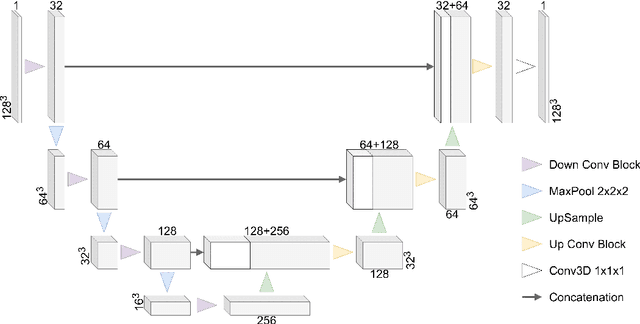

In this paper, an automatic algorithm aimed at volumetric segmentation of acute ischemic stroke lesion in non-contrast computed tomography brain 3D images is proposed. Our deep-learning approach is based on the popular 3D U-Net convolutional neural network architecture, which was modified by adding the squeeze-and-excitation blocks and residual connections. Robust pre-processing methods were implemented to improve the segmentation accuracy. Moreover, a specific patches sampling strategy was used to address the large size of medical images, to smooth out the effect of the class imbalance problem and to stabilize neural network training. All experiments were performed using five-fold cross-validation on the dataset containing non-contrast computed tomography volumetric brain scans of 81 patients diagnosed with acute ischemic stroke. Two radiology experts manually segmented images independently and then verified the labeling results for inconsistencies. The quantitative results of the proposed algorithm and obtained segmentation were measured by the Dice similarity coefficient, sensitivity, specificity and precision metrics. Our proposed model achieves an average Dice of $0.628\pm0.033$, sensitivity of $0.699\pm0.039$, specificity of $0.9965\pm0.0016$ and precision of $0.619\pm0.036$, showing promising segmentation results.
APIS: A paired CT-MRI dataset for ischemic stroke segmentation challenge
Sep 26, 2023Stroke is the second leading cause of mortality worldwide. Immediate attention and diagnosis play a crucial role regarding patient prognosis. The key to diagnosis consists in localizing and delineating brain lesions. Standard stroke examination protocols include the initial evaluation from a non-contrast CT scan to discriminate between hemorrhage and ischemia. However, non-contrast CTs may lack sensitivity in detecting subtle ischemic changes in the acute phase. As a result, complementary diffusion-weighted MRI studies are captured to provide valuable insights, allowing to recover and quantify stroke lesions. This work introduced APIS, the first paired public dataset with NCCT and ADC studies of acute ischemic stroke patients. APIS was presented as a challenge at the 20th IEEE International Symposium on Biomedical Imaging 2023, where researchers were invited to propose new computational strategies that leverage paired data and deal with lesion segmentation over CT sequences. Despite all the teams employing specialized deep learning tools, the results suggest that the ischemic stroke segmentation task from NCCT remains challenging. The annotated dataset remains accessible to the public upon registration, inviting the scientific community to deal with stroke characterization from NCCT but guided with paired DWI information.
Synchronous Image-Label Diffusion Probability Model with Application to Stroke Lesion Segmentation on Non-contrast CT
Jul 18, 2023Stroke lesion volume is a key radiologic measurement for assessing the prognosis of Acute Ischemic Stroke (AIS) patients, which is challenging to be automatically measured on Non-Contrast CT (NCCT) scans. Recent diffusion probabilistic models have shown potentials of being used for image segmentation. In this paper, a novel Synchronous image-label Diffusion Probability Model (SDPM) is proposed for stroke lesion segmentation on NCCT using Markov diffusion process. The proposed SDPM is fully based on a Latent Variable Model (LVM), offering a complete probabilistic elaboration. An additional net-stream, parallel with a noise prediction stream, is introduced to obtain initial noisy label estimates for efficiently inferring the final labels. By optimizing the specified variational boundaries, the trained model can infer multiple label estimates for reference given the input images with noises. The proposed model was assessed on three stroke lesion datasets including one public and two private datasets. Compared to several U-net and transformer-based segmentation methods, our proposed SDPM model is able to achieve state-of-the-art performance. The code is publicly available.