 Add to Chrome
 Add to Firefox
 Add to Edge
SolarFCD: A Large-Scale Dataset and Benchmark for Solar Fault Classification in Photovoltaic Systems
Apr 26, 2026
The increasing global deployment of solar photovoltaic (PV) systems needs robust, scalable, and automated inspection technologies capable of detecting a wide range of panel flaws under a variety of operating situations. The lack of large-scale, multi-modal, publicly available annotated datasets is a major obstacle preventing advancement in this field. We introduce SolarFCD, an extensive dataset of solar panel defects created by methodically combining and reconciling three publicly accessible datasets covering two imaging modalities: RGB/Drone images and Thermal Infrared. The dataset consist of 4,435 images arranged under four unified defect classes such as: healthy images, Surface Obstruction, structural fault, and electrical fault. The dataset was divided into training, validation, and test splits at an 80:10:10 ratio through methodical label mapping, near-duplicate removal, and targeted augmentation of minority classes. Sixteen classification architectures from five design families were trained and assessed on the dataset to provide repeatable benchmark baselines. With an accuracy of 86.68%, precision of 88.65%, recall of 88.62%, and F1-score of 88.17%, ResNet101V2 performed the best overall. Per-class results showed balanced detection across all four defect categories within a narrow performance band of less than 1.2 percentage points. To promote open and repeatable research in automated PV inspection and solar energy operations and maintenance, the dataset, annotation files, and baseline code are made openly available.

StructDamage:A Large Scale Unified Crack and Surface Defect Dataset for Robust Structural Damage Detection
Mar 11, 2026Automated detection and classification of structural cracks and surface defects is a critical challenge in civil engineering, infrastructure maintenance, and heritage preservation. Recent advances in Computer Vision (CV) and Deep Learning (DL) have significantly improved automatic crack detection. However, these methods rely heavily on large, diverse, and carefully curated datasets that include various crack types across different surface materials. Many existing public crack datasets lack geographic diversity, surface types, scale, and labeling consistency, making it challenging for trained algorithms to generalize effectively in real world conditions. We provide a novel dataset, StructDamage, a curated collection of approximately 78,093 images spanning nine surface types: walls, tile, stone, road, pavement, deck, concrete, and brick. The dataset was constructed by systematically aggregating, harmonizing, and reannotating images from 32 publicly available datasets covering concrete structures, asphalt pavements, masonry walls, bridges, and historic buildings. All images are organized in a folder level classification hierarchy suitable for training Convolutional Neural Networks (CNNs) and Vision Transformers. To highlight the practical value of the dataset, we present baseline classification results using fifteen DL architectures from six model families, with twelve achieving macro F1-scores over 0.96. The best performing model DenseNet201 achieves 98.62% accuracy. The proposed dataset provides a comprehensive and versatile resource suitable for classification tasks. With thorough documentation and a standard structure, it is designed to promote reproducible research and support the development and fair evaluation of robust crack damage detection approaches.
GlobalWasteData: A Large-Scale, Integrated Dataset for Robust Waste Classification and Environmental Monitoring
Feb 07, 2026The growing amount of waste is a problem for the environment that requires efficient sorting techniques for various kinds of waste. An automated waste classification system is used for this purpose. The effectiveness of these Artificial Intelligence (AI) models depends on the quality and accessibility of publicly available datasets, which provide the basis for training and analyzing classification algorithms. Although several public waste classification datasets exist, they remain fragmented, inconsistent, and biased toward specific environments. Differences in class names, annotation formats, image conditions, and class distributions make it difficult to combine these datasets or train models that generalize well to real world scenarios. To address these issues, we introduce the GlobalWasteData (GWD) archive, a large scale dataset of 89,807 images across 14 main categories, annotated with 68 distinct subclasses. We compile this novel integrated GWD archive by merging multiple publicly available datasets into a single, unified resource. This GWD archive offers consistent labeling, improved domain diversity, and more balanced class representation, enabling the development of robust and generalizable waste recognition models. Additional preprocessing steps such as quality filtering, duplicate removal, and metadata generation further improve dataset reliability. Overall, this dataset offers a strong foundation for Machine Learning (ML) applications in environmental monitoring, recycling automation, and waste identification, and is publicly available to promote future research and reproducibility.
Dual-Encoder Transformer-Based Multimodal Learning for Ischemic Stroke Lesion Segmentation Using Diffusion MRI
Dec 23, 2025Accurate segmentation of ischemic stroke lesions from diffusion magnetic resonance imaging (MRI) is essential for clinical decision-making and outcome assessment. Diffusion-Weighted Imaging (DWI) and Apparent Diffusion Coefficient (ADC) scans provide complementary information on acute and sub-acute ischemic changes; however, automated lesion delineation remains challenging due to variability in lesion appearance. In this work, we study ischemic stroke lesion segmentation using multimodal diffusion MRI from the ISLES 2022 dataset. Several state-of-the-art convolutional and transformer-based architectures, including U-Net variants, Swin-UNet, and TransUNet, are benchmarked. Based on performance, a dual-encoder TransUNet architecture is proposed to learn modality-specific representations from DWI and ADC inputs. To incorporate spatial context, adjacent slice information is integrated using a three-slice input configuration. All models are trained under a unified framework and evaluated using the Dice Similarity Coefficient (DSC). Results show that transformer-based models outperform convolutional baselines, and the proposed dual-encoder TransUNet achieves the best performance, reaching a Dice score of 85.4% on the test set. The proposed framework offers a robust solution for automated ischemic stroke lesion segmentation from diffusion MRI.
Anatomy-Guided Representation Learning Using a Transformer-Based Network for Thyroid Nodule Segmentation in Ultrasound Images
Dec 14, 2025Accurate thyroid nodule segmentation in ultrasound images is critical for diagnosis and treatment planning. However, ambiguous boundaries between nodules and surrounding tissues, size variations, and the scarcity of annotated ultrasound data pose significant challenges for automated segmentation. Existing deep learning models struggle to incorporate contextual information from the thyroid gland and generalize effectively across diverse cases. To address these challenges, we propose SSMT-Net, a Semi-Supervised Multi-Task Transformer-based Network that leverages unlabeled data to enhance Transformer-centric encoder feature extraction capability in an initial unsupervised phase. In the supervised phase, the model jointly optimizes nodule segmentation, gland segmentation, and nodule size estimation, integrating both local and global contextual features. Extensive evaluations on the TN3K and DDTI datasets demonstrate that SSMT-Net outperforms state-of-the-art methods, with higher accuracy and robustness, indicating its potential for real-world clinical applications.
Biological Brain Age Estimation using Sex-Aware Adversarial Variational Autoencoder with Multimodal Neuroimages
Dec 07, 2024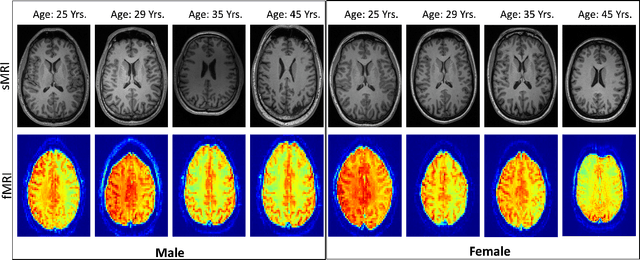
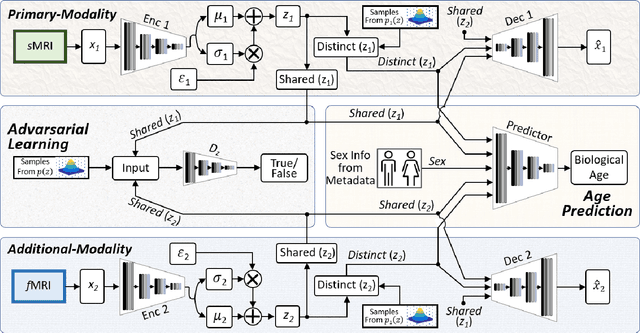
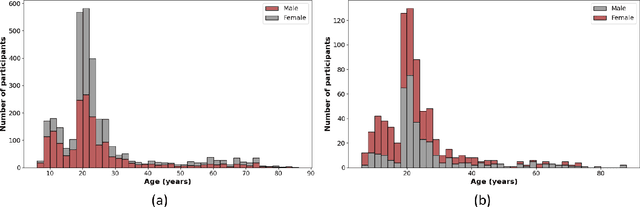
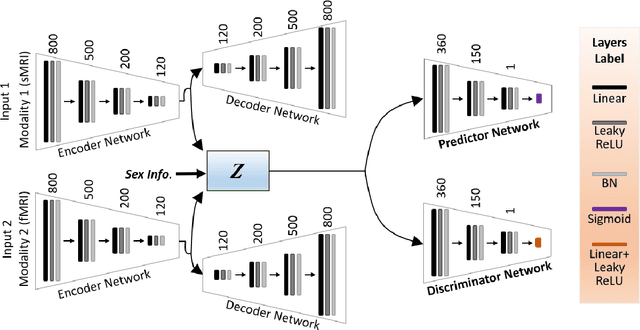
Brain aging involves structural and functional changes and therefore serves as a key biomarker for brain health. Combining structural magnetic resonance imaging (sMRI) and functional magnetic resonance imaging (fMRI) has the potential to improve brain age estimation by leveraging complementary data. However, fMRI data, being noisier than sMRI, complicates multimodal fusion. Traditional fusion methods often introduce more noise than useful information, which can reduce accuracy compared to using sMRI alone. In this paper, we propose a novel multimodal framework for biological brain age estimation, utilizing a sex-aware adversarial variational autoencoder (SA-AVAE). Our framework integrates adversarial and variational learning to effectively disentangle the latent features from both modalities. Specifically, we decompose the latent space into modality-specific codes and shared codes to represent complementary and common information across modalities, respectively. To enhance the disentanglement, we introduce cross-reconstruction and shared-distinct distance ratio loss as regularization terms. Importantly, we incorporate sex information into the learned latent code, enabling the model to capture sex-specific aging patterns for brain age estimation via an integrated regressor module. We evaluate our model using the publicly available OpenBHB dataset, a comprehensive multi-site dataset for brain age estimation. The results from ablation studies and comparisons with state-of-the-art methods demonstrate that our framework outperforms existing approaches and shows significant robustness across various age groups, highlighting its potential for real-time clinical applications in the early detection of neurodegenerative diseases.
Multi-Task Adversarial Variational Autoencoder for Estimating Biological Brain Age with Multimodal Neuroimaging
Nov 15, 2024
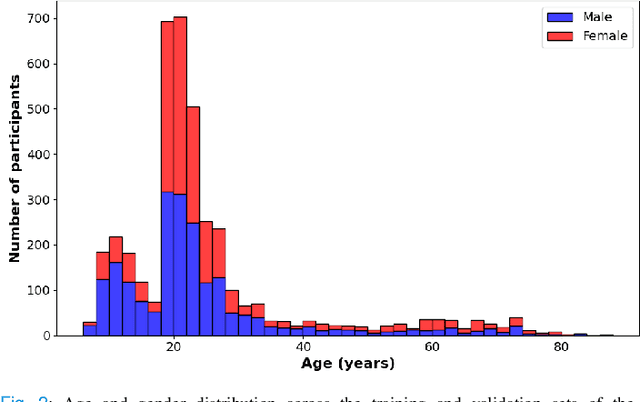

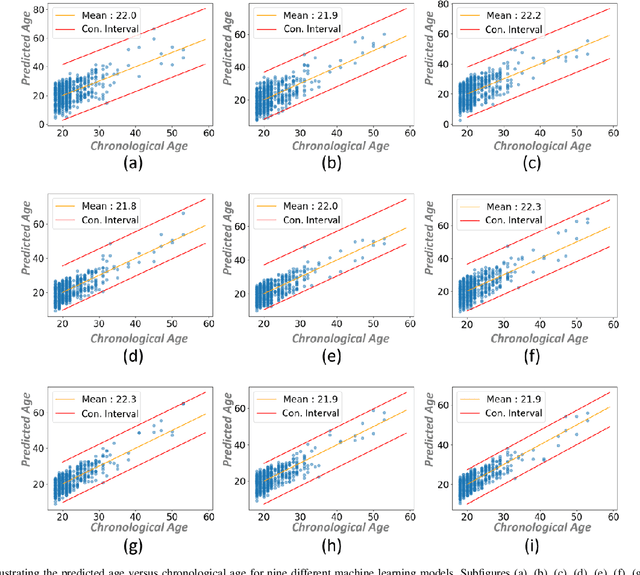
Despite advances in deep learning for estimating brain age from structural MRI data, incorporating functional MRI data is challenging due to its complex structure and the noisy nature of functional connectivity measurements. To address this, we present the Multitask Adversarial Variational Autoencoder, a custom deep learning framework designed to improve brain age predictions through multimodal MRI data integration. This model separates latent variables into generic and unique codes, isolating shared and modality-specific features. By integrating multitask learning with sex classification as an additional task, the model captures sex-specific aging patterns. Evaluated on the OpenBHB dataset, a large multisite brain MRI collection, the model achieves a mean absolute error of 2.77 years, outperforming traditional methods. This success positions M-AVAE as a powerful tool for metaverse-based healthcare applications in brain age estimation.