 Add to Chrome
 Add to Firefox
 Add to Edge
HLE-Verified: A Systematic Verification and Structured Revision of Humanity's Last Exam
Feb 17, 2026
Humanity's Last Exam (HLE) has become a widely used benchmark for evaluating frontier large language models on challenging, multi-domain questions. However, community-led analyses have raised concerns that HLE contains a non-trivial number of noisy items, which can bias evaluation results and distort cross-model comparisons. To address this challenge, we introduce HLE-Verified, a verified and revised version of HLE with a transparent verification protocol and fine-grained error taxonomy. Our construction follows a two-stage validation-and-repair workflow resulting in a certified benchmark. In Stage I, each item undergoes binary validation of the problem and final answer through domain-expert review and model-based cross-checks, yielding 641 verified items. In Stage II, flawed but fixable items are revised under strict constraints preserving the original evaluation intent, through dual independent expert repairs, model-assisted auditing, and final adjudication, resulting in 1,170 revised-and-certified items. The remaining 689 items are released as a documented uncertain set with explicit uncertainty sources and expertise tags for future refinement. We evaluate seven state-of-the-art language models on HLE and HLE-Verified, observing an average absolute accuracy gain of 7--10 percentage points on HLE-Verified. The improvement is particularly pronounced on items where the original problem statement and/or reference answer is erroneous, with gains of 30--40 percentage points. Our analyses further reveal a strong association between model confidence and the presence of errors in the problem statement or reference answer, supporting the effectiveness of our revisions. Overall, HLE-Verified improves HLE-style evaluations by reducing annotation noise and enabling more faithful measurement of model capabilities. Data is available at: https://github.com/SKYLENAGE-AI/HLE-Verified

LawBench: Benchmarking Legal Knowledge of Large Language Models
Sep 28, 2023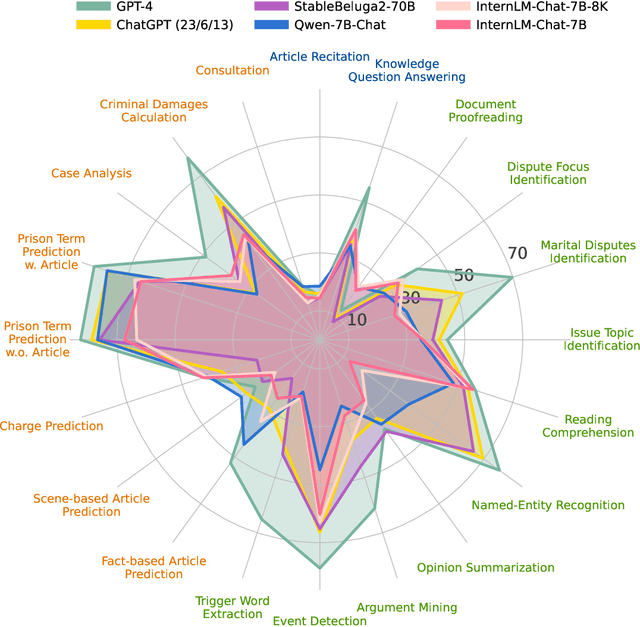
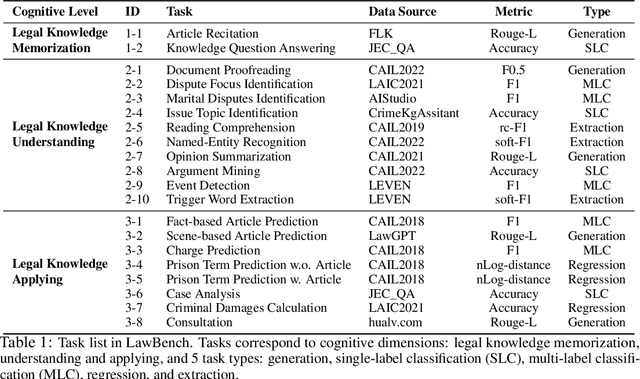
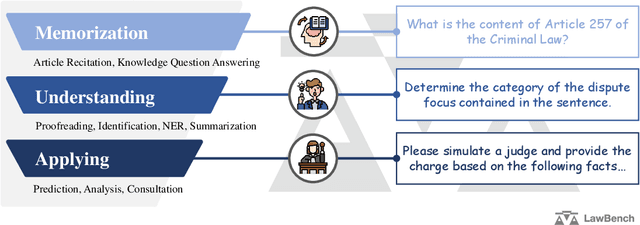
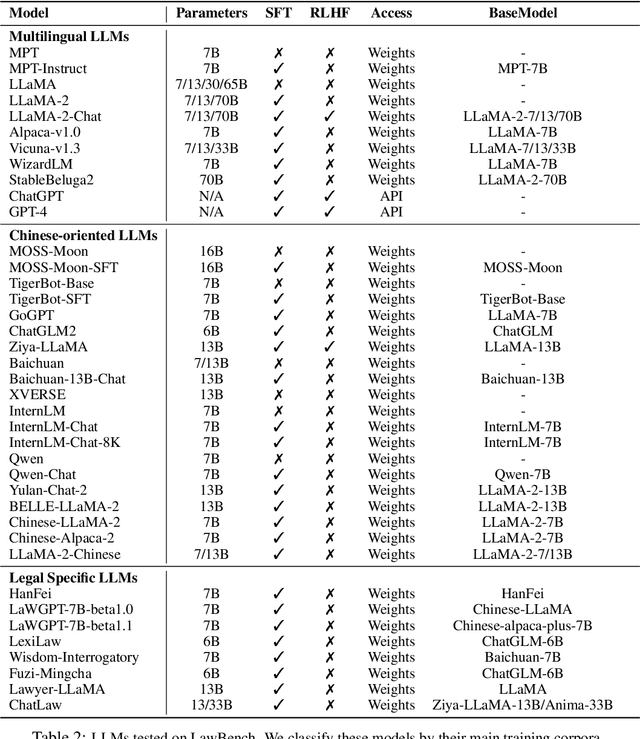
Large language models (LLMs) have demonstrated strong capabilities in various aspects. However, when applying them to the highly specialized, safe-critical legal domain, it is unclear how much legal knowledge they possess and whether they can reliably perform legal-related tasks. To address this gap, we propose a comprehensive evaluation benchmark LawBench. LawBench has been meticulously crafted to have precise assessment of the LLMs' legal capabilities from three cognitive levels: (1) Legal knowledge memorization: whether LLMs can memorize needed legal concepts, articles and facts; (2) Legal knowledge understanding: whether LLMs can comprehend entities, events and relationships within legal text; (3) Legal knowledge applying: whether LLMs can properly utilize their legal knowledge and make necessary reasoning steps to solve realistic legal tasks. LawBench contains 20 diverse tasks covering 5 task types: single-label classification (SLC), multi-label classification (MLC), regression, extraction and generation. We perform extensive evaluations of 51 LLMs on LawBench, including 20 multilingual LLMs, 22 Chinese-oriented LLMs and 9 legal specific LLMs. The results show that GPT-4 remains the best-performing LLM in the legal domain, surpassing the others by a significant margin. While fine-tuning LLMs on legal specific text brings certain improvements, we are still a long way from obtaining usable and reliable LLMs in legal tasks. All data, model predictions and evaluation code are released in https://github.com/open-compass/LawBench/. We hope this benchmark provides in-depth understanding of the LLMs' domain-specified capabilities and speed up the development of LLMs in the legal domain.