 Add to Chrome
 Add to Firefox
 Add to Edge
MEDN: Motion-Emotion Feature Decoupling Network for Micro-Expression Recognition
Apr 20, 2026
Unlike macro-expression, micro-expression does not follow a strictly consistent mapping rule between emotions and Action Units (AUs). As a result, some micro-expressions share identical AUs yet represent completely opposite emotional categories, making them highly visually similar. Existing microexpression recognition (MER) methods mostly rely on explicit facial motion cues (e.g., optical flow, frame differences, AU features) while ignoring implicit emotion information. To tackle this issue, this paper presents a Motion Emotion Feature Decoupling Network (MEDN) for MER. We design a dual-branch framework to separately extract motion and emotion features. In the motion branch, an AU-detection task restricts features to the explicit motion domain, and orthogonal loss is adopted to reduce motion emotion feature coupling. For implicit emotion modeling, we propose a Sparse Emotion Vision Transformer (SEVit) that sparsifies spatial tokens to highlight local temporal variations with multi-scale sparsity rates. A Collaborative Fusion Module (CoFM) is further developed to fuse disentangled motion and emotion features adaptively. Extensive experiments on three benchmark datasets validate that MEDN effectively decouples motion and emotion features and achieves superior recognition performance, offering a new perspective for enhancing recognition accuracy and generalization.

COMET: "Cone of experience" enhanced large multimodal model for mathematical problem generation
Jul 16, 2024The automatic generation of high-quality mathematical problems is practically valuable in many educational scenarios. Large multimodal model provides a novel technical approach for the mathematical problem generation because of its wide success in cross-modal data scenarios. However, the traditional method of separating problem solving from problem generation and the mainstream fine-tuning framework of monotonous data structure with homogeneous training objectives limit the application of large multimodal model in mathematical problem generation. Addressing these challenges, this paper proposes COMET, a "Cone of Experience" enhanced large multimodal model for mathematical problem generation. Firstly, from the perspective of mutual ability promotion and application logic, we unify stem generation and problem solving into mathematical problem generation. Secondly, a three-stage fine-turning framework guided by the "Cone of Experience" is proposed. The framework divides the fine-tuning data into symbolic experience, iconic experience, and direct experience to draw parallels with experiences in the career growth of teachers. Several fine-grained data construction and injection methods are designed in this framework. Finally, we construct a Chinese multimodal mathematical problem dataset to fill the vacancy of Chinese multimodal data in this field. Combined with objective and subjective indicators, experiments on multiple datasets fully verify the effectiveness of the proposed framework and model.
Automated discovery of symbolic laws governing skill acquisition from naturally occurring data
Apr 08, 2024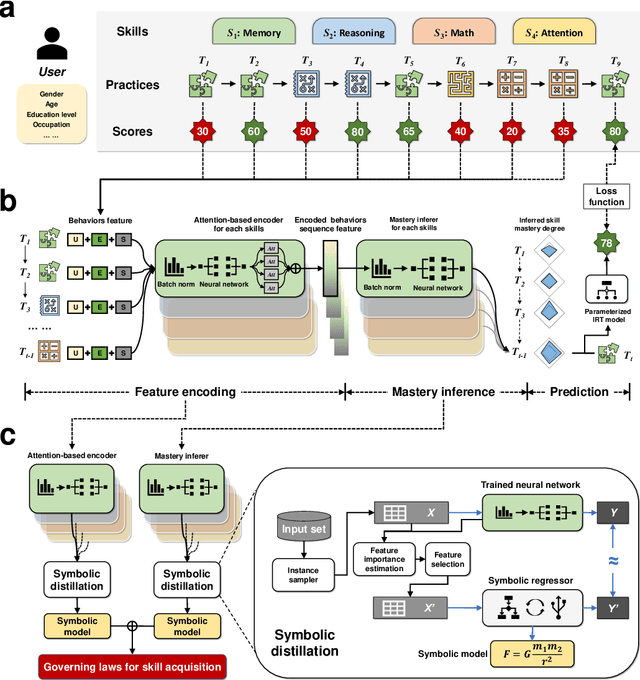
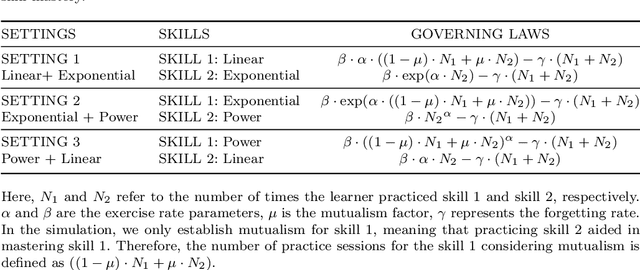
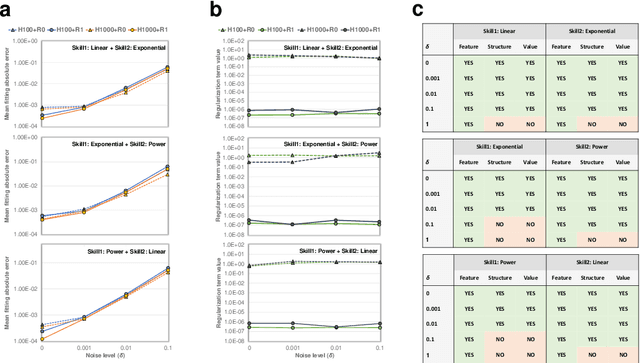
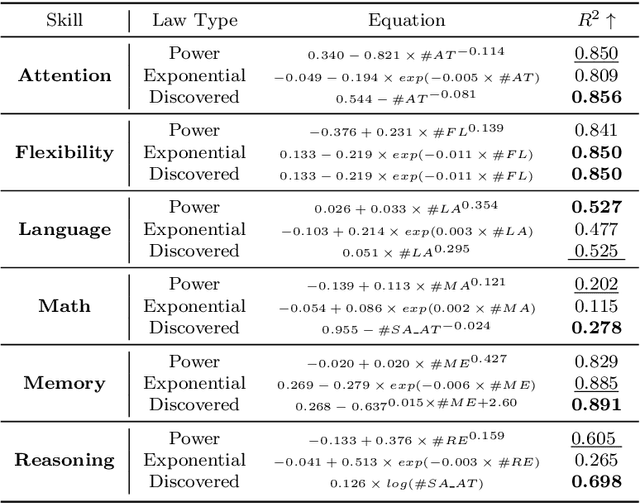
Skill acquisition is a key area of research in cognitive psychology as it encompasses multiple psychological processes. The laws discovered under experimental paradigms are controversial and lack generalizability. This paper aims to unearth the laws of skill learning from large-scale training log data. A two-stage algorithm was developed to tackle the issues of unobservable cognitive states and algorithmic explosion in searching. Initially a deep learning model is employed to determine the learner's cognitive state and assess the feature importance. Subsequently, symbolic regression algorithms are utilized to parse the neural network model into algebraic equations. The experimental results of simulated data demonstrate that the proposed algorithm can accurately restore various preset laws within a certain range of noise, in continues feedback setting. Application of proposed method to Lumosity training data demonstrates superior performance compared to traditional and latest models in terms of fitness. The results indicate the discovery of two new forms of skill acquisition laws, while some previous findings have been reaffirmed.