 Add to Chrome
 Add to Firefox
 Add to Edge
MIS-HCC: Hierarchical Channel Clustering for Efficient Medical Image Segmentation
Jul 19, 2026
Medical image segmentation models require both high accuracy and lightweight design to accommodate real-world medical applications. The deployment of these models on resource-limited medical platforms remains a significant challenge due to their high computational and parameter requirements. Existing pruning methods for model compression mostly overlook the intrinsic connections and similarity between the internal structures of complex deep neural networks. As a result, compressed models may not effectively retain the basic features of the pretrained network. To solve this problem, we propose a hierarchical clustering compression method for medical image segmentation models (MIS-HCC). This approach employs hierarchical clustering to partition channels and fuse their parameters efficiently. Specifically, it leverages the Wasserstein distance to represent similarity of channels within layers of pre-trained network, forming a similarity matrix that guides the clustering process. Channels within each cluster are then fused to produce a compressed network. Experimental results on three medical image datasets application demonstrate that MIS-HCC outperforms the state-of-the-art methods in both accuracy and compression efficiency, offering an effective solution for deploying medical image segmentation models on resource-limited medical platforms.

A Vector-based Representation to Enhance Head Pose Estimation
Oct 14, 2020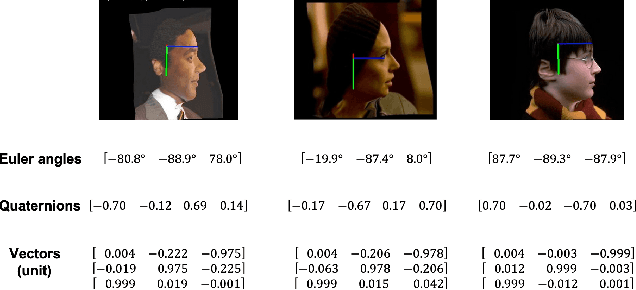
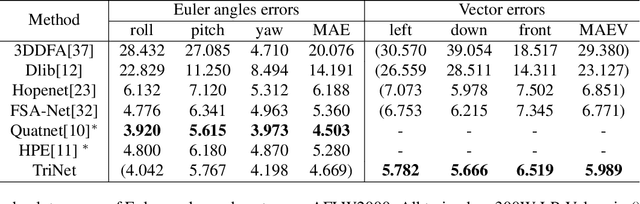
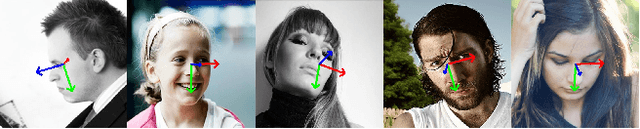
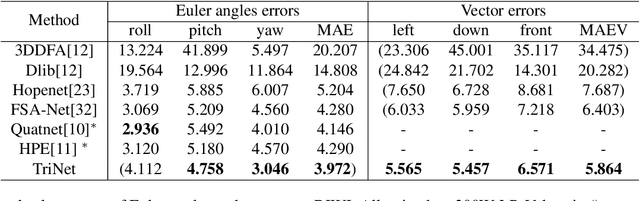
This paper proposes to use the three vectors in a rotation matrix as the representation in head pose estimation and develops a new neural network based on the characteristic of such representation. We address two potential issues existed in current head pose estimation works: 1. Public datasets for head pose estimation use either Euler angles or quaternions to annotate data samples. However, both of these annotations have the issue of discontinuity and thus could result in some performance issues in neural network training. 2. Most research works report Mean Absolute Error (MAE) of Euler angles as the measurement of performance. We show that MAE may not reflect the actual behavior especially for the cases of profile views. To solve these two problems, we propose a new annotation method which uses three vectors to describe head poses and a new measurement Mean Absolute Error of Vectors (MAEV) to assess the performance. We also train a new neural network to predict the three vectors with the constraints of orthogonality. Our proposed method achieves state-of-the-art results on both AFLW2000 and BIWI datasets. Experiments show our vector-based annotation method can effectively reduce prediction errors for large pose angles.