 Add to Chrome
 Add to Firefox
 Add to Edge
Spike-based Belief Propagation in Nonlinear Dynamical Systems
Aug 20, 2026
This paper presents a Bayesian control framework that integrates spike-based dynamics with probabilistic inference for adaptive control. Bayesian inference is widely regarded as a core computational principle of brain function, providing a normative framework for perception, decision-making, and learning under uncertainty. By combining a biologically inspired spiking neural model with Bayesian inference principles, we propose a brain-like control algorithm capable of operating in uncertain environments. We use the mountain car parking problem as a benchmark with non-linear dynamics. Our results demonstrate that the proposed controller can successfully update states in real time and generate goal-directed action plans through spike-driven dynamics. The results highlight the proposed model's potential as a bridge between computational neuroscience and probabilistic control theory.

Sophisticated Policies from Epistemic Priors
Jul 21, 2026Sophisticated Inference is a variant of active inference often associated with recursive belief modeling and tree search. We argue that its central computational role is simpler: within a planning horizon, it makes active inference closed-loop by allowing future actions to depend on future states and observations. This closed-loop structure can be represented in the epistemic-prior variational free energy framework. Epistemic priors supply the active-inference objective, while a joint posterior over future states and actions supplies the state-contingent control structure. We evaluate this decomposition in the Reactivity Maze, a stochastic benchmark designed to separate epistemic incentive from inner-horizon closed-loop control. The comparison includes three variational objectives with the same state-action posterior family, an action-state factorized active inference objective, Sophisticated Inference, and standard Expected Free Energy planning. The results show that neither ingredient is sufficient on its own. Methods without an epistemic component do not seek information, while methods that prevent future actions from depending on future states cannot turn information into reliable goal-reaching. By contrast, both Sophisticated Inference and full-joint epistemic-prior active inference solve the environment by combining epistemic drive with closed-loop inference. These results show that the advantage associated with Sophisticated Inference need not be specific to tree search itself. It arises from the closed-loop form of active inference, and this form can be represented in epistemic-prior variational inference when the posterior keeps future actions dependent on future states.
What Type of Inference is Active Inference?
Jun 03, 2026Active inference casts decision-making as inference, with the Expected Free Energy (EFE) unifying goal-directed and information-seeking behavior. Recent work showed that EFE minimization can be written as Variational Free Energy (VFE) minimization on a generative model augmented with epistemic priors. We prove that the VFE of the augmented model can be rewritten as the VFE of the predictive model plus explicit entropy-correction terms, making the EFE contribution transparent. We then show that proper EFE-based planning requires combining these epistemic corrections with a planning correction that turns marginal inference into policy optimization, yielding a full variational characterization of EFE-based planning. This clarifies which corrections are needed for cross-entropy planning and for full EFE-based planning. The same entropy-corrected formulation leads to a detailed message-passing scheme for EFE-based planning together with simpler ablations. Experiments on three grid-world environments show that the planning correction already helps when observations are decisive, whereas the additional observation-side epistemic corrections matter most when observations are merely suggestive.
Composing Non-Conjugate Factor Graphs with Closed-Form Variational Inference
May 28, 2026Stacking probabilistic building blocks into deeper architectures typically breaks closed-form inference. We show that closed-form inference can be preserved. We identify five factor-graph primitives: a bilinear factor, an exponential link, a Gamma prior, a Gaussian likelihood, and an equality node, and prove that any model composed from them admits closed-form variational message passing. The construction works because each primitive preserves a small set of message families: under mean-field factorization, messages on Gaussian variables remain Gaussian and messages on precision variables remain Gamma, while the only non-conjugate interface, the exponential link, remains tractable through the Gaussian moment-generating function and the sufficient statistics of the Gamma family. We demonstrate composition at increasing depth, from static ensembles through input-dependent gating to split-branch routing, and show that stacking routing layers encodes arbitrary decision trees, establishing universal function approximation with closed-form inference. Applied to ensemble time-series forecasting, the framework yields a Bayesian mixture of experts in which gating functions are inferred rather than learned, providing calibrated uncertainty over expert selection across five benchmark datasets.
Active Inference for Physical AI Agents -- An Engineering Perspective
Mar 21, 2026Physical AI agents, such as robots and other embodied systems operating under tight and fluctuating resource constraints, remain far less capable than biological agents in open-ended real-world environments. This paper argues that Active Inference (AIF), grounded in the Free Energy Principle, offers a principled foundation for closing that gap. We develop this argument from first principles, following a chain from probability theory through Bayesian machine learning and variational inference to active inference and reactive message passing. From the FEP perspective, systems that maintain their structural and functional integrity over time can, under suitable assumptions, be described as minimizing variational free energy (VFE), and AIF operationalizes this by unifying perception, learning, planning, and control within a single computational objective. We show that VFE minimization is naturally realized by reactive message passing on factor graphs, where inference emerges from local, parallel computations. This realization is well matched to the constraints of physical operation, including hard deadlines, asynchronous data, fluctuating power budgets, and changing environments. Because reactive message passing is event-driven, interruptible, and locally adaptable, performance degrades gracefully under reduced resources while model structure can adjust online. We further show that, under suitable coupling and coarse-graining conditions, coupled AIF agents can be described as higher-level AIF agents, yielding a homogeneous architecture based on the same message-passing primitive across scales. Our contribution is not empirical benchmarking, but a clear theoretical and architectural case for the engineering community.
Spike-Timing-Dependent Plasticity for Bernoulli Message Passing
Dec 19, 2025Bayesian inference provides a principled framework for understanding brain function, while neural activity in the brain is inherently spike-based. This paper bridges these two perspectives by designing spiking neural networks that simulate Bayesian inference through message passing for Bernoulli messages. To train the networks, we employ spike-timing-dependent plasticity, a biologically plausible mechanism for synaptic plasticity which is based on the Hebbian rule. Our results demonstrate that the network's performance closely matches the true numerical solution. We further demonstrate the versatility of our approach by implementing a factor graph example from coding theory, illustrating signal transmission over an unreliable channel.
A Spiking Neural Network Implementation of Gaussian Belief Propagation
Dec 11, 2025Bayesian inference offers a principled account of information processing in natural agents. However, it remains an open question how neural mechanisms perform their abstract operations. We investigate a hypothesis where a distributed form of Bayesian inference, namely message passing on factor graphs, is performed by a simulated network of leaky-integrate-and-fire neurons. Specifically, we perform Gaussian belief propagation by encoding messages that come into factor nodes as spike-based signals, propagating these signals through a spiking neural network (SNN) and decoding the spike-based signal back to an outgoing message. Three core linear operations, equality (branching), addition, and multiplication, are realized in networks of leaky integrate-and-fire models. Validation against the standard sum-product algorithm shows accurate message updates, while applications to Kalman filtering and Bayesian linear regression demonstrate the framework's potential for both static and dynamic inference tasks. Our results provide a step toward biologically grounded, neuromorphic implementations of probabilistic reasoning.
Expected Free Energy-based Planning as Variational Inference
Apr 21, 2025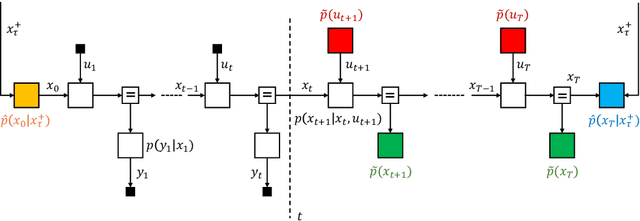

We address the problem of planning under uncertainty, where an agent must choose actions that not only achieve desired outcomes but also reduce uncertainty. Traditional methods often treat exploration and exploitation as separate objectives, lacking a unified inferential foundation. Active inference, grounded in the Free Energy Principle, offers such a foundation by minimizing Expected Free Energy (EFE), a cost function that combines utility with epistemic drives like ambiguity resolution and novelty seeking. However, the computational burden of EFE minimization has remained a major obstacle to its scalability. In this paper, we show that EFE-based planning arises naturally from minimizing a variational free energy functional on a generative model augmented with preference and epistemic priors. This result reinforces theoretical consistency with the Free Energy Principle, by casting planning itself as variational inference. Our formulation yields optimal policies that jointly support goal achievement and information gain, while incorporating a complexity term that accounts for bounded computational resources. This unifying framework connects and extends existing methods, enabling scalable, resource-aware implementations of active inference agents.
Improved Depth Estimation of Bayesian Neural Networks
Oct 15, 2024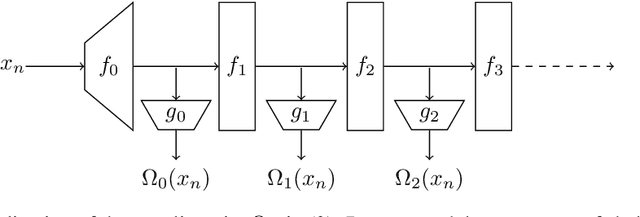

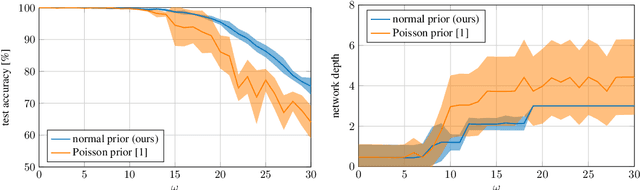
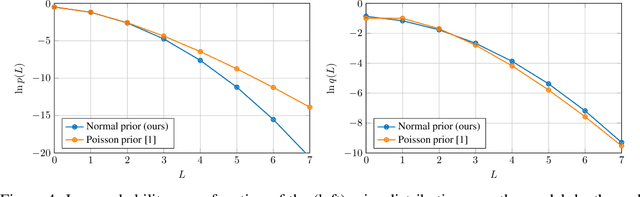
This paper proposes improvements over earlier work by Nazareth and Blei (2022) for estimating the depth of Bayesian neural networks. Here, we propose a discrete truncated normal distribution over the network depth to independently learn its mean and variance. Posterior distributions are inferred by minimizing the variational free energy, which balances the model complexity and accuracy. Our method improves test accuracy on the spiral data set and reduces the variance in posterior depth estimates.
Toward Design of Synthetic Active Inference Agents by Mere Mortals
Jul 26, 2023The theoretical properties of active inference agents are impressive, but how do we realize effective agents in working hardware and software on edge devices? This is an interesting problem because the computational load for policy exploration explodes exponentially, while the computational resources are very limited for edge devices. In this paper, we discuss the necessary features for a software toolbox that supports a competent non-expert engineer to develop working active inference agents. We introduce a toolbox-in-progress that aims to accelerate the democratization of active inference agents in a similar way as TensorFlow propelled applications of deep learning technology.