 Add to Chrome
 Add to Firefox
 Add to Edge
Continual LLM Upcycling: A Predictor-Gated Bank-Wise Sparsity Training Recipe for Dense-to-Sparse LLMs
Jun 09, 2026
We study dense-to-sparse continual training as a way to construct channel-sparse large language models from dense checkpoints. Starting from a Qwen2.5-8B dense backbone, we continue training at 32K context and introduce a predictor-gated sparse SwiGLU FFN in the 32K stage. For each token and layer, we use a low-rank predictor to produce FFN-channel routing logits. We then apply a bank-wise top-k rule to retain 16 channels in every 64-channel bank, yielding 4x sparsity in the FFN intermediate activation. Unlike post-hoc sparse inference methods, the routing module is placed on the main language modeling path and optimized during continual training, enabling the dense model to be upcycled into a hardware-oriented sparse model. We report the architecture, training recipe, benchmark performance, and training lessons. We also identify a layer-local long-context failure mode on RULER-CWE and propose a single-layer repair algorithm that substantially improves the affected length range.

Accelerating Scientific Research with Gemini: Case Studies and Common Techniques
Feb 03, 2026Recent advances in large language models (LLMs) have opened new avenues for accelerating scientific research. While models are increasingly capable of assisting with routine tasks, their ability to contribute to novel, expert-level mathematical discovery is less understood. We present a collection of case studies demonstrating how researchers have successfully collaborated with advanced AI models, specifically Google's Gemini-based models (in particular Gemini Deep Think and its advanced variants), to solve open problems, refute conjectures, and generate new proofs across diverse areas in theoretical computer science, as well as other areas such as economics, optimization, and physics. Based on these experiences, we extract common techniques for effective human-AI collaboration in theoretical research, such as iterative refinement, problem decomposition, and cross-disciplinary knowledge transfer. While the majority of our results stem from this interactive, conversational methodology, we also highlight specific instances that push beyond standard chat interfaces. These include deploying the model as a rigorous adversarial reviewer to detect subtle flaws in existing proofs, and embedding it within a "neuro-symbolic" loop that autonomously writes and executes code to verify complex derivations. Together, these examples highlight the potential of AI not just as a tool for automation, but as a versatile, genuine partner in the creative process of scientific discovery.
From Exploration to Exploitation: A Two-Stage Entropy RLVR Approach for Noise-Tolerant MLLM Training
Nov 11, 2025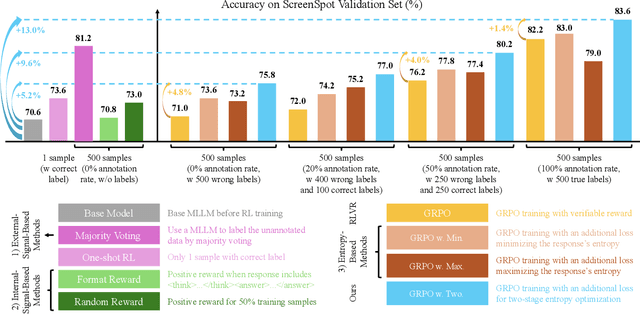

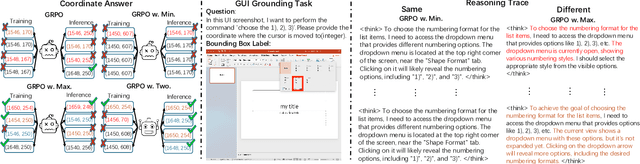

Reinforcement Learning with Verifiable Rewards (RLVR) for Multimodal Large Language Models (MLLMs) is highly dependent on high-quality labeled data, which is often scarce and prone to substantial annotation noise in real-world scenarios. Existing unsupervised RLVR methods, including pure entropy minimization, can overfit to incorrect labels and limit the crucial reward ranking signal for Group-Relative Policy Optimization (GRPO). To address these challenges and enhance noise tolerance, we propose a novel two-stage, token-level entropy optimization method for RLVR. This approach dynamically guides the model from exploration to exploitation during training. In the initial exploration phase, token-level entropy maximization promotes diverse and stochastic output generation, serving as a strong regularizer that prevents premature convergence to noisy labels and ensures sufficient intra-group variation, which enables more reliable reward gradient estimation in GRPO. As training progresses, the method transitions into the exploitation phase, where token-level entropy minimization encourages the model to produce confident and deterministic outputs, thereby consolidating acquired knowledge and refining prediction accuracy. Empirically, across three MLLM backbones - Qwen2-VL-2B, Qwen2-VL-7B, and Qwen2.5-VL-3B - spanning diverse noise settings and multiple tasks, our phased strategy consistently outperforms prior approaches by unifying and enhancing external, internal, and entropy-based methods, delivering robust and superior performance across the board.
LLM-Barber: Block-Aware Rebuilder for Sparsity Mask in One-Shot for Large Language Models
Aug 20, 2024Large language models (LLMs) have grown significantly in scale, leading to a critical need for efficient model pruning techniques. Existing post-training pruning techniques primarily focus on measuring weight importance on converged dense models to determine salient weights to retain. However, they often overlook the changes in weight importance during the pruning process, which can lead to performance degradation in the pruned models. To address this issue, we present LLM-Barber (Block-Aware Rebuilder for Sparsity Mask in One-Shot), a novel one-shot pruning framework that rebuilds the sparsity mask of pruned models without any retraining or weight reconstruction. LLM-Barber incorporates block-aware error optimization across Self-Attention and MLP blocks, ensuring global performance optimization. Inspired by the recent discovery of prominent outliers in LLMs, LLM-Barber introduces an innovative pruning metric that identifies weight importance using weights multiplied by gradients. Our experiments show that LLM-Barber can efficiently prune models like LLaMA and OPT families with 7B to 13B parameters on a single A100 GPU in just 30 minutes, achieving state-of-the-art results in both perplexity and zero-shot performance across various language benchmarks. Code is available at https://github.com/YupengSu/LLM-Barber.
APTQ: Attention-aware Post-Training Mixed-Precision Quantization for Large Language Models
Feb 21, 2024Large Language Models (LLMs) have greatly advanced the natural language processing paradigm. However, the high computational load and huge model sizes pose a grand challenge for deployment on edge devices. To this end, we propose APTQ (Attention-aware Post-Training Mixed-Precision Quantization) for LLMs, which considers not only the second-order information of each layer's weights, but also, for the first time, the nonlinear effect of attention outputs on the entire model. We leverage the Hessian trace as a sensitivity metric for mixed-precision quantization, ensuring an informed precision reduction that retains model performance. Experiments show APTQ surpasses previous quantization methods, achieving an average of 4 bit width a 5.22 perplexity nearly equivalent to full precision in the C4 dataset. In addition, APTQ attains state-of-the-art zero-shot accuracy of 68.24\% and 70.48\% at an average bitwidth of 3.8 in LLaMa-7B and LLaMa-13B, respectively, demonstrating its effectiveness to produce high-quality quantized LLMs.