 Add to Chrome
 Add to Firefox
 Add to Edge
Adaptive Supervised Anchoring for On-Policy Self-Distillation
Aug 11, 2026
On-policy self-distillation (OPSD) adapts a language model by distilling guidance from a frozen teacher on trajectories sampled from the student. Its effectiveness, however, depends critically on the quality of those trajectories. We show that when student rollouts drift from target trajectories, conditioning the teacher on off-target prefixes substantially weakens its task-relevant supervision. Controlled prefix-corruption experiments expose this failure mode, which we term rollout-conditioned signal degradation. To address this problem, we propose a unified training framework that separates two complementary supervision pathways. The first retains rollout-conditioned distribution matching, providing guidance on states the student actually visits. The second applies supervised cross-entropy on canonical ground-truth contexts, avoiding the incompatibility of imposing target tokens on erroneous rollout prefixes. Token-level rollout-target alignment is used to adapt the strength of the canonical-context anchor, emphasizing it during cold start and relaxing it as rollout quality improves. Experiments across multiple model scales, two task families, and general-reasoning benchmarks show that the proposed approach improves task acquisition over OPSD while preserving general capabilities, resulting in a more favorable empirical plasticity-stability trade-off. These findings identify context quality as a central bottleneck in on-policy self-distillation and demonstrate the value of separating rollout-conditioned guidance from canonical supervision.

Exploring Structured Semantic Prior for Multi Label Recognition with Incomplete Labels
Mar 24, 2023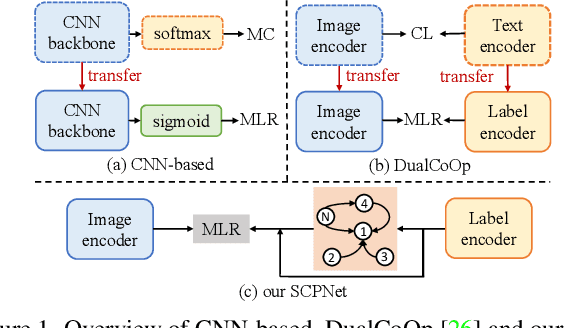

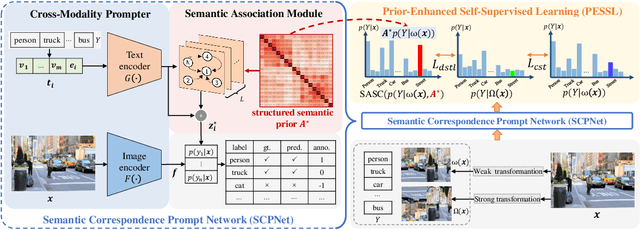

Multi-label recognition (MLR) with incomplete labels is very challenging. Recent works strive to explore the image-to-label correspondence in the vision-language model, \ie, CLIP, to compensate for insufficient annotations. In spite of promising performance, they generally overlook the valuable prior about the label-to-label correspondence. In this paper, we advocate remedying the deficiency of label supervision for the MLR with incomplete labels by deriving a structured semantic prior about the label-to-label correspondence via a semantic prior prompter. We then present a novel Semantic Correspondence Prompt Network (SCPNet), which can thoroughly explore the structured semantic prior. A Prior-Enhanced Self-Supervised Learning method is further introduced to enhance the use of the prior. Comprehensive experiments and analyses on several widely used benchmark datasets show that our method significantly outperforms existing methods on all datasets, well demonstrating the effectiveness and the superiority of our method. Our code will be available at https://github.com/jameslahm/SCPNet.
* Accepted by IEEE/CVF Conference on Computer Vision and Pattern Recognition (CVPR) 2023