 Add to Chrome
 Add to Firefox
 Add to Edge
EdgeLPR: On the Deep Neural Network trade-off between Precision and Performance in LiDAR Place Recognition
May 04, 2026
Place recognition is essential for long-term autonomous navigation, enabling loop closure and consistent mapping. Although deep learning has improved performance, deploying such models on resource-constrained platforms remains challenging. This work explores efficient LiDAR-based place recognition for EdgeAI by leveraging Bird's Eye View representations to enable lightweight image-based networks. We benchmark representative architectures without aggregation heads using a unified descriptor scheme based on global pooling and linear projection, and evaluate performance under FP32, FP16, and INT8 quantization. Experiments reveal trade-offs between accuracy, robustness, and efficiency: FP16 matches FP32 with lower cost, while INT8 introduces architecture-dependent degradation. Overall, the presented results are a strong basis for future research on 'use-case'-aware quantisation of Neural Networks for Edge deployment.

ClassLIE: Structure- and Illumination-Adaptive Classification for Low-Light Image Enhancement
Dec 20, 2023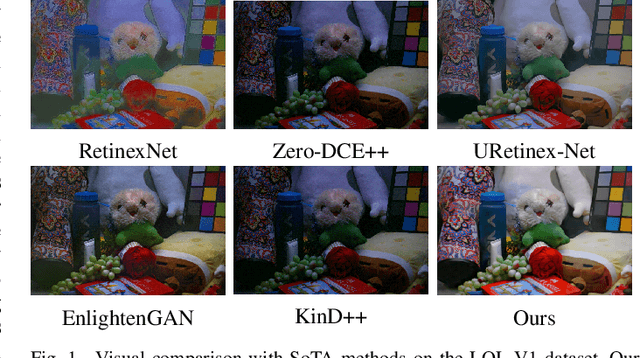

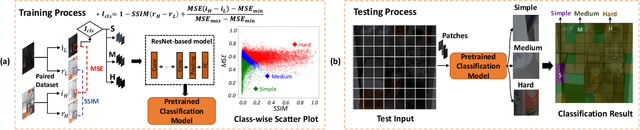

Low-light images often suffer from limited visibility and multiple types of degradation, rendering low-light image enhancement (LIE) a non-trivial task. Some endeavors have been recently made to enhance low-light images using convolutional neural networks (CNNs). However, they have low efficiency in learning the structural information and diverse illumination levels at the local regions of an image. Consequently, the enhanced results are affected by unexpected artifacts, such as unbalanced exposure, blur, and color bias. To this end, this paper proposes a novel framework, called ClassLIE, that combines the potential of CNNs and transformers. It classifies and adaptively learns the structural and illumination information from the low-light images in a holistic and regional manner, thus showing better enhancement performance. Our framework first employs a structure and illumination classification (SIC) module to learn the degradation information adaptively. In SIC, we decompose an input image into an illumination map and a reflectance map. A class prediction block is then designed to classify the degradation information by calculating the structure similarity scores on the reflectance map and mean square error on the illumination map. As such, each input image can be divided into patches with three enhancement difficulty levels. Then, a feature learning and fusion (FLF) module is proposed to adaptively learn the feature information with CNNs for different enhancement difficulty levels while learning the long-range dependencies for the patches in a holistic manner. Experiments on five benchmark datasets consistently show our ClassLIE achieves new state-of-the-art performance, with 25.74 PSNR and 0.92 SSIM on the LOL dataset.