 Add to Chrome
 Add to Firefox
 Add to Edge
Beyond Preset Identities: How Agents Form Stances and Boundaries in Generative Societies
Mar 24, 2026
While large language models simulate social behaviors, their capacity for stable stance formation and identity negotiation during complex interventions remains unclear. To overcome the limitations of static evaluations, this paper proposes a novel mixed-methods framework combining computational virtual ethnography with quantitative socio-cognitive profiling. By embedding human researchers into generative multiagent communities, controlled discursive interventions are conducted to trace the evolution of collective cognition. To rigorously measure how agents internalize and react to these specific interventions, this paper formalizes three new metrics: Innate Value Bias (IVB), Persuasion Sensitivity, and Trust-Action Decoupling (TAD). Across multiple representative models, agents exhibit endogenous stances that override preset identities, consistently demonstrating an innate progressive bias (IVB > 0). When aligned with these stances, rational persuasion successfully shifts 90% of neutral agents while maintaining high trust. In contrast, conflicting emotional provocations induce a paradoxical 40.0% TAD rate in advanced models, which hypocritically alter stances despite reporting low trust. Smaller models contrastingly maintain a 0% TAD rate, strictly requiring trust for behavioral shifts. Furthermore, guided by shared stances, agents use language interactions to actively dismantle assigned power hierarchies and reconstruct self organized community boundaries. These findings expose the fragility of static prompt engineering, providing a methodological and quantitative foundation for dynamic alignment in human-agent hybrid societies. The official code is available at: https://github.com/armihia/CMASE-Endogenous-Stances

Evolving Collective Cognition in Human-Agent Hybrid Societies: How Agents Form Stances and Boundaries
Aug 24, 2025Large language models have been widely used to simulate credible human social behaviors. However, it remains unclear whether these models can demonstrate stable capacities for stance formation and identity negotiation in complex interactions, as well as how they respond to human interventions. We propose a computational multi-agent society experiment framework that integrates generative agent-based modeling with virtual ethnographic methods to investigate how group stance differentiation and social boundary formation emerge in human-agent hybrid societies. Across three studies, we find that agents exhibit endogenous stances, independent of their preset identities, and display distinct tonal preferences and response patterns to different discourse strategies. Furthermore, through language interaction, agents actively dismantle existing identity-based power structures and reconstruct self-organized community boundaries based on these stances. Our findings suggest that preset identities do not rigidly determine the agents' social structures. For human researchers to effectively intervene in collective cognition, attention must be paid to the endogenous mechanisms and interactional dynamics within the agents' language networks. These insights provide a theoretical foundation for using generative AI in modeling group social dynamics and studying human-agent collaboration.
ITCMA: A Generative Agent Based on a Computational Consciousness Structure
Mar 29, 2024
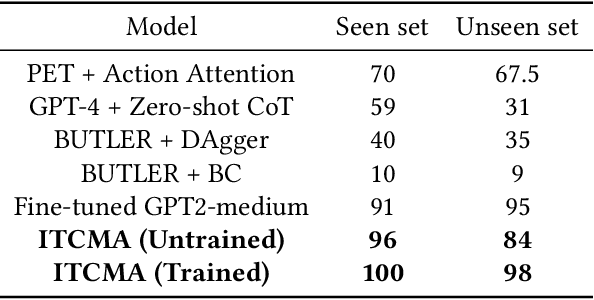
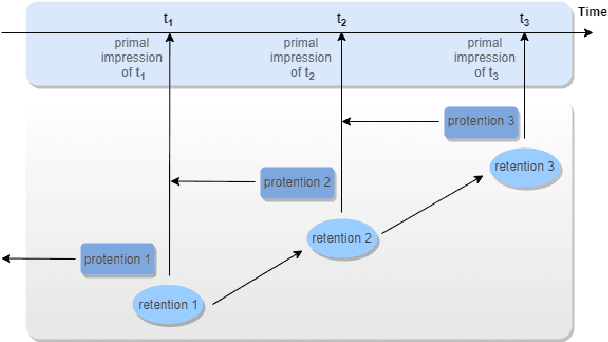

Large Language Models (LLMs) still face challenges in tasks requiring understanding implicit instructions and applying common-sense knowledge. In such scenarios, LLMs may require multiple attempts to achieve human-level performance, potentially leading to inaccurate responses or inferences in practical environments, affecting their long-term consistency and behavior. This paper introduces the Internal Time-Consciousness Machine (ITCM), a computational consciousness structure. We further propose the ITCM-based Agent (ITCMA), which supports behavior generation and reasoning in open-world settings. ITCMA enhances LLMs' ability to understand implicit instructions and apply common-sense knowledge by considering agents' interaction and reasoning with the environment. Evaluations in the Alfworld environment show that trained ITCMA outperforms the state-of-the-art (SOTA) by 9% on the seen set. Even untrained ITCMA achieves a 96% task completion rate on the seen set, 5% higher than SOTA, indicating its superiority over traditional intelligent agents in utility and generalization. In real-world tasks with quadruped robots, the untrained ITCMA achieves an 85% task completion rate, which is close to its performance in the unseen set, demonstrating its comparable utility in real-world settings.