 Add to Chrome
 Add to Firefox
 Add to Edge
SWE-NFI: Studying and Benchmarking Coding Agents for Non-Functional Improvements
Jul 29, 2026
Although coding agents have achieved impressive performance on correctness-oriented benchmarks, their ability to make behavior-preserving non-functional improvements (NFIs) remains underexplored. In real-world software development, developers continuously improve software quality without changing observable behavior, yet existing benchmarks primarily evaluate functional correctness and provide limited support for assessing these non-functional improvements. In this paper, we present SWE-NFI, a benchmark for evaluating coding agents on NFIs beyond functional correctness. Our benchmark contains 188 tasks constructed from real merged pull requests in open-source Python projects. We operationalize developer-oriented NFIs into 92 executable rules and develop a comprehensive evaluation suite that combines functional correctness testing with rule-based NFI evaluation. We evaluate state-of-the-art commercial and open-source coding agents. Although the best-performing agent achieves a 70.0\% functional correctness rate, all evaluated agents generally fall short of human developers in overall NFI capability. The gap is particularly evident for structural code improvements, where agents' NFI scores range from 0.0 to 1.3, compared with 1.5 for the human reference. Our benchmark and findings provide a reproducible foundation for evaluating and advancing coding agents beyond functional correctness.

Towards Secure Logging: Characterizing and Benchmarking Logging Code Security Issues with LLMs
Apr 22, 2026Logging code plays an important role in software systems by recording key events and behaviors, which are essential for debugging and monitoring. However, insecure logging practices can inadvertently expose sensitive information or enable attacks such as log injection, posing serious threats to system security and privacy. Prior research has examined general defects in logging code, but systematic analysis of logging code security issues remains limited, particularly in leveraging LLMs for detection and repair. In this paper, we derive a comprehensive taxonomy of logging code security issues, encompassing four common issue categories and 10 corresponding patterns. We further construct a benchmark dataset with 101 real-world logging security issue reports that have been manually reviewed and annotated. We then propose an automated framework that incorporates various contextual knowledge to evaluate LLMs' capabilities in detecting and repairing logging security issues. Our experimental results reveal a notable disparity in performance: while LLMs are moderately effective at detecting security issues (e.g., the accuracy ranges from 12.9% to 52.5% on average), they face noticeable challenges in reliably generating correct code repairs. We also find that the issue description alone improves the LLMs' detection accuracy more than the security pattern explanation or a combination of both. Overall, our findings provide actionable insights for practitioners and highlight the potential and limitations of current LLMs for secure logging.
GreenStableYolo: Optimizing Inference Time and Image Quality of Text-to-Image Generation
Jul 20, 2024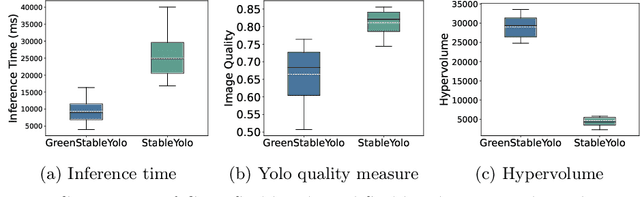
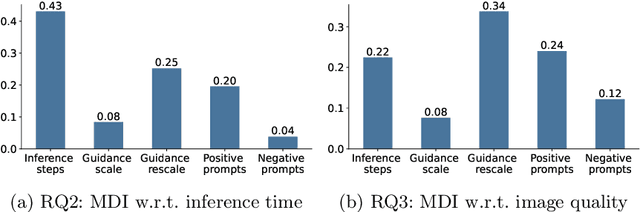
Tuning the parameters and prompts for improving AI-based text-to-image generation has remained a substantial yet unaddressed challenge. Hence we introduce GreenStableYolo, which improves the parameters and prompts for Stable Diffusion to both reduce GPU inference time and increase image generation quality using NSGA-II and Yolo. Our experiments show that despite a relatively slight trade-off (18%) in image quality compared to StableYolo (which only considers image quality), GreenStableYolo achieves a substantial reduction in inference time (266% less) and a 526% higher hypervolume, thereby advancing the state-of-the-art for text-to-image generation.