 Add to Chrome
 Add to Firefox
 Add to Edge
Objects as Audio-Visual Modal Sound Fields
Aug 06, 2026
While modern 3D reconstruction excels at modeling object geometry and appearance, it largely ignores the rich acoustic cues revealed through physical interaction. Object impact sounds convey material, stiffness, and structural properties that complement vision, yet existing impact sound modeling approaches either rely on expensive physics-based simulation or require large datasets to generalize in a purely data-driven manner. We introduce Audio-Visual Modal Sound Field (AV-MSF), a novel object-level acoustic representation reconstructed from multi-view images and only a few impact sound recordings. AV-MSF builds on 3D Gaussian Splatting integrated with dense 3D visual feature to provide a strong geometry-aware prior, and represents the impact sound field using compact, physically meaningful modal parameters, enabling robust few-shot reconstruction. Experiments on two real-world datasets show that AV-MSF achieves state-of-the-art impact sound rendering, outperforming both physics-based and data-driven baselines. Furthermore, we demonstrate downstream applications enabled by our representation, including contact localization and object sound editing.

FreeFix: Boosting 3D Gaussian Splatting via Fine-Tuning-Free Diffusion Models
Jan 28, 2026Neural Radiance Fields and 3D Gaussian Splatting have advanced novel view synthesis, yet still rely on dense inputs and often degrade at extrapolated views. Recent approaches leverage generative models, such as diffusion models, to provide additional supervision, but face a trade-off between generalization and fidelity: fine-tuning diffusion models for artifact removal improves fidelity but risks overfitting, while fine-tuning-free methods preserve generalization but often yield lower fidelity. We introduce FreeFix, a fine-tuning-free approach that pushes the boundary of this trade-off by enhancing extrapolated rendering with pretrained image diffusion models. We present an interleaved 2D-3D refinement strategy, showing that image diffusion models can be leveraged for consistent refinement without relying on costly video diffusion models. Furthermore, we take a closer look at the guidance signal for 2D refinement and propose a per-pixel confidence mask to identify uncertain regions for targeted improvement. Experiments across multiple datasets show that FreeFix improves multi-frame consistency and achieves performance comparable to or surpassing fine-tuning-based methods, while retaining strong generalization ability.
Reinforcement Learning Within the Classical Robotics Stack: A Case Study in Robot Soccer
Dec 12, 2024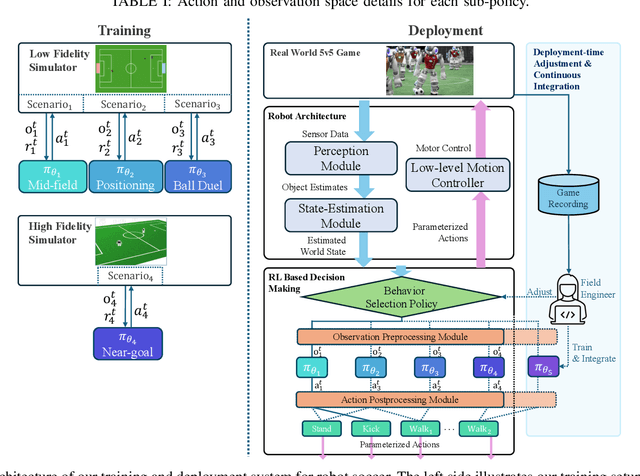
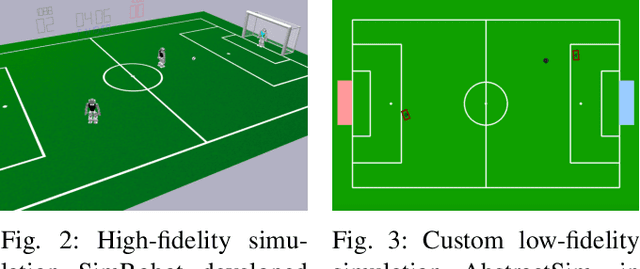

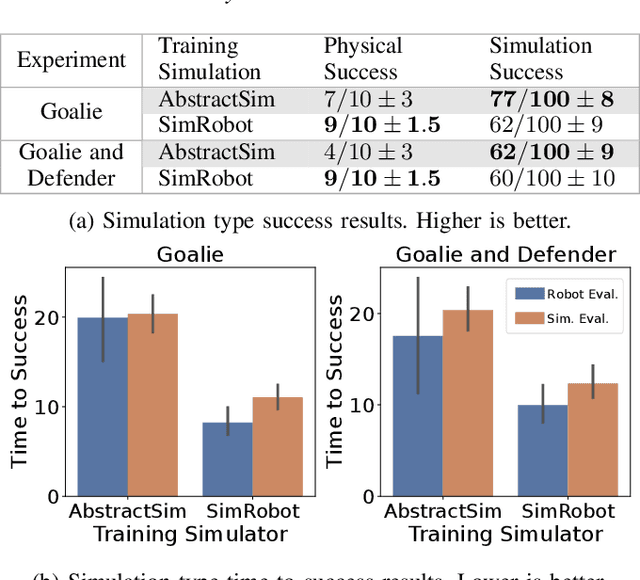
Robot decision-making in partially observable, real-time, dynamic, and multi-agent environments remains a difficult and unsolved challenge. Model-free reinforcement learning (RL) is a promising approach to learning decision-making in such domains, however, end-to-end RL in complex environments is often intractable. To address this challenge in the RoboCup Standard Platform League (SPL) domain, we developed a novel architecture integrating RL within a classical robotics stack, while employing a multi-fidelity sim2real approach and decomposing behavior into learned sub-behaviors with heuristic selection. Our architecture led to victory in the 2024 RoboCup SPL Challenge Shield Division. In this work, we fully describe our system's architecture and empirically analyze key design decisions that contributed to its success. Our approach demonstrates how RL-based behaviors can be integrated into complete robot behavior architectures.