 Add to Chrome
 Add to Firefox
 Add to Edge
Rethinking Secure Semantic Communications in the Age of Generative and Agentic AI: Threats and Opportunities
Jan 06, 2026
Semantic communication (SemCom) improves communication efficiency by transmitting task-relevant information instead of raw bits and is expected to be a key technology for 6G networks. Recent advances in generative AI (GenAI) further enhance SemCom by enabling robust semantic encoding and decoding under limited channel conditions. However, these efficiency gains also introduce new security and privacy vulnerabilities. Due to the broadcast nature of wireless channels, eavesdroppers can also use powerful GenAI-based semantic decoders to recover private information from intercepted signals. Moreover, rapid advances in agentic AI enable eavesdroppers to perform long-term and adaptive inference through the integration of memory, external knowledge, and reasoning capabilities. This allows eavesdroppers to further infer user private behavior and intent beyond the transmitted content. Motivated by these emerging challenges, this paper comprehensively rethinks the security and privacy of SemCom systems in the age of generative and agentic AI. We first present a systematic taxonomy of eavesdropping threat models in SemCom systems. Then, we provide insights into how GenAI and agentic AI can enhance eavesdropping threats. Meanwhile, we also highlight potential opportunities for leveraging GenAI and agentic AI to design privacy-preserving SemCom systems.

Dual-Representation Interaction Driven Image Quality Assessment with Restoration Assistance
Nov 26, 2024No-Reference Image Quality Assessment for distorted images has always been a challenging problem due to image content variance and distortion diversity. Previous IQA models mostly encode explicit single-quality features of synthetic images to obtain quality-aware representations for quality score prediction. However, performance decreases when facing real-world distortion and restored images from restoration models. The reason is that they do not consider the degradation factors of the low-quality images adequately. To address this issue, we first introduce the DRI method to obtain degradation vectors and quality vectors of images, which separately model the degradation and quality information of low-quality images. After that, we add the restoration network to provide the MOS score predictor with degradation information. Then, we design the Representation-based Semantic Loss (RS Loss) to assist in enhancing effective interaction between representations. Extensive experimental results demonstrate that the proposed method performs favorably against existing state-of-the-art models on both synthetic and real-world datasets.
Efficient Meta-Learning Enabled Lightweight Multiscale Few-Shot Object Detection in Remote Sensing Images
Apr 29, 2024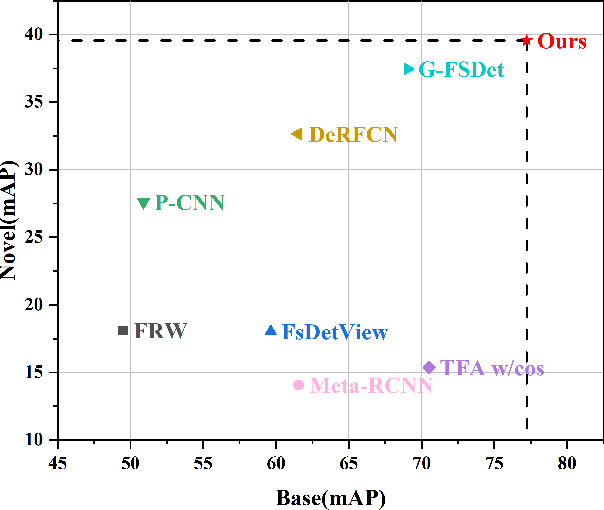
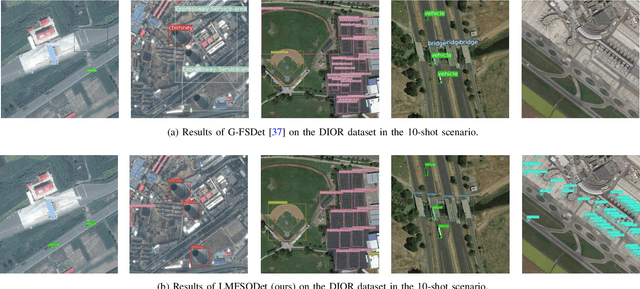
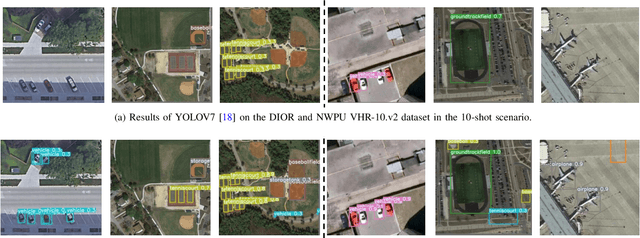
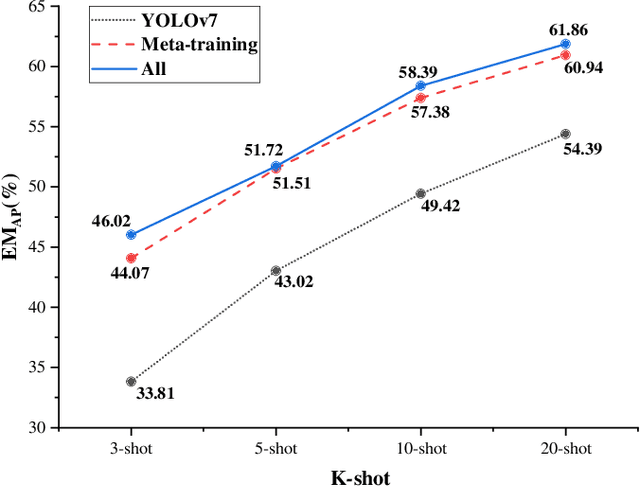
Presently, the task of few-shot object detection (FSOD) in remote sensing images (RSIs) has become a focal point of attention. Numerous few-shot detectors, particularly those based on two-stage detectors, face challenges when dealing with the multiscale complexities inherent in RSIs. Moreover, these detectors present impractical characteristics in real-world applications, mainly due to their unwieldy model parameters when handling large amount of data. In contrast, we recognize the advantages of one-stage detectors, including high detection speed and a global receptive field. Consequently, we choose the YOLOv7 one-stage detector as a baseline and subject it to a novel meta-learning training framework. This transformation allows the detector to adeptly address FSOD tasks while capitalizing on its inherent advantage of lightweight. Additionally, we thoroughly investigate the samples generated by the meta-learning strategy and introduce a novel meta-sampling approach to retain samples produced by our designed meta-detection head. Coupled with our devised meta-cross loss, we deliberately utilize ``negative samples" that are often overlooked to extract valuable knowledge from them. This approach serves to enhance detection accuracy and efficiently refine the overall meta-learning strategy. To validate the effectiveness of our proposed detector, we conducted performance comparisons with current state-of-the-art detectors using the DIOR and NWPU VHR-10.v2 datasets, yielding satisfactory results.