 Add to Chrome
 Add to Firefox
 Add to Edge
On the Sparsity-Storage-Accuracy Tradeoff in Parsimoniously Activated Dictionary Learning
Jun 21, 2026
Dictionary learning has long been studied from both optimization and probabilistic perspectives. While formulations with element-wise sparsity regularization (e.g., L1-based sparse coding) admit well-established probabilistic interpretations, many structured variants that impose global constraints lack a clear and tractable generative view. In this paper, we revisit a class of practically effective yet theoretically under-explored dictionary learning methods that impose a simple global regularization on the number of activated dictionary atoms, which we term parsimoniously activated dictionary learning (PADL). We show that PADL admits an equivalent formulation as maximum a posteriori estimation under a structured generative model, with auxiliary latent variables that govern global activation patterns. This formulation allows us to derive generalization guarantees that are difficult to obtain under the original formulation. More importantly, it yields an analytical characterization of the tradeoff between sparsity, storage cost, and reconstruction accuracy, enabling data-driven estimation of optimal hyperparameters. Based on this connection, we develop an efficient and interpretable PADL algorithm that eliminates manual hyperparameter tuning, achieving improved reconstruction performance under comparable sparsity levels on visual benchmarks. We further demonstrate its practical utility in accelerating inference for vision-language models.

Reflective Preference Optimization (RPO): Enhancing On-Policy Alignment via Hint-Guided Reflection
Dec 15, 2025Direct Preference Optimization (DPO) has emerged as a lightweight and effective alternative to Reinforcement Learning from Human Feedback (RLHF) and Reinforcement Learning with AI Feedback (RLAIF) for aligning large language and vision-language models. However, the standard DPO formulation, in which both the chosen and rejected responses are generated by the same policy, suffers from a weak learning signal because the two responses often share similar errors and exhibit small Kullback-Leibler (KL) divergence. This leads to slow and unstable convergence. To address this limitation, we introduce Reflective Preference Optimization (RPO), a new framework that incorporates hint-guided reflection into the DPO paradigm. RPO uses external models to identify hallucination sources and generate concise reflective hints, enabling the construction of on-policy preference pairs with stronger contrastiveness and clearer preference signals. We theoretically show that conditioning on hints increases the expected preference margin through mutual information and improves sample efficiency while remaining within the policy distribution family. Empirically, RPO achieves superior alignment with fewer training samples and iterations, substantially reducing hallucination rates and delivering state-of-the-art performance across multimodal benchmarks.
S2ML: Spatio-Spectral Mutual Learning for Depth Completion
Nov 08, 2025The raw depth images captured by RGB-D cameras using Time-of-Flight (TOF) or structured light often suffer from incomplete depth values due to weak reflections, boundary shadows, and artifacts, which limit their applications in downstream vision tasks. Existing methods address this problem through depth completion in the image domain, but they overlook the physical characteristics of raw depth images. It has been observed that the presence of invalid depth areas alters the frequency distribution pattern. In this work, we propose a Spatio-Spectral Mutual Learning framework (S2ML) to harmonize the advantages of both spatial and frequency domains for depth completion. Specifically, we consider the distinct properties of amplitude and phase spectra and devise a dedicated spectral fusion module. Meanwhile, the local and global correlations between spatial-domain and frequency-domain features are calculated in a unified embedding space. The gradual mutual representation and refinement encourage the network to fully explore complementary physical characteristics and priors for more accurate depth completion. Extensive experiments demonstrate the effectiveness of our proposed S2ML method, outperforming the state-of-the-art method CFormer by 0.828 dB and 0.834 dB on the NYU-Depth V2 and SUN RGB-D datasets, respectively.
Learning Free Token Reduction for Multi-Modal LLM
Jan 29, 2025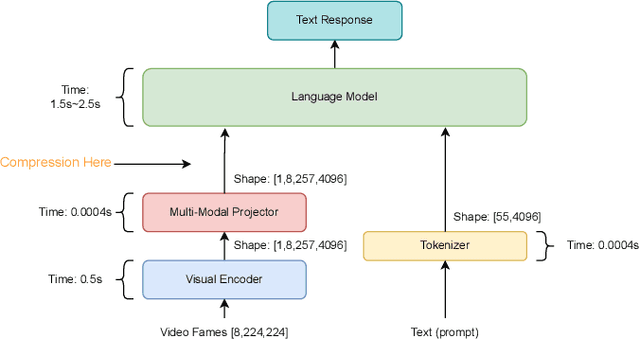
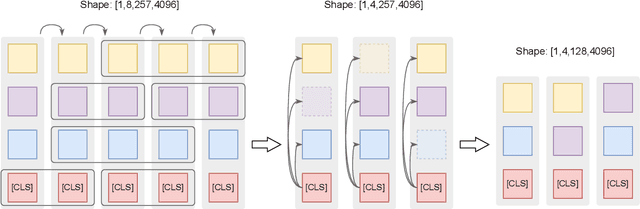
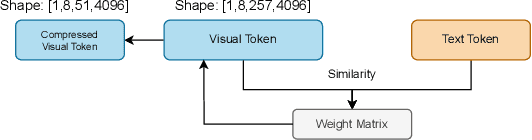
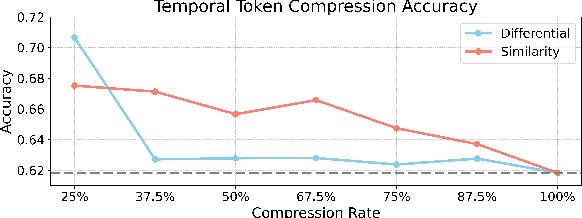
Vision-Language Models (VLMs) have achieved remarkable success across a range of multimodal tasks; however, their practical deployment is often constrained by high computational costs and prolonged inference times. Since the vision modality typically carries more information than the text modality, compressing visual prompts offers a promising solution to alleviate these challenges. Existing approaches predominantly focus on refining model architectures or directly reducing the number of visual tokens. However, these methods often compromise inference performance due to a lack of consideration for the unique spatial and temporal characteristics of visual data. In this work, we propose a token compression paradigm that operates on both spatial and temporal dimensions. Our approach includes a learning-free, plug-and-play compression pipeline that can be seamlessly integrated into most Multimodal Large Language Model (MLLM) frameworks. By leveraging this method, we enhance the model inference capability while simultaneously reducing its computational cost. Experimental results on the Video-QA task demonstrate the effectiveness of the proposed approach, showcasing significant improvements in efficiency without sacrificing performance.