 Add to Chrome
 Add to Firefox
 Add to Edge
Discrete Diffusion for Complex and Congested Multi-Agent Path Finding with Sparse Social Attention
May 13, 2026
Multi-Agent Path Finding (MAPF) is a coordination problem that requires computing globally consistent, collision-free trajectories from individual start positions to assigned goal positions under combinatorial planning complexity. In dense environments, suboptimal initial plans induce compound conflicts that hinder feasible repair. For repair-based solvers like LNS2, initial plan quality critically affects downstream repair, yet this factor remains underexplored. We propose DiffLNS, a hybrid framework that integrates a discrete denoising diffusion probabilistic model (D3PM) with LNS2. The D3PM serves as an initializer with sparse social attention that learns a spatiotemporal prior over coordinated multi-agent action trajectories from expert demonstrations and samples multiple joint plans. Operating directly on the categorical action space, our discrete diffusion preserves the MAPF action structure and samples from a multimodal joint-plan distribution to produce diverse drafts well suited for neighborhood repair. These drafts act as warm starts for downstream repair, which completes unfinished trajectories and resolves remaining conflicts under hard MAPF constraints. Experimental results show that despite being trained only on instances with at most 96 agents, the initializer generalizes to scenarios with up to 312 agents at inference time. Across 20 complex and congested settings, DiffLNS achieves an average success rate of 95.8%, outperforming the strongest tested baseline by 9.6 percentage points and matching or exceeding all baselines in all 20 settings. To the best of our knowledge, this is the first work to leverage discrete diffusion for warm-starting an LNS-based MAPF solver.

A Safer Vision-based Autonomous Planning System for Quadrotor UAVs with Dynamic Obstacle Trajectory Prediction and Its Application with LLMs
Nov 21, 2023For intelligent quadcopter UAVs, a robust and reliable autonomous planning system is crucial. Most current trajectory planning methods for UAVs are suitable for static environments but struggle to handle dynamic obstacles, which can pose challenges and even dangers to flight. To address this issue, this paper proposes a vision-based planning system that combines tracking and trajectory prediction of dynamic obstacles to achieve efficient and reliable autonomous flight. We use a lightweight object detection algorithm to identify dynamic obstacles and then use Kalman Filtering to track and estimate their motion states. During the planning phase, we not only consider static obstacles but also account for the potential movements of dynamic obstacles. For trajectory generation, we use a B-spline-based trajectory search algorithm, which is further optimized with various constraints to enhance safety and alignment with the UAV's motion characteristics. We conduct experiments in both simulation and real-world environments, and the results indicate that our approach can successfully detect and avoid obstacles in dynamic environments in real-time, offering greater reliability compared to existing approaches. Furthermore, with the advancements in Natural Language Processing (NLP) technology demonstrating exceptional zero-shot generalization capabilities, more user-friendly human-machine interactions have become feasible, and this study also explores the integration of autonomous planning systems with Large Language Models (LLMs).
Deep Radar Inverse Sensor Models for Dynamic Occupancy Grid Maps
May 25, 2023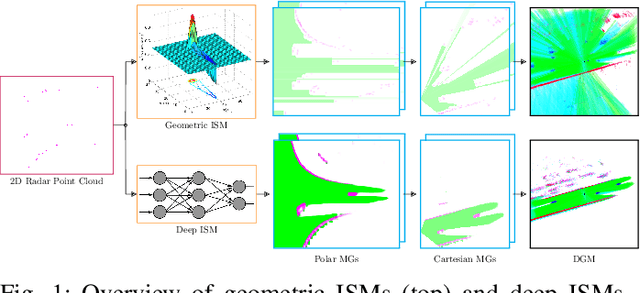
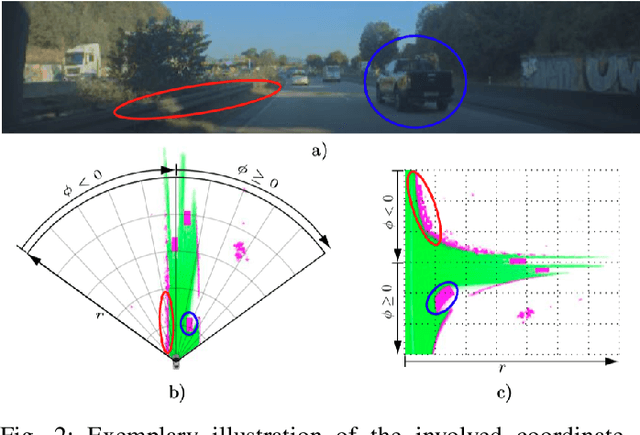
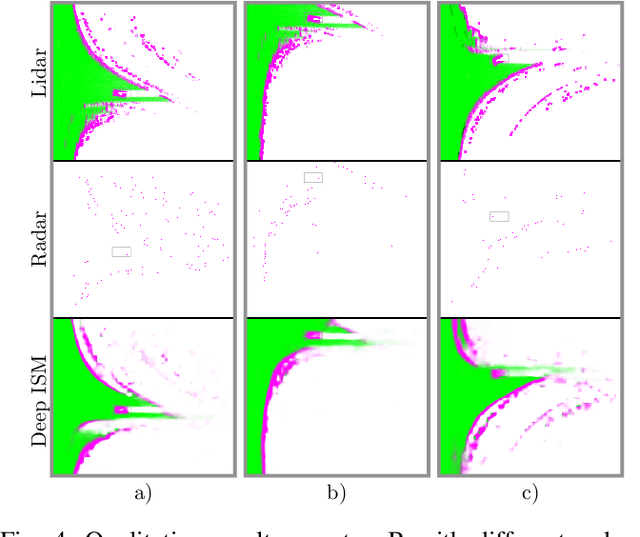
To implement autonomous driving, one essential step is to model the vehicle environment based on the sensor inputs. Radars, with their well-known advantages, became a popular option to infer the occupancy state of grid cells surrounding the vehicle. To tackle data sparsity and noise of radar detections, we propose a deep learning-based Inverse Sensor Model (ISM) to learn the mapping from sparse radar detections to polar measurement grids. Improved lidar-based measurement grids are used as reference. The learned radar measurement grids, combined with radar Doppler velocity measurements, are further used to generate a Dynamic Grid Map (DGM). Experiments in real-world highway scenarios show that our approach outperforms the hand-crafted geometric ISMs. In comparison to state-of-the-art deep learning methods, our approach is the first one to learn a single-frame measurement grid in the polar scheme from radars with a limited Field Of View (FOV). The learning framework makes the learned ISM independent of the radar mounting. This enables us to flexibly use one or more radar sensors without network retraining and without requirements on 360{\deg} sensor coverage.