 Add to Chrome
 Add to Firefox
 Add to Edge
SLIM-0.5B: Learning Action-Grounded Predictive Latents for Robot Manipulation
Aug 10, 2026
Vision-language-action policies rely on large multimodal backbones to jointly perform perception, language conditioning, and action generation at every control step. Much of this capacity supports open-domain semantics, whereas continuous robot manipulation primarily requires compact representations of observations, actions, and the transitions induced by actions. Pixel-level world models provide another route, but predicting visual details irrelevant to control can be unnecessarily expensive. We propose SLIM (Self-supervised Latent Interaction Model), a compact 0.5B-parameter latent interaction policy. SLIM learns action-grounded predictive latents that capture both action-conditioned future transitions and the actions that explain observed changes. SLIM learns these representations through self-supervised masked trajectory prediction, combining action reconstruction with future-latent prediction. A compact Mixture-of-Transformers (MoT) backbone models interactions between observation latents and action tokens. The resulting policy is trained with flow matching for language-conditioned action generation. Across simulation benchmarks and real-world evaluation, SLIM matches or exceeds representative large-scale VLA and world-action-model baselines with fewer parameters, no additional embodied pretraining, lower inference latency, and substantially lower GPU memory usage.

Scene-Conditioned PINN-GNN for Multipath RF Maps: Cross-Scene Generation and In-Scene Completion
Jul 02, 2026Radio frequency (RF) maps provide a compact representation of multipath propagation characteristics and are fundamental to channel modeling, coverage analysis, and environment-aware wireless optimization. This paper proposes a unified RF map construction framework based on a physics-informed neural network (PINN) and a graph neural network (GNN), supporting both cross-scene generation and in-scene completion with 2D and 2.5D environmental representations. The PINN embeds electromagnetic propagation constraints to establish a physically consistent mapping from receiver locations to multipath parameters, including path gain, time of arrival, and angles, while the GNN enforces spatial consistency by modeling correlations among neighboring receivers. To comprehensively evaluate multipath reconstruction quality, we propose a peak-weighted dynamic time warping metric that jointly accounts for amplitude errors and peak delay misalignment in channel impulse responses. Extensive experiments demonstrate that the proposed method consistently outperforms image-based, diffusion-based, and interpolation baselines across both map-level and multipath-level metrics, achieving robust generalization and high-fidelity RF map construction under sparse observations.
Orca: The World is in Your Mind
Jun 30, 2026We introduce Orca, an initial instantiation of a general world foundation model. Orca learns a unified world latent space from multimodal world signals and exposes it through multimodal readout interfaces. Rather than optimizing isolated next-token, next-frame, or next-action prediction, we are centered on Next-State-Prediction modeling, offering a unified state-transition modeling route toward understanding, predicting, and acting upon the world. Orca learns through two complementary paradigms: unconscious learning captures dense natural state transitions from continuous videos, and conscious learning models sparse meaningful state transitions by language-described events and VQA supervision. For pre-training, we construct a large-scale world-learning inventory data, including 125K hours of video data and 160M event annotations. After pre-training, Orca learns a unified world latent space. To examine whether the learned latent supports downstream, we evaluate it by three representative downstream readouts: text generation, image prediction, and embodied action generation. Orca's backbone is frozen, and only the lightweight modality-specific decoders are trainable. Experiments show the scalability of the proposed paradigm and verify that stronger world latent enables stronger downstream readouts. Orca outperforms similar-sized specialized baselines. These results show that Orca, as a general world foundation model, presents a promising approach to understanding, predicting, and acting upon the world. Finally, we discuss the current limitations, aiming to provide useful insights and inspiration for the community.
From Reasoning Chains to Verifiable Subproblems: Curriculum Reinforcement Learning Enables Credit Assignment for LLM Reasoning
May 21, 2026Reinforcement learning from verifiable rewards (RLVR) has shown strong promise for LLM reasoning, but outcome-based RLVR remains inefficient on hard problems because correct final-answer rollouts are rare and sample-level credit assignment cannot use partial progress in failed attempts. We introduce SCRL (Subproblem Curriculum Reinforcement Learning), a curriculum RL framework that derives verifiable subproblems from reference reasoning chains and fixes the final subproblem as the original problem. This turns partial progress on hard problems into verifiable learning signals. Algorithmically, SCRL uses subproblem-level normalization, which normalizes rewards independently at each subproblem position and assigns the resulting advantages to the corresponding answer spans, enabling finer-grained credit assignment without external rubrics or reward models. Our analysis shows that subproblem curricula lift hard problems out of gradient dead zones, with larger relative gains as the original problem becomes harder. Across seven mathematical reasoning benchmarks, SCRL outperforms strong curriculum-learning baselines, improving average accuracy over GRPO by +4.1 points on Qwen3-4B-Base and +1.9 points on Qwen3-14B-Base. On AIME24, AIME25, and IMO-Bench, SCRL further improves pass@1 by +3.7 points and pass@64 by +4.6 points on Qwen3-4B-Base, indicating better exploration on hard reasoning problems.
PINN and GNN-based RF Map Construction for Wireless Communication Systems
Jul 30, 2025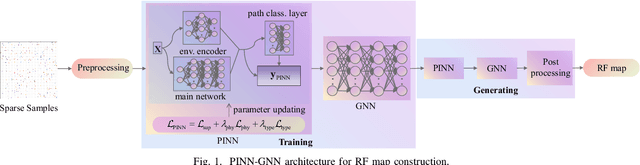
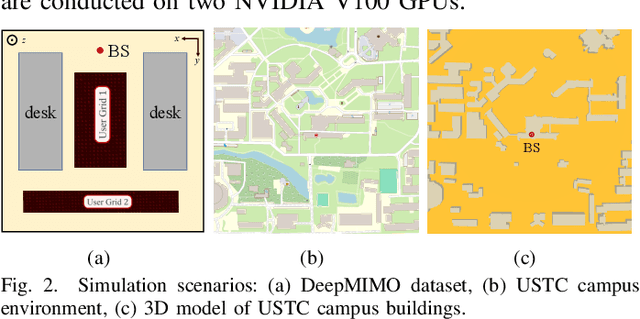
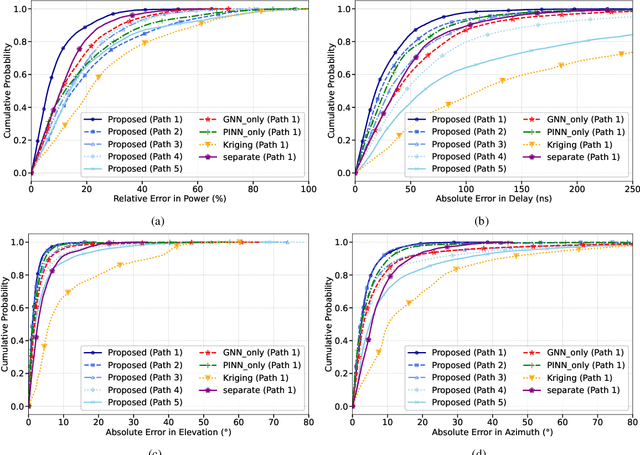
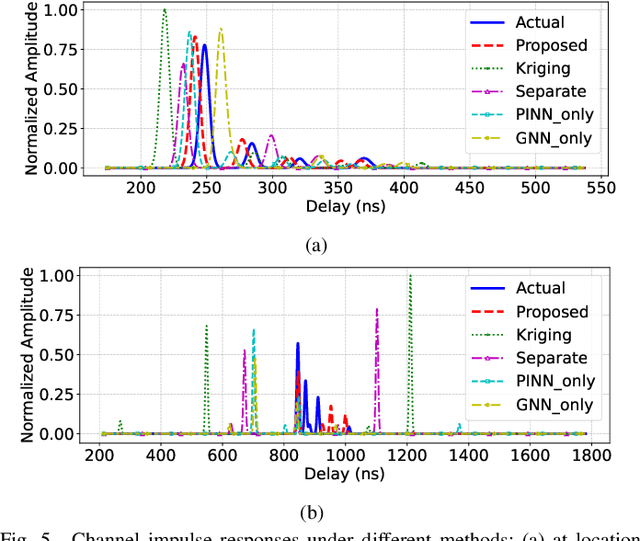
Radio frequency (RF) map is a promising technique for capturing the characteristics of multipath signal propagation, offering critical support for channel modeling, coverage analysis, and beamforming in wireless communication networks. This paper proposes a novel RF map construction method based on a combination of physics-informed neural network (PINN) and graph neural network (GNN). The PINN incorporates physical constraints derived from electromagnetic propagation laws to guide the learning process, while the GNN models spatial correlations among receiver locations. By parameterizing multipath signals into received power, delay, and angle of arrival (AoA), and integrating both physical priors and spatial dependencies, the proposed method achieves accurate prediction of multipath parameters. Experimental results demonstrate that the method enables high-precision RF map construction under sparse sampling conditions and delivers robust performance in both indoor and complex outdoor environments, outperforming baseline methods in terms of generalization and accuracy.
Learning Global and Local Features of Power Load Series Through Transformer and 2D-CNN: An image-based Multi-step Forecasting Approach Incorporating Phase Space Reconstruction
Jul 16, 2024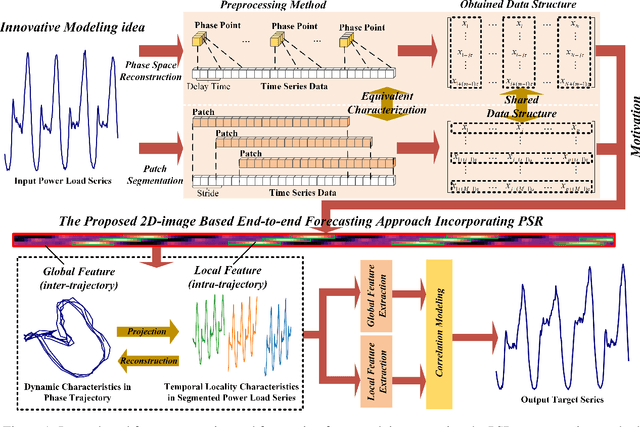

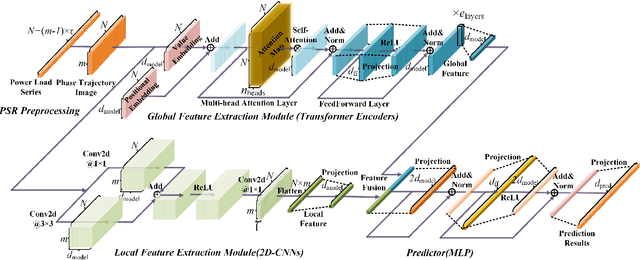
As modern power systems continue to evolve, accurate power load forecasting remains a critical issue. The phase space reconstruction method can effectively retain the chaotic characteristics of power load from a system dynamics perspective and thus is a promising knowledge-based preprocessing method for power load forecasting. However, limited by its fundamental theory, there is still a gap in implementing a multi-step forecasting scheme in current studies. To bridge this gap, this study proposes a novel multi-step forecasting approach by integrating the PSR with neural networks. Firstly, the useful features in the phase trajectory obtained from the preprocessing of PSR are discussed in detail. Through mathematical derivation, the equivalent characterization of the PSR and another time series preprocessing method, patch segmentation, is demonstrated for the first time. Based on this prior knowledge, an image-based modeling perspective with the global and local feature extraction strategy is introduced. Subsequently, a novel deep learning model, namely PSR-GALIEN, is designed for end-to-end processing, in which the Transformer Encoder and 2D-convolutional neural networks are employed for the extraction of the global and local patterns in the image, and a multi-layer perception based predictor is used for the efficient correlation modeling. Then, extensive experiments are conducted on five real-world benchmark datasets to verify the effectiveness as well as to have an insight into the detailed properties. The results show that, comparing it with six state-of-the-art deep learning models, the forecasting performance of PSR-GALIEN consistently surpasses these baselines, which achieves superior accuracy in both intra-day and day-ahead forecasting scenarios. At the same time, a visualization-based method is proposed to explain the attributions of the forecasting results.