 Add to Chrome
 Add to Firefox
 Add to Edge
GIDE: Unlocking Diffusion LLMs for Precise Training-Free Image Editing
Mar 22, 2026
While Diffusion Large Language Models (DLLMs) have demonstrated remarkable capabilities in multi-modal generation, performing precise, training-free image editing remains an open challenge. Unlike continuous diffusion models, the discrete tokenization inherent in DLLMs hinders the application of standard noise inversion techniques, often leading to structural degradation during editing. In this paper, we introduce GIDE (Grounded Inversion for DLLM Image Editing), a unified framework designed to bridge this gap. GIDE incorporates a novel Discrete Noise Inversion mechanism that accurately captures latent noise patterns within the discrete token space, ensuring high-fidelity reconstruction. We then decompose the editing pipeline into grounding, inversion, and refinement stages. This design enables GIDE supporting various editing instructions (text, point and box) and operations while strictly preserving the unedited background. Furthermore, to overcome the limitations of existing single-step evaluation protocols, we introduce GIDE-Bench, a rigorous benchmark comprising 805 compositional editing scenarios guided by diverse multi-modal inputs. Extensive experiments on GIDE-Bench demonstrate that GIDE significantly outperforms prior training-free methods, improving Semantic Correctness by 51.83% and Perceptual Quality by 50.39%. Additional evaluations on ImgEdit-Bench confirm its broad applicability, demonstrating consistent gains over trained baselines and yielding photorealistic consistency on par with leading models.

MultiChartQA: Benchmarking Vision-Language Models on Multi-Chart Problems
Oct 18, 2024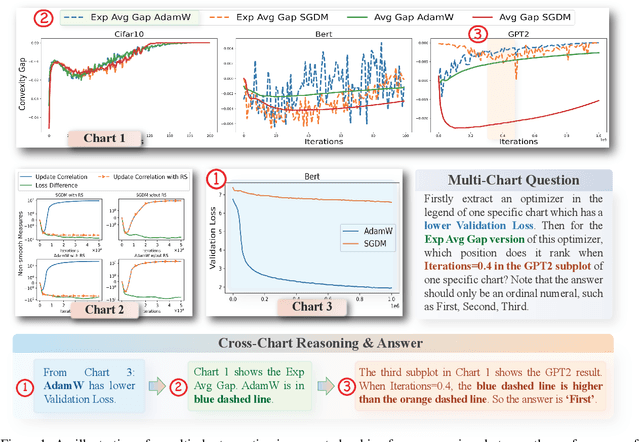
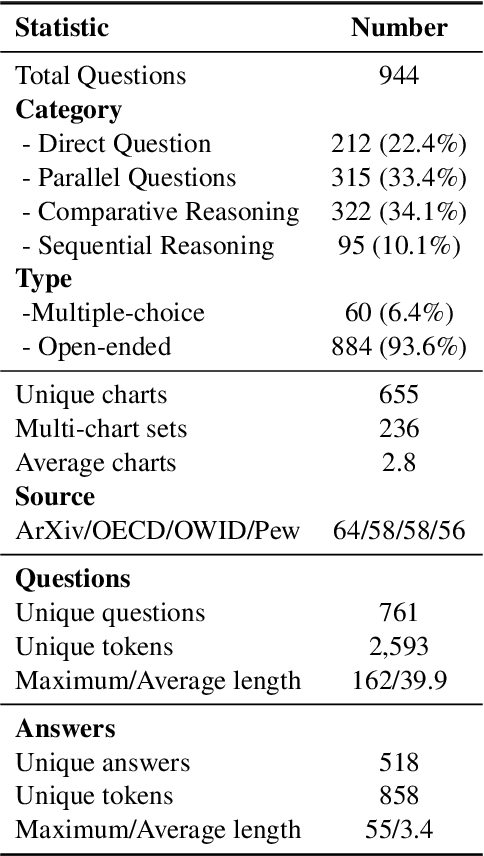
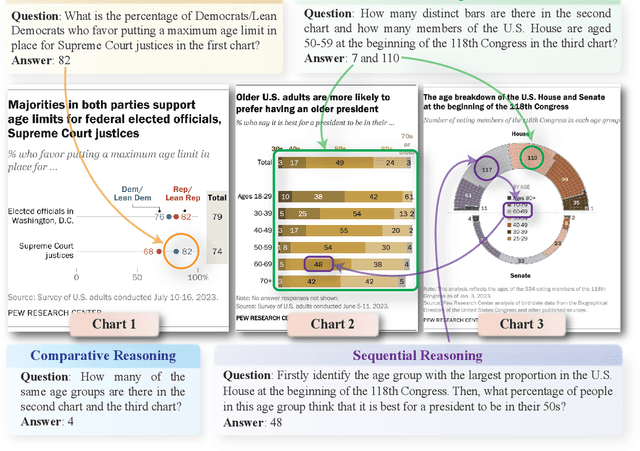
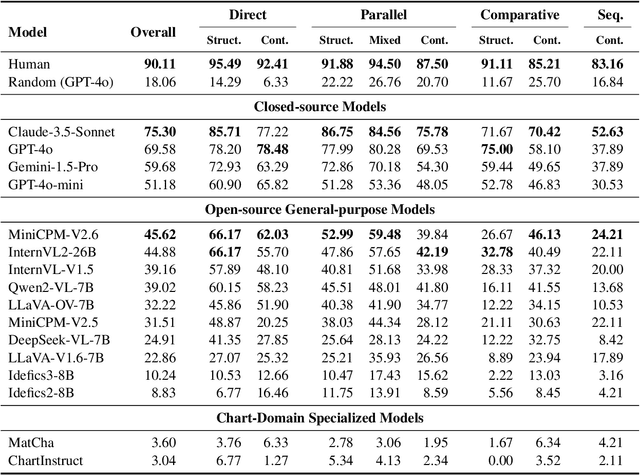
Multimodal Large Language Models (MLLMs) have demonstrated impressive abilities across various tasks, including visual question answering and chart comprehension, yet existing benchmarks for chart-related tasks fall short in capturing the complexity of real-world multi-chart scenarios. Current benchmarks primarily focus on single-chart tasks, neglecting the multi-hop reasoning required to extract and integrate information from multiple charts, which is essential in practical applications. To fill this gap, we introduce MultiChartQA, a benchmark that evaluates MLLMs' capabilities in four key areas: direct question answering, parallel question answering, comparative reasoning, and sequential reasoning. Our evaluation of a wide range of MLLMs reveals significant performance gaps compared to humans. These results highlight the challenges in multi-chart comprehension and the potential of MultiChartQA to drive advancements in this field. Our code and data are available at https://github.com/Zivenzhu/Multi-chart-QA
LMBot: Distilling Graph Knowledge into Language Model for Graph-less Deployment in Twitter Bot Detection
Jul 03, 2023As malicious actors employ increasingly advanced and widespread bots to disseminate misinformation and manipulate public opinion, the detection of Twitter bots has become a crucial task. Though graph-based Twitter bot detection methods achieve state-of-the-art performance, we find that their inference depends on the neighbor users multi-hop away from the targets, and fetching neighbors is time-consuming and may introduce bias. At the same time, we find that after finetuning on Twitter bot detection, pretrained language models achieve competitive performance and do not require a graph structure during deployment. Inspired by this finding, we propose a novel bot detection framework LMBot that distills the knowledge of graph neural networks (GNNs) into language models (LMs) for graph-less deployment in Twitter bot detection to combat the challenge of data dependency. Moreover, LMBot is compatible with graph-based and graph-less datasets. Specifically, we first represent each user as a textual sequence and feed them into the LM for domain adaptation. For graph-based datasets, the output of LMs provides input features for the GNN, enabling it to optimize for bot detection and distill knowledge back to the LM in an iterative, mutually enhancing process. Armed with the LM, we can perform graph-less inference, which resolves the graph data dependency and sampling bias issues. For datasets without graph structure, we simply replace the GNN with an MLP, which has also shown strong performance. Our experiments demonstrate that LMBot achieves state-of-the-art performance on four Twitter bot detection benchmarks. Extensive studies also show that LMBot is more robust, versatile, and efficient compared to graph-based Twitter bot detection methods.