 Add to Chrome
 Add to Firefox
 Add to Edge
A Bearing-Strength Method for Motion Estimation of Unknown Energy Emitters
Jul 14, 2026
This paper studies motion estimation of moving energy emitters using passive sensors. The emitters may be light, acoustic, or radio sources. While the bearing vector pointing from the sensor to the emitter can be easily obtained, existing approaches mainly rely on the bearing-only motion estimation method. However, this method suffers from a fundamental limitation that the sensor must have lateral motion to ensure observability. Unfortunately, this lateral motion requirement often conflicts with the sensor's desired motion in many tasks. In this paper, we point out that the received signal strength, which can also be obtained easily in many ways, can greatly enhance motion estimation. Surprisingly, this strength information has not been well explored so far. Here, we propose a new bearing-strength method to fully exploit both the bearing and strength measurements. Our theoretical analysis shows that the system observability is significantly enhanced in the sense that the lateral motion condition is not required anymore. Real-world experimental results verify the proposed method and the theoretical analysis. It is notable that the benefit of the proposed method comes with no additional cost since it simply utilizes the received strength information that has not been fully exploited in the past.

Infra-Swarm: Robust Vision-Based Multi-Robot Swarming via Near-Infrared Spectral Vision
Jul 14, 2026Distributed swarms typically rely on either active wireless communication or passive vision, and they are frequently hindered by bandwidth constraints or environmental sensitivity. This paper proposes Infra-Swarm, a robust vision-based swarm. Each robot is equipped with a near-infrared light source and four ordinary gray-scale cameras. The Infra-Swarm system directly measures the centimeter-level 3D position of neighbors based on the position (bearing) and intensity (strength) of optical flares in the captured images. By utilizing 940 nm narrow-band filters to physically reject 99.2% of ambient light interference, the perception front-end achieves hardware-level robustness against illumination variations. Furthermore, its minimal computational overhead provides a resilient foundation for the massive scalability of robotic collectives on resource-constrained hardware.
Observability-Enhanced Target Motion Estimation via Bearing-Box: Theory and MAV Applications
Jan 11, 2026Monocular vision-based target motion estimation is a fundamental challenge in numerous applications. This work introduces a novel bearing-box approach that fully leverages modern 3D detection measurements that are widely available nowadays but have not been well explored for motion estimation so far. Unlike existing methods that rely on restrictive assumptions such as isotropic target shape and lateral motion, our bearing-box estimator can estimate both the target's motion and its physical size without these assumptions by exploiting the information buried in a 3D bounding box. When applied to multi-rotor micro aerial vehicles (MAVs), the estimator yields an interesting advantage: it further removes the need for higher-order motion assumptions by exploiting the unique coupling between MAV's acceleration and thrust. This is particularly significant, as higher-order motion assumptions are widely believed to be necessary in state-of-the-art bearing-based estimators. We support our claims with rigorous observability analyses and extensive experimental validation, demonstrating the estimator's superior performance in real-world scenarios.
EvDetMAV: Generalized MAV Detection from Moving Event Cameras
Jun 24, 2025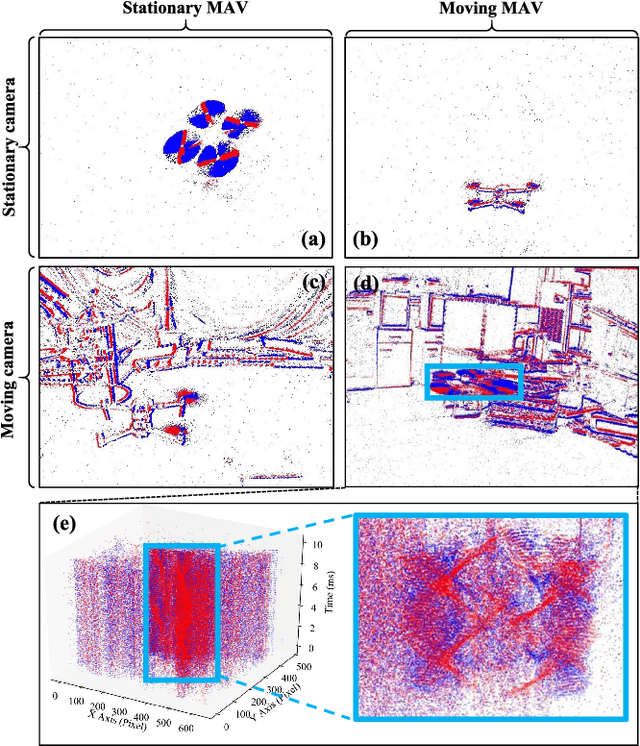
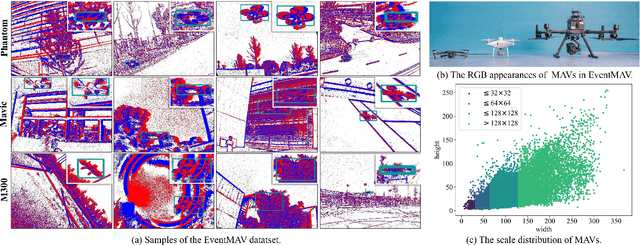
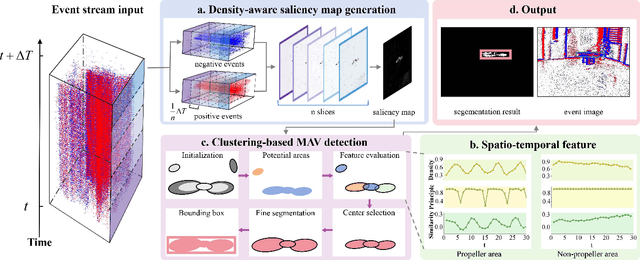
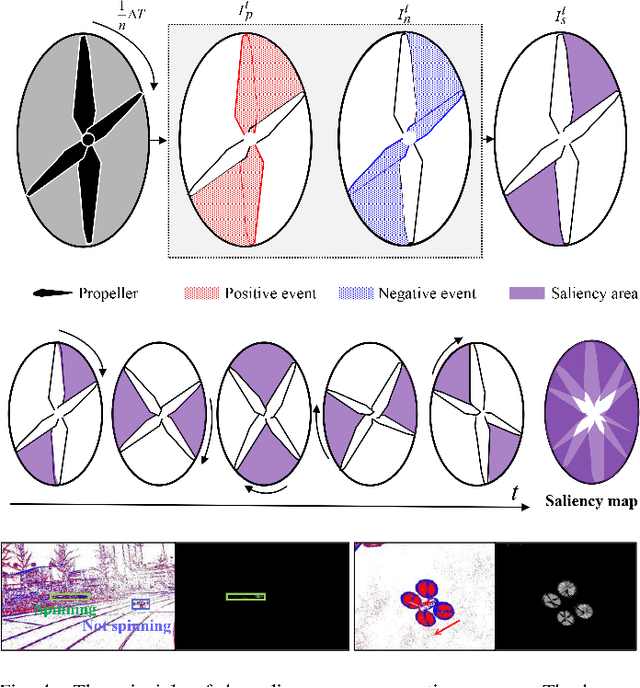
Existing micro aerial vehicle (MAV) detection methods mainly rely on the target's appearance features in RGB images, whose diversity makes it difficult to achieve generalized MAV detection. We notice that different types of MAVs share the same distinctive features in event streams due to their high-speed rotating propellers, which are hard to see in RGB images. This paper studies how to detect different types of MAVs from an event camera by fully exploiting the features of propellers in the original event stream. The proposed method consists of three modules to extract the salient and spatio-temporal features of the propellers while filtering out noise from background objects and camera motion. Since there are no existing event-based MAV datasets, we introduce a novel MAV dataset for the community. This is the first event-based MAV dataset comprising multiple scenarios and different types of MAVs. Without training, our method significantly outperforms state-of-the-art methods and can deal with challenging scenarios, achieving a precision rate of 83.0\% (+30.3\%) and a recall rate of 81.5\% (+36.4\%) on the proposed testing dataset. The dataset and code are available at: https://github.com/WindyLab/EvDetMAV.
A Bearing-Angle Approach for Unknown Target Motion Analysis Based on Visual Measurements
Jan 30, 2024Vision-based estimation of the motion of a moving target is usually formulated as a bearing-only estimation problem where the visual measurement is modeled as a bearing vector. Although the bearing-only approach has been studied for decades, a fundamental limitation of this approach is that it requires extra lateral motion of the observer to enhance the target's observability. Unfortunately, the extra lateral motion conflicts with the desired motion of the observer in many tasks. It is well-known that, once a target has been detected in an image, a bounding box that surrounds the target can be obtained. Surprisingly, this common visual measurement especially its size information has not been well explored up to now. In this paper, we propose a new bearing-angle approach to estimate the motion of a target by modeling its image bounding box as bearing-angle measurements. Both theoretical analysis and experimental results show that this approach can significantly enhance the observability without relying on additional lateral motion of the observer. The benefit of the bearing-angle approach comes with no additional cost because a bounding box is a standard output of object detection algorithms. The approach simply exploits the information that has not been fully exploited in the past. No additional sensing devices or special detection algorithms are required.