 Add to Chrome
 Add to Firefox
 Add to Edge
Mixture-of-Experts Diffusion Models for Adaptive Massive MIMO Channel Estimation via Variational Bayesian Inference
May 18, 2026
Channel estimation is essential to massive multiple-input multiple-output (MIMO) systems. While recent generative model-based approaches using lightweight diffusion models (DMs) have achieved superior performance, they typically rely on a single data-driven prior, which limits their adaptability to varying channel distributions in real-world scenarios. To address this deficiency, we propose a mixture-of-experts (MoE) diffusion model (DM) framework combined with variational Bayesian inference. Specifically, our approach employs multiple pre-trained DMs, with each trained on a specific type of propagation channels. We then propose a probabilistic graphical model in which the channel is modeled as a latent variable drawn from one of these candidate generative priors with a certain probability. By integrating variational Bayesian inference with DM-based data priors, the underlying channel along with the expert indicator variable are jointly inferred, thus enabling automatic model adaptation for channel estimation. The effectiveness of our approach is evaluated on 3GPP CDL channels. Simulation results demonstrate that our proposed approach achieves a clear performance improvement over the standard DM-based method that employs a single prior trained on aggregated data from all channel types, particularly when the channel samples from different propagation environments are imbalanced.

Diagnosing and Addressing Pitfalls in KG-RAG Datasets: Toward More Reliable Benchmarking
May 29, 2025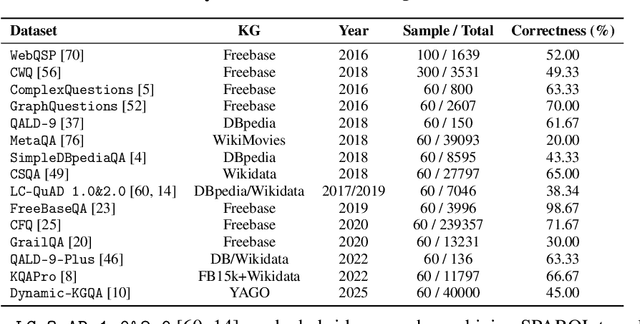
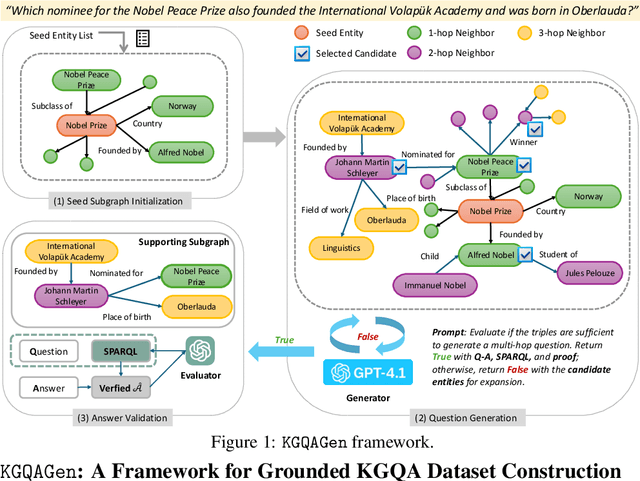
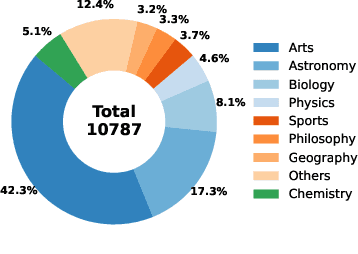
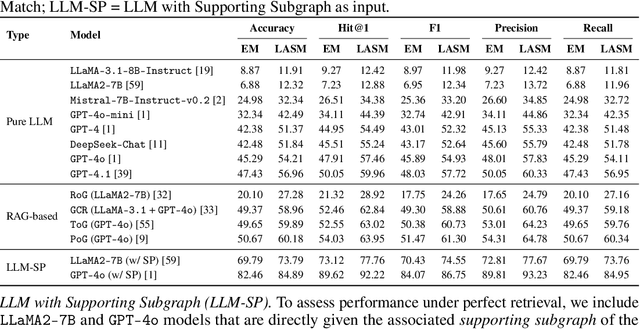
Knowledge Graph Question Answering (KGQA) systems rely on high-quality benchmarks to evaluate complex multi-hop reasoning. However, despite their widespread use, popular datasets such as WebQSP and CWQ suffer from critical quality issues, including inaccurate or incomplete ground-truth annotations, poorly constructed questions that are ambiguous, trivial, or unanswerable, and outdated or inconsistent knowledge. Through a manual audit of 16 popular KGQA datasets, including WebQSP and CWQ, we find that the average factual correctness rate is only 57 %. To address these issues, we introduce KGQAGen, an LLM-in-the-loop framework that systematically resolves these pitfalls. KGQAGen combines structured knowledge grounding, LLM-guided generation, and symbolic verification to produce challenging and verifiable QA instances. Using KGQAGen, we construct KGQAGen-10k, a ten-thousand scale benchmark grounded in Wikidata, and evaluate a diverse set of KG-RAG models. Experimental results demonstrate that even state-of-the-art systems struggle on this benchmark, highlighting its ability to expose limitations of existing models. Our findings advocate for more rigorous benchmark construction and position KGQAGen as a scalable framework for advancing KGQA evaluation.