 Add to Chrome
 Add to Firefox
 Add to Edge
Should Missing Modalities Always Be Necessary to Repair for Multi-modal Sentiment Analysis?
Jul 19, 2026
Existing methods for multimodal sentiment analysis (MSA) under missing modalities usually follow a repair-first paradigm. We revisit this assumption and ask: \emph{should every missing modality be repaired?} A per-sample oracle analysis shows the answer is not always: full-modality input is optimal for only a small fraction of samples, and every modality subset is preferred by some samples. These results suggest that adding or repairing modalities may not always improve prediction, and that the utility of each modality is sample-dependent. Building on this finding, we propose \textbf{S}ufficiency-\textbf{I}nformed \textbf{E}vidential \textbf{V}al\textbf{vE} (\textbf{SIEVE}) that turns ``whether to repair'' into an explicit, learnable decision at the sample level. SIEVE compares a direct prediction branch with a repair branch, derives an empirical sufficiency signal from their per-sample loss gap, and routes each input through an evidential gate that jointly models sufficiency and its epistemic uncertainty. SIEVE is repair-agnostic: it operates as a plug-and-play decision on top of any explicit or implicit repair module, without modifying its internal design. Experiments on CMU-MOSI and IEMOCAP show that SIEVE consistently improves representative repair backbones across evaluated missing rates, and approaches the per-sample dual-branch achievable optimum.

PhysicsArena: The First Multimodal Physics Reasoning Benchmark Exploring Variable, Process, and Solution Dimensions
May 21, 2025Multimodal Large Language Models (MLLMs) have demonstrated remarkable capabilities in diverse reasoning tasks, yet their application to complex physics reasoning remains underexplored. Physics reasoning presents unique challenges, requiring grounding in physical conditions and the interpretation of multimodal information. Current physics benchmarks are limited, often focusing on text-only inputs or solely on problem-solving, thereby overlooking the critical intermediate steps of variable identification and process formulation. To address these limitations, we introduce PhysicsArena, the first multimodal physics reasoning benchmark designed to holistically evaluate MLLMs across three critical dimensions: variable identification, physical process formulation, and solution derivation. PhysicsArena aims to provide a comprehensive platform for assessing and advancing the multimodal physics reasoning abilities of MLLMs.
CAFES: A Collaborative Multi-Agent Framework for Multi-Granular Multimodal Essay Scoring
May 20, 2025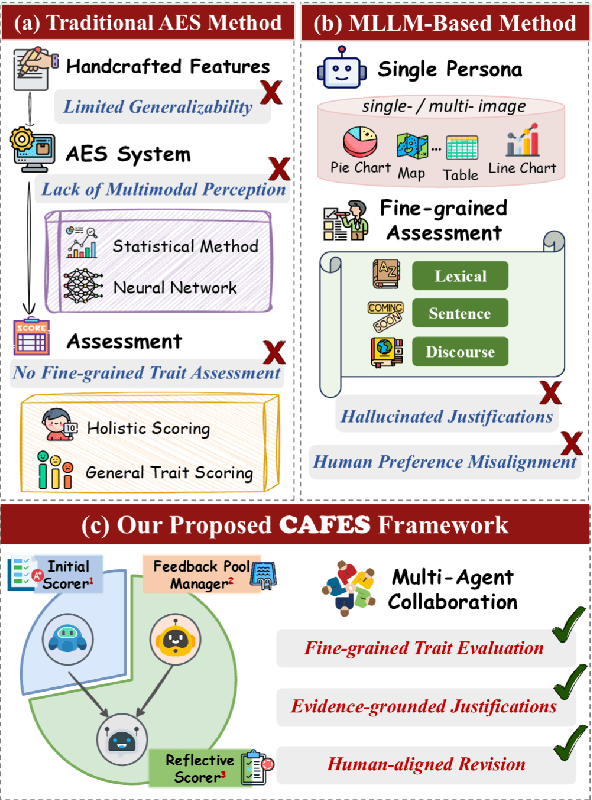
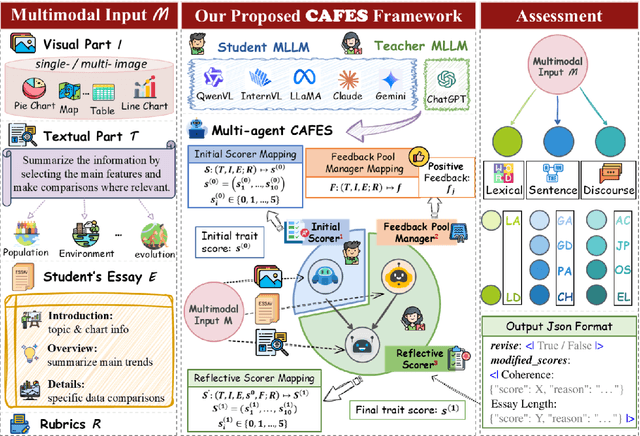
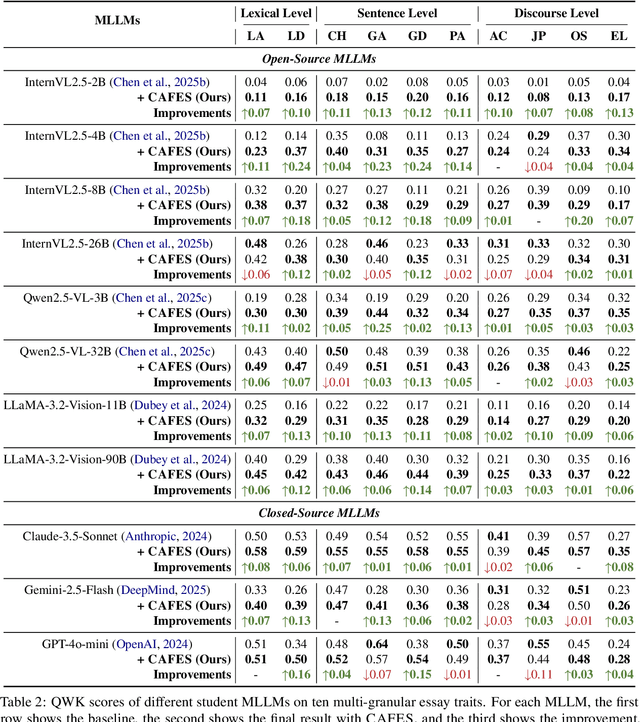
Automated Essay Scoring (AES) is crucial for modern education, particularly with the increasing prevalence of multimodal assessments. However, traditional AES methods struggle with evaluation generalizability and multimodal perception, while even recent Multimodal Large Language Model (MLLM)-based approaches can produce hallucinated justifications and scores misaligned with human judgment. To address the limitations, we introduce CAFES, the first collaborative multi-agent framework specifically designed for AES. It orchestrates three specialized agents: an Initial Scorer for rapid, trait-specific evaluations; a Feedback Pool Manager to aggregate detailed, evidence-grounded strengths; and a Reflective Scorer that iteratively refines scores based on this feedback to enhance human alignment. Extensive experiments, using state-of-the-art MLLMs, achieve an average relative improvement of 21% in Quadratic Weighted Kappa (QWK) against ground truth, especially for grammatical and lexical diversity. Our proposed CAFES framework paves the way for an intelligent multimodal AES system. The code will be available upon acceptance.