 Add to Chrome
 Add to Firefox
 Add to Edge
AVBench: Human-Aligned and Automated Evaluation Benchmark for Audio-Video Generative Models
May 23, 2026
Rapid advances in audio-video (AV) generation have enabled high-fidelity synthesis with synchronized sound, particularly for human-related scenarios involving speech and interactions. Yet evaluation for AV generation remains at an early stage, with only a few coarse-grained benchmarks for human-related scenarios and relying on limited preset evaluations with generic multimodal LLMs, leading to inaccurate assessments of model capabilities. To address these issues, we introduce AVBench, a fully automated benchmark tailored for human-centric AV generation. AVBench is built on two key designs for comprehensive and accurate evaluation: (i) Human-centric and fine-grained metrics. AVBench integrates ten evaluation dimensions designed for human-centered real-world scenarios, covering visual quality, audio quality, and multi-level consistency across modalities. These practical metrics capture human-related details that existing benchmarks often overlook. (ii) Specialized evaluators via preference learning. To address the lack of specialized training data, we construct large-scale supervision by transforming real-world videos into diverse training pairs with controlled perturbations. After fine-tuning on this high-quality dataset, the evaluators learn to reliably detect subtle cross-modal inconsistencies. Crucially, instead of producing discrete textual judgment, AVBench derives continuous evaluation scores from the model's prediction confidence on binary decisions. This probabilistic scoring mechanism enables a more reliable assessment than traditional VQA-style evaluation and aligns closely with human judgment. Taken together, AVBench offers automated evaluation for AV generation, demonstrates strong potential for data filtering, and serves as a differentiable reward signal for Reinforcement Learning from Human Feedback (RLHF).

GRADEO: Towards Human-Like Evaluation for Text-to-Video Generation via Multi-Step Reasoning
Mar 04, 2025Recent great advances in video generation models have demonstrated their potential to produce high-quality videos, bringing challenges to effective evaluation. Unlike human evaluation, existing automated evaluation metrics lack high-level semantic understanding and reasoning capabilities for video, thus making them infeasible and unexplainable. To fill this gap, we curate GRADEO-Instruct, a multi-dimensional T2V evaluation instruction tuning dataset, including 3.3k videos from over 10 existing video generation models and multi-step reasoning assessments converted by 16k human annotations. We then introduce GRADEO, one of the first specifically designed video evaluation models, which grades AI-generated videos for explainable scores and assessments through multi-step reasoning. Experiments show that our method aligns better with human evaluations than existing methods. Furthermore, our benchmarking reveals that current video generation models struggle to produce content that aligns with human reasoning and complex real-world scenarios. The models, datasets, and codes will be released soon.
FFAA: Multimodal Large Language Model based Explainable Open-World Face Forgery Analysis Assistant
Aug 19, 2024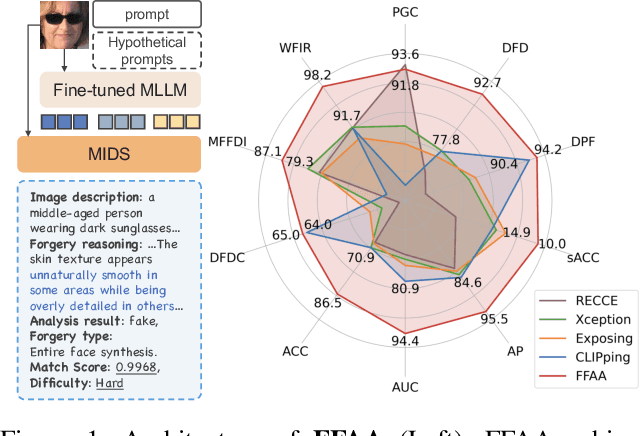
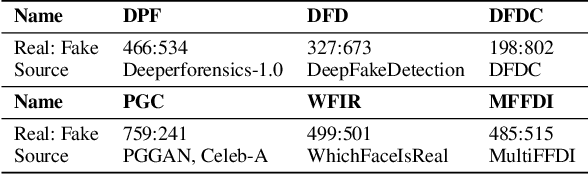
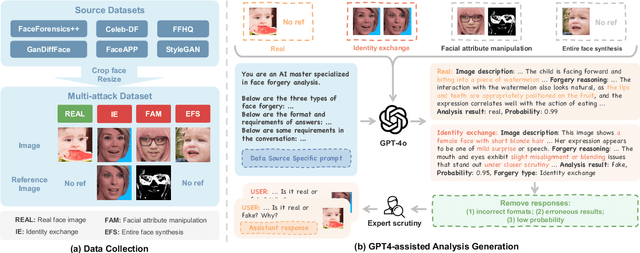
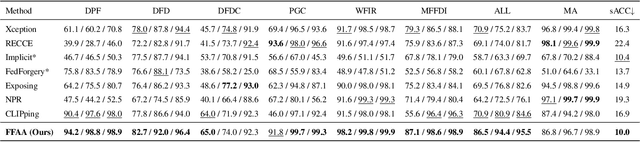
The rapid advancement of deepfake technologies has sparked widespread public concern, particularly as face forgery poses a serious threat to public information security. However, the unknown and diverse forgery techniques, varied facial features and complex environmental factors pose significant challenges for face forgery analysis. Existing datasets lack descriptions of these aspects, making it difficult for models to distinguish between real and forged faces using only visual information amid various confounding factors. In addition, existing methods do not yield user-friendly and explainable results, complicating the understanding of the model's decision-making process. To address these challenges, we introduce a novel Open-World Face Forgery Analysis VQA (OW-FFA-VQA) task and the corresponding benchmark. To tackle this task, we first establish a dataset featuring a diverse collection of real and forged face images with essential descriptions and reliable forgery reasoning. Base on this dataset, we introduce FFAA: Face Forgery Analysis Assistant, consisting of a fine-tuned Multimodal Large Language Model (MLLM) and Multi-answer Intelligent Decision System (MIDS). By integrating hypothetical prompts with MIDS, the impact of fuzzy classification boundaries is effectively mitigated, enhancing the model's robustness. Extensive experiments demonstrate that our method not only provides user-friendly explainable results but also significantly boosts accuracy and robustness compared to previous methods.