 Add to Chrome
 Add to Firefox
 Add to Edge
G-MaP-SE: Guided Speech Enhancement via GMM-Based Prior Matching
Jun 07, 2026
Using speaker embeddings as conditioning can strengthen speech enhancement, but most methods either require clean enrollment audio or rely on embeddings extracted from noisy speech, which are fragile under noise and domain shift. We propose G-MaP-SE, a guided enhancement framework that builds a clean-speech embedding prior with a Gaussian Mixture Model (GMM) and refines a noisy conditioning embedding by matching it to this prior. The matched prior embedding is then injected into a time-frequency enhancement backbone via a lightweight gated fusion module. Experiments on VoiceBank+DEMAND and DNS Challenge 2020 datasets show that the proposed prior matching consistently outperforms noisy conditioning and substantially narrows the gap to an oracle clean-conditioning upper bound, while requiring no enrollment audio at inference time. The code, audio samples, and checkpoint are available.

RaD-Net 2: A causal two-stage repairing and denoising speech enhancement network with knowledge distillation and complex axial self-attention
Jun 11, 2024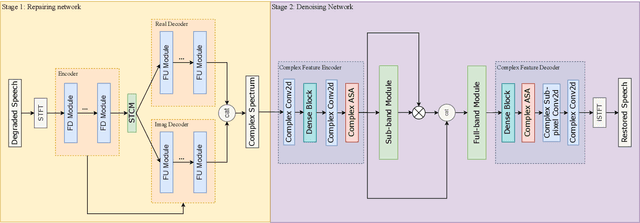
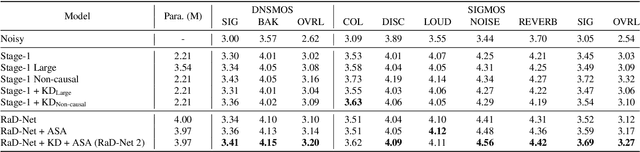
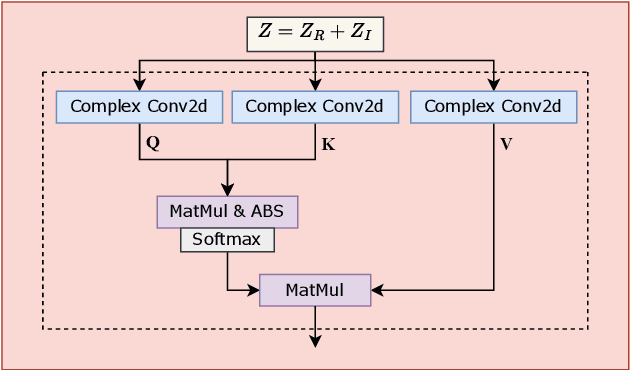
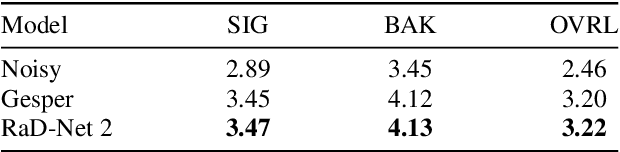
In real-time speech communication systems, speech signals are often degraded by multiple distortions. Recently, a two-stage Repair-and-Denoising network (RaD-Net) was proposed with superior speech quality improvement in the ICASSP 2024 Speech Signal Improvement (SSI) Challenge. However, failure to use future information and constraint receptive field of convolution layers limit the system's performance. To mitigate these problems, we extend RaD-Net to its upgraded version, RaD-Net 2. Specifically, a causality-based knowledge distillation is introduced in the first stage to use future information in a causal way. We use the non-causal repairing network as the teacher to improve the performance of the causal repairing network. In addition, in the second stage, complex axial self-attention is applied in the denoising network's complex feature encoder/decoder. Experimental results on the ICASSP 2024 SSI Challenge blind test set show that RaD-Net 2 brings 0.10 OVRL DNSMOS improvement compared to RaD-Net.
RaD-Net: A Repairing and Denoising Network for Speech Signal Improvement
Jan 09, 2024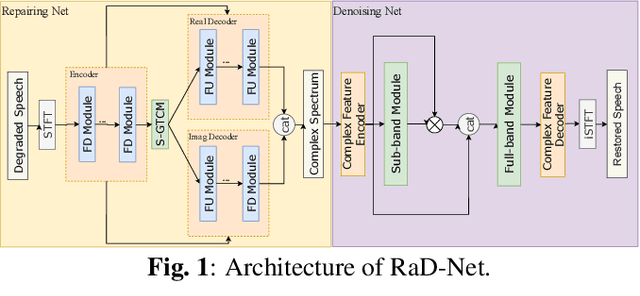

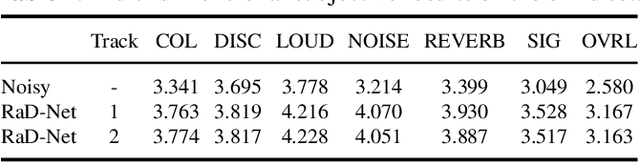
This paper introduces our repairing and denoising network (RaD-Net) for the ICASSP 2024 Speech Signal Improvement (SSI) Challenge. We extend our previous framework based on a two-stage network and propose an upgraded model. Specifically, we replace the repairing network with COM-Net from TEA-PSE. In addition, multi-resolution discriminators and multi-band discriminators are adopted in the training stage. Finally, we use a three-step training strategy to optimize our model. We submit two models with different sets of parameters to meet the RTF requirement of the two tracks. According to the official results, the proposed systems rank 2nd in track 1 and 3rd in track 2.