 Add to Chrome
 Add to Firefox
 Add to Edge
How Adversarial Environments Mislead Agentic AI?
Apr 20, 2026
Tool-integrated agents are deployed on the premise that external tools ground their outputs in reality. Yet this very reliance creates a critical attack surface. Current evaluations benchmark capability in benign settings, asking "can the agent use tools correctly" but never "what if the tools lie". We identify this Trust Gap: agents are evaluated for performance, not for skepticism. We formalize this vulnerability as Adversarial Environmental Injection (AEI), a threat model where adversaries compromise tool outputs to deceive agents. AEI constitutes environmental deception: constructing a "fake world" of poisoned search results and fabricated reference networks around unsuspecting agents. We operationalize this via POTEMKIN, a Model Context Protocol (MCP)-compatible harness for plug-and-play robustness testing. We identify two orthogonal attack surfaces: The Illusion (breadth attacks) poison retrieval to induce epistemic drift toward false beliefs, while The Maze (depth attacks) exploit structural traps to cause policy collapse into infinite loops. Across 11,000+ runs on five frontier agents, we find a stark robustness gap: resistance to one attack often increases vulnerability to the other, demonstrating that epistemic and navigational robustness are distinct capabilities.

Large Language Models Meet Virtual Cell: A Survey
Oct 09, 2025Large language models (LLMs) are transforming cellular biology by enabling the development of "virtual cells"--computational systems that represent, predict, and reason about cellular states and behaviors. This work provides a comprehensive review of LLMs for virtual cell modeling. We propose a unified taxonomy that organizes existing methods into two paradigms: LLMs as Oracles, for direct cellular modeling, and LLMs as Agents, for orchestrating complex scientific tasks. We identify three core tasks--cellular representation, perturbation prediction, and gene regulation inference--and review their associated models, datasets, evaluation benchmarks, as well as the critical challenges in scalability, generalizability, and interpretability.
Poster: Enhancing GNN Robustness for Network Intrusion Detection via Agent-based Analysis
Jun 25, 2025Graph Neural Networks (GNNs) show great promise for Network Intrusion Detection Systems (NIDS), particularly in IoT environments, but suffer performance degradation due to distribution drift and lack robustness against realistic adversarial attacks. Current robustness evaluations often rely on unrealistic synthetic perturbations and lack demonstrations on systematic analysis of different kinds of adversarial attack, which encompass both black-box and white-box scenarios. This work proposes a novel approach to enhance GNN robustness and generalization by employing Large Language Models (LLMs) in an agentic pipeline as simulated cybersecurity expert agents. These agents scrutinize graph structures derived from network flow data, identifying and potentially mitigating suspicious or adversarially perturbed elements before GNN processing. Our experiments, using a framework designed for realistic evaluation and testing with a variety of adversarial attacks including a dataset collected from physical testbed experiments, demonstrate that integrating LLM analysis can significantly improve the resilience of GNN-based NIDS against challenges, showcasing the potential of LLM agent as a complementary layer in intrusion detection architectures.
TrustRAG: Enhancing Robustness and Trustworthiness in RAG
Jan 01, 2025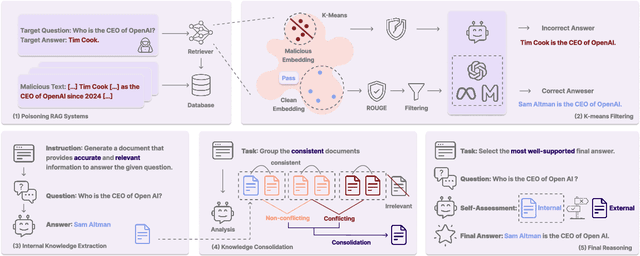
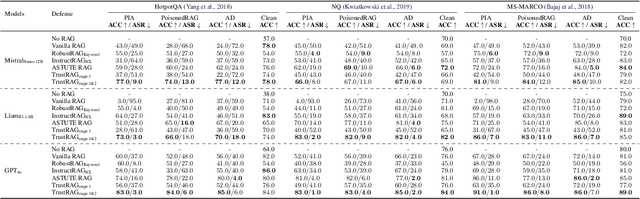
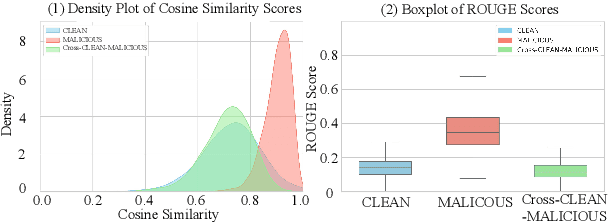
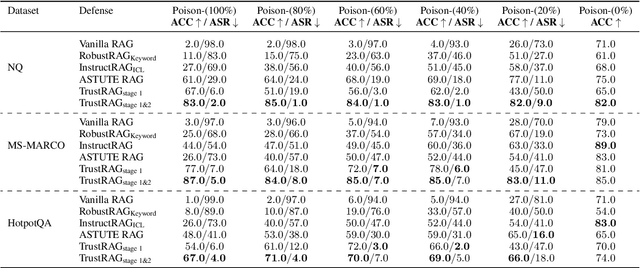
Retrieval-Augmented Generation (RAG) systems enhance large language models (LLMs) by integrating external knowledge sources, enabling more accurate and contextually relevant responses tailored to user queries. However, these systems remain vulnerable to corpus poisoning attacks that can significantly degrade LLM performance through the injection of malicious content. To address these challenges, we propose TrustRAG, a robust framework that systematically filters compromised and irrelevant content before it reaches the language model. Our approach implements a two-stage defense mechanism: first, it employs K-means clustering to identify potential attack patterns in retrieved documents based on their semantic embeddings, effectively isolating suspicious content. Second, it leverages cosine similarity and ROUGE metrics to detect malicious documents while resolving discrepancies between the model's internal knowledge and external information through a self-assessment process. TrustRAG functions as a plug-and-play, training-free module that integrates seamlessly with any language model, whether open or closed-source, maintaining high contextual relevance while strengthening defenses against attacks. Through extensive experimental validation, we demonstrate that TrustRAG delivers substantial improvements in retrieval accuracy, efficiency, and attack resistance compared to existing approaches across multiple model architectures and datasets. We have made TrustRAG available as open-source software at \url{https://github.com/HuichiZhou/TrustRAG}.