 Add to Chrome
 Add to Firefox
 Add to Edge
DeepOHeat-v2: Self-Improving Operator Learning for Fast and Trustworthy Thermal Optimization in 3D-IC Design
Aug 17, 2026
Thermal-aware optimization of multi-die 3D integrated circuits evaluates many designs, each a costly heat-equation solve. Operator-learning surrogates replace this solve with a fast forward pass, ideally trained from physics alone, without labeled data. DeepOHeat-v1 made such surrogates fast and trustworthy, but only on low-contrast geometries. High-contrast multi-die stacks break it in two ways: discontinuous conductivities make the continuous physics loss ill-defined at material interfaces, and ill-conditioning ($κ_2(A_h) \approx 6 \times 10^4$) puts the discretized strong-form loss beyond first-order optimization. We propose DeepOHeat-v2 to overcome both. First, we train on a discretized physics loss that handles the discontinuities natively; its energy form reduces the prediction-space loss-Hessian conditioning from $κ^2$ to $κ$, and a matrix-preconditioned optimizer cuts the mean peak temperature error from over 30 K to 0.55 K. Second, because optimization leaves the training distribution, we propose a self-improving framework: a hotspot trust gate sends flagged placements to a reference solver, and the surrogate incrementally retrains on the refined solutions, keeping an update only when it improves held-out validation error. On a multi-die benchmark, the surrogate-true peak gap on the returned design falls from 1.12 K to 0.11 K, matching a solve-at-every-step optimizer while running $56\times$ faster.

DeepOHeat-v1: Efficient Operator Learning for Fast and Trustworthy Thermal Simulation and Optimization in 3D-IC Design
Apr 04, 2025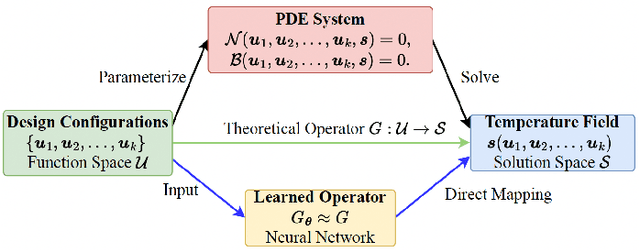
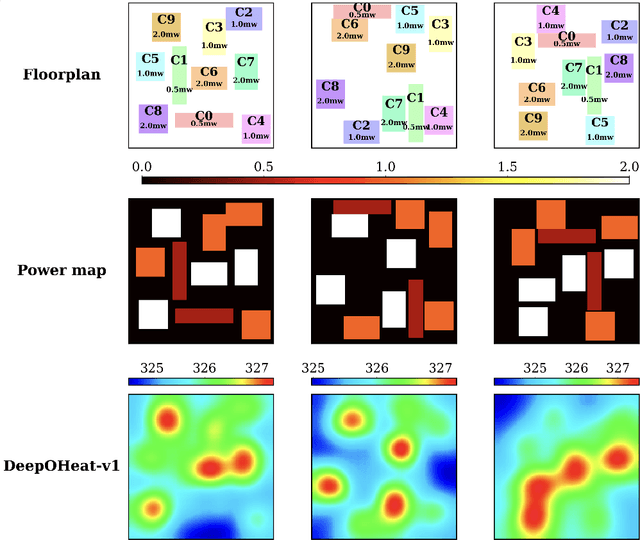
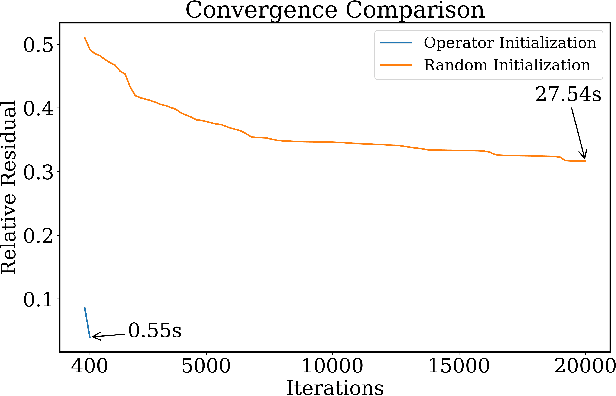
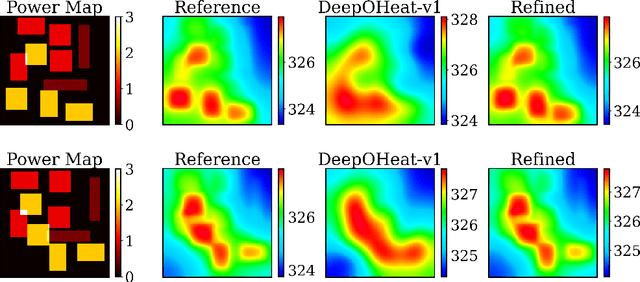
Thermal analysis is crucial in three-dimensional integrated circuit (3D-IC) design due to increased power density and complex heat dissipation paths. Although operator learning frameworks such as DeepOHeat have demonstrated promising preliminary results in accelerating thermal simulation, they face critical limitations in prediction capability for multi-scale thermal patterns, training efficiency, and trustworthiness of results during design optimization. This paper presents DeepOHeat-v1, an enhanced physics-informed operator learning framework that addresses these challenges through three key innovations. First, we integrate Kolmogorov-Arnold Networks with learnable activation functions as trunk networks, enabling an adaptive representation of multi-scale thermal patterns. This approach achieves a $1.25\times$ and $6.29\times$ reduction in error in two representative test cases. Second, we introduce a separable training method that decomposes the basis function along the coordinate axes, achieving $62\times$ training speedup and $31\times$ GPU memory reduction in our baseline case, and enabling thermal analysis at resolutions previously infeasible due to GPU memory constraints. Third, we propose a confidence score to evaluate the trustworthiness of the predicted results, and further develop a hybrid optimization workflow that combines operator learning with finite difference (FD) using Generalized Minimal Residual (GMRES) method for incremental solution refinement, enabling efficient and trustworthy thermal optimization. Experimental results demonstrate that DeepOHeat-v1 achieves accuracy comparable to optimization using high-fidelity finite difference solvers, while speeding up the entire optimization process by $70.6\times$ in our test cases, effectively minimizing the peak temperature through optimal placement of heat-generating components.
DeepOHeat: Operator Learning-based Ultra-fast Thermal Simulation in 3D-IC Design
Feb 25, 2023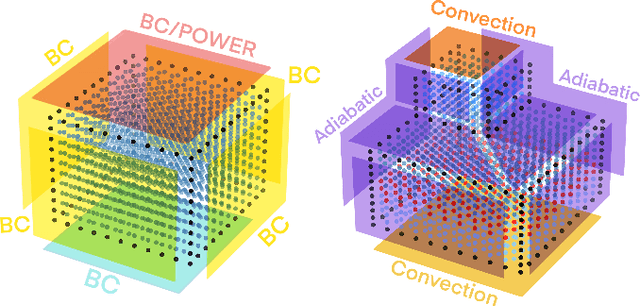
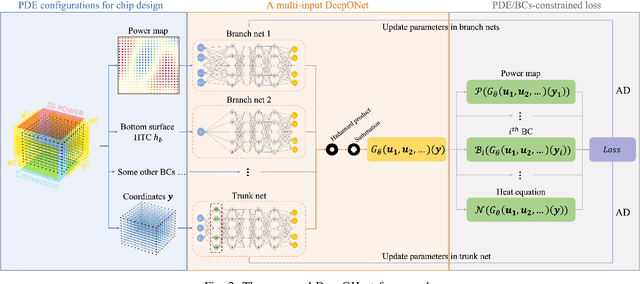
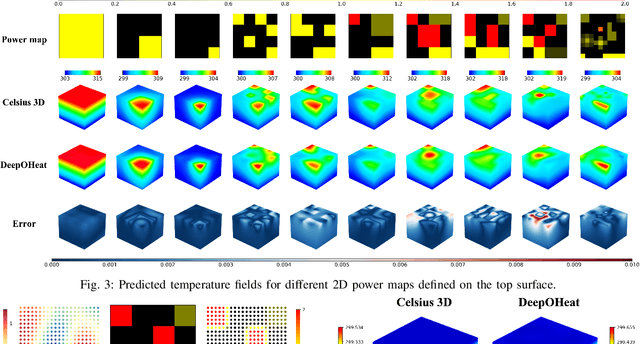
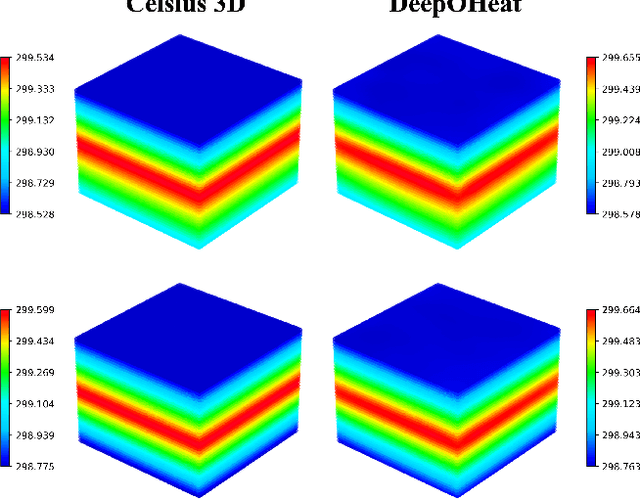
Thermal issue is a major concern in 3D integrated circuit (IC) design. Thermal optimization of 3D IC often requires massive expensive PDE simulations. Neural network-based thermal prediction models can perform real-time prediction for many unseen new designs. However, existing works either solve 2D temperature fields only or do not generalize well to new designs with unseen design configurations (e.g., heat sources and boundary conditions). In this paper, for the first time, we propose DeepOHeat, a physics-aware operator learning framework to predict the temperature field of a family of heat equations with multiple parametric or non-parametric design configurations. This framework learns a functional map from the function space of multiple key PDE configurations (e.g., boundary conditions, power maps, heat transfer coefficients) to the function space of the corresponding solution (i.e., temperature fields), enabling fast thermal analysis and optimization by changing key design configurations (rather than just some parameters). We test DeepOHeat on some industrial design cases and compare it against Celsius 3D from Cadence Design Systems. Our results show that, for the unseen testing cases, a well-trained DeepOHeat can produce accurate results with $1000\times$ to $300000\times$ speedup.