 Add to Chrome
 Add to Firefox
 Add to Edge
From Textural Counterpoint to Feature Encoding: A Multi-Dimensional Machine Representation Study of Haydn's "The Lark" Integrating Electroacoustic Analysis
Jul 07, 2026
Chamber music, as a highly precise multi-part interactive system, contains a logic of "role assignment and dynamic interaction" that provides an extremely valuable blueprint for exploring human-computer collaborative composition paradigms. Addressing the lack of role perception capabilities in existing deep music generation models during polyphonic interactions, this paper conducts an interdisciplinary analysis of Haydn's String Quartet in D Major, The Lark (Op. 64, No. 5). We propose a novel research path: "Classical Morphology Qualitative Analysis-Electroacoustic Quantitative Measurement-Machine Representation Reconstruction." The study first utilizes auditory analysis to dissect the counterpoint morphology of the leading voice and the underlying groove in the first movement. Subsequently, it introduces spectrum and dynamic feature analysis tools from a Digital Audio Workstation (DAW) to translate subjective auditory perception into objective, measurable physical parameters. Building on this, the paper introduces a fundamentally new approach to low-level computer feature extraction: completely abandoning the traditional mechanical quantization grid, introducing Event-based Timestamps to record the duration of micro-timing, and transforming acoustic features into an independent "Role-Aware Encoding" as an aesthetic heuristic mechanism (a phenomenological anchor). This study not only completes the logical loop spanning classical analysis, electronic music mapping, and AI symbolic generation but also establishes a profound theoretical foundation-from the perspectives of interactive aesthetics and media philosophy-for constructing human-computer collaborative music systems imbued with "social attributes" and "otherness awareness."

LK Jam: System Architecture and Implementation of a Real-Time Human-AI Interactive Music Generation System using Role-Aware GRU
Jun 19, 2026As artificial intelligence advances into the era of Embodied AI, live musical interaction urgently needs to break free from the limitations of offline, unidirectional generation, achieving a "virtual synergy" capable of low-latency, dynamic interplay. To address this, this technical report presents LK_Jam, a real-time, bidirectional human-computer interactive music generation system based on a lightweight Gated Recurrent Unit (GRU) and a high-performance audio host architecture. In the algorithmic representation layer, this system abandons the computationally expensive fixed time-grid. Instead, it constructs a multi-dimensional sparse event stream integrating time-shifts, continuous harmonic embeddings, and role-aware encoding, enabling the model to accurately capture turn-taking logic and micro-timing in a single-step inference. In the engineering implementation layer, this paper builds a strict multithreaded lock-free communication bridge using C++ and the JUCE framework, incorporating the RTNeural inference engine designed specifically for real-time audio. By utilizing compile-time network topology solidification and a zero-allocation (allocation-free) mechanism, the end-to-end overhead of autoregressive decoding is strictly locked at \(O(1)\) complexity, structurally mitigating the risk of audio thread dropouts in DAW plugin environments. Furthermore, this study designs a three-stage progressive training strategy, achieving a leap from basic chord harmonization to expert-level interaction. Preliminary observations and architectural analysis demonstrate that while ensuring musical coherence and interactive role-play, the proposed system successfully challenges extreme real-time engineering constraints, offering a highly robust and deployable technical paradigm for next-generation AI co-performers in live music.
ChladniSonify: A Visual-Acoustic Mapping Method for Chladni Patterns in New Media Art Creation
May 11, 2026In new media art creation, the mapping between vision and hearing is often subjective. As a classic carrier of sound visualization, Chladni patterns have great potential in building audio-visual mapping mechanisms. However, existing tools face pain points: high technical barriers for simulation, offline computing failing real-time interaction, and uncontrollable mapping rules in general sonification tools. To address these, this paper proposes ChladniSonify, a real-time visual-acoustic mapping method for Chladni patterns. Based on Kirchhoff-Love plate theory, we build a paired dataset via numerical programming and calibrate it using ANSYS finite element simulation. Focusing on the slender nodal lines of Chladni patterns, we adopt a lightweight CNN with CBAM to achieve high-precision, low-latency pattern classification. Finally, we build an end-to-end system in Python and Max/MSP, mapping recognized patterns to corresponding sine wave frequencies. Results show the system has excellent usability: the classification module achieves 99.33% accuracy on the test set with 7.03 ms inference latency; the mapped frequency matches the theoretical value with zero deviation; the average end-to-end latency is under 50 ms, meeting real-time interactive needs. This work provides a reproducible engineering prototype for Chladni audio-visual art creation.
Training-free Diffusion Model Adaptation for Variable-Sized Text-to-Image Synthesis
Jun 14, 2023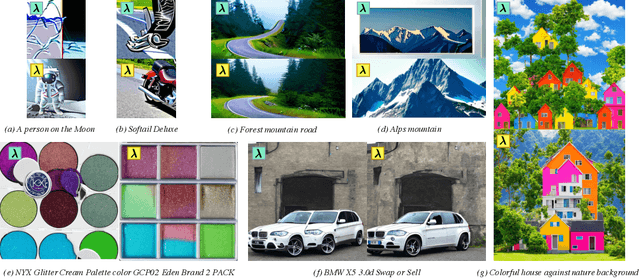
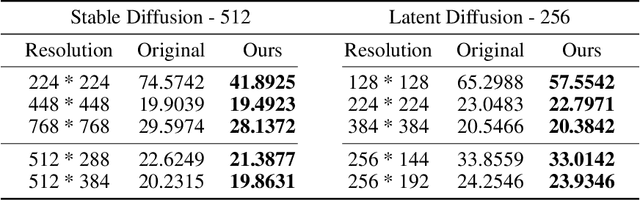
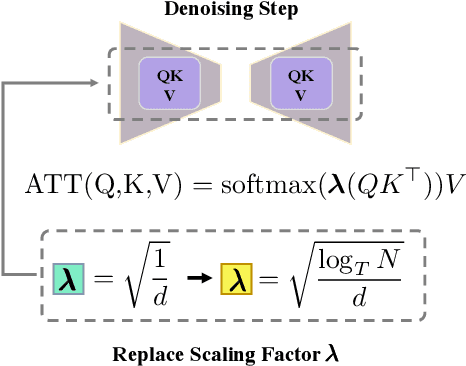
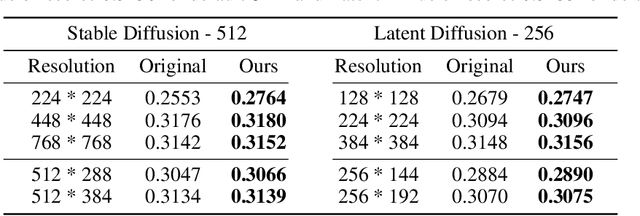
Diffusion models (DMs) have recently gained attention with state-of-the-art performance in text-to-image synthesis. Abiding by the tradition in deep learning, DMs are trained and evaluated on the images with fixed sizes. However, users are demanding for various images with specific sizes and various aspect ratio. This paper focuses on adapting text-to-image diffusion models to handle such variety while maintaining visual fidelity. First we observe that, during the synthesis, lower resolution images suffer from incomplete object portrayal, while higher resolution images exhibit repetitive presentation. Next, we establish a statistical relationship indicating that attention entropy changes with token quantity, suggesting that models aggregate spatial information in proportion to image resolution. The subsequent interpretation on our observations is that objects are incompletely depicted due to limited spatial information for low resolutions, while repetitive presentation arises from redundant spatial information for high resolutions. From this perspective, we propose a scaling factor to alleviate the change of attention entropy and mitigate the defective pattern observed. Extensive experimental results validate the efficacy of the proposed scaling factor, which enables the model to achieve better visual effects, image quality, and text alignment. Notably, these improvements are achieved without additional training or fine-tuning techniques.
Style Spectroscope: Improve Interpretability and Controllability through Fourier Analysis
Aug 12, 2022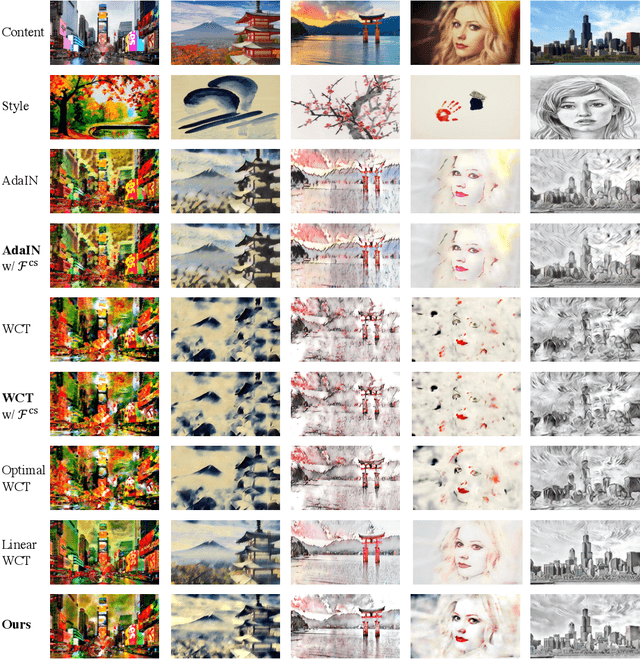

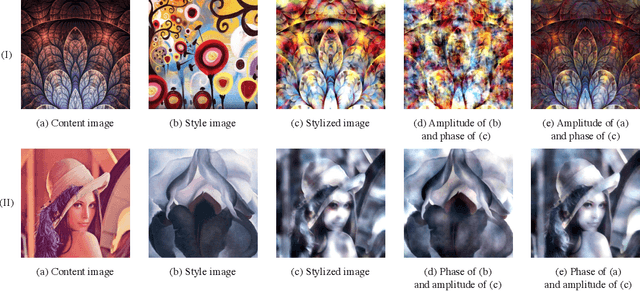
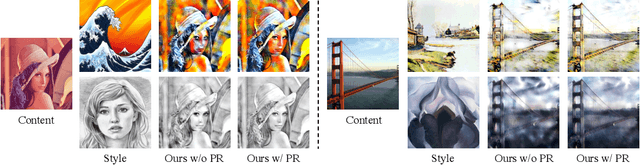
Universal style transfer (UST) infuses styles from arbitrary reference images into content images. Existing methods, while enjoying many practical successes, are unable of explaining experimental observations, including different performances of UST algorithms in preserving the spatial structure of content images. In addition, methods are limited to cumbersome global controls on stylization, so that they require additional spatial masks for desired stylization. In this work, we provide a systematic Fourier analysis on a general framework for UST. We present an equivalent form of the framework in the frequency domain. The form implies that existing algorithms treat all frequency components and pixels of feature maps equally, except for the zero-frequency component. We connect Fourier amplitude and phase with Gram matrices and a content reconstruction loss in style transfer, respectively. Based on such equivalence and connections, we can thus interpret different structure preservation behaviors between algorithms with Fourier phase. Given the interpretations we have, we propose two manipulations in practice for structure preservation and desired stylization. Both qualitative and quantitative experiments demonstrate the competitive performance of our method against the state-of-the-art methods. We also conduct experiments to demonstrate (1) the abovementioned equivalence, (2) the interpretability based on Fourier amplitude and phase and (3) the controllability associated with frequency components.