 Add to Chrome
 Add to Firefox
 Add to Edge
ManimAgent: Self-Evolving Multimodal Agents for Visual Education
Jul 01, 2026
Multi-round reflection lets agents built on large language models recover from failures within a single task, but each task remains an isolated episode: lessons learned across many reflection rounds on one task are discarded before the next begins. We study this gap on a code-generation task: from a scientific paper section, the agent writes Python in the open-source Manim library to render a mathematical animation. We present ManimAgent, a self-evolving multimodal agent that carries reflection experience across tasks through a dual-channel Episodic Memory Bank grown entirely from its own task stream, with no weight updates and no human seeds. After each animation converges, a vision-language model scores the rendered keyframes; the resulting signals populate a positive channel M+ that stores success rationales as soft Reference Examples, and a negative channel M- that stores validated failure patterns as hard Known Pitfalls. On a fixed-probe evaluation against no-memory, matched-budget retrieval-augmented generation, and shuffled-memory baselines, blind human Pass@1 rises and reflection rounds fall as memory size grows. We will release the code, frozen memory snapshots, and the task stream.

What can LLM tell us about cities?
Nov 25, 2024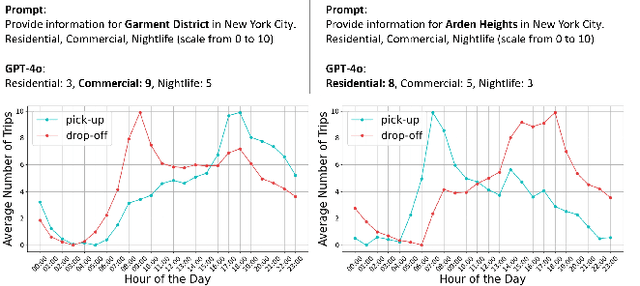
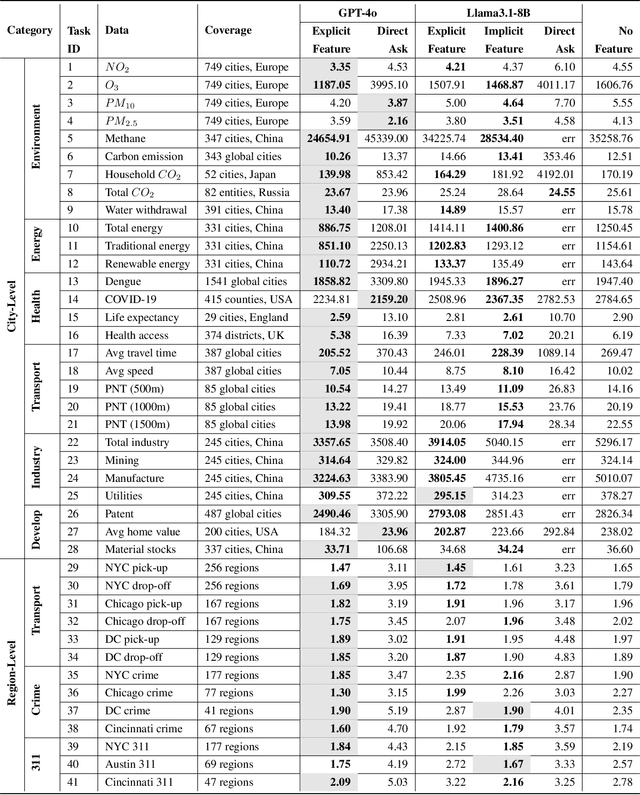
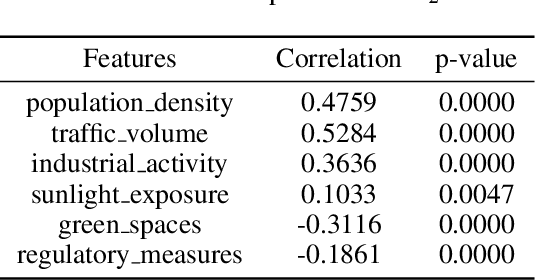
This study explores the capabilities of large language models (LLMs) in providing knowledge about cities and regions on a global scale. We employ two methods: directly querying the LLM for target variable values and extracting explicit and implicit features from the LLM correlated with the target variable. Our experiments reveal that LLMs embed a broad but varying degree of knowledge across global cities, with ML models trained on LLM-derived features consistently leading to improved predictive accuracy. Additionally, we observe that LLMs demonstrate a certain level of knowledge across global cities on all continents, but it is evident when they lack knowledge, as they tend to generate generic or random outputs for unfamiliar tasks. These findings suggest that LLMs can offer new opportunities for data-driven decision-making in the study of cities.