 Add to Chrome
 Add to Firefox
 Add to Edge
MARS-Dragonfly: Agile and Robust Flight Control of Modular Aerial Robot Systems
Apr 07, 2026
Modular Aerial Robot Systems (MARS) comprise multiple drone units with reconfigurable connected formations, providing high adaptability to diverse mission scenarios, fault conditions, and payload capacities. However, existing control algorithms for MARS rely on simplified quasi-static models and rule-based allocation, which generate discontinuous and unbounded motor commands. This leads to attitude error accumulation as the number of drone units scales, ultimately causing severe oscillations during docking, separation, and waypoint tracking. To address these limitations, we first design a compact mechanical system that enables passive docking, detection-free passive locking, and magnetic-assisted separation using a single micro servo. Second, we introduce a force-torque-equivalent and polytope-constraint virtual quadrotor that explicitly models feasible wrench sets. Together, these abstractions capture the full MARS dynamics and enable existing quadrotor controllers to be applied across different configurations. We further optimize the yaw angle that maximizes control authority to enhance agility. Third, building on this abstraction, we design a two-stage predictive-allocation pipeline: a constrained predictive tracker computes virtual inputs while respecting force/torque bounds, and a dynamic allocator maps these inputs to individual modules with balanced objectives to produce smooth, trackable motor commands. Simulations across over 10 configurations and real-world experiments demonstrate stable docking, locking, and separation, as well as effective control performance. To our knowledge, this is the first real-world demonstration of MARS achieving agile flight and transport with 40 deg peak pitch while maintaining an average position error of 0.0896 m. The video is available at: https://youtu.be/yqjccrIpz5o

Robust Fault-Tolerant Control and Agile Trajectory Planning for Modular Aerial Robotic Systems
Mar 12, 2025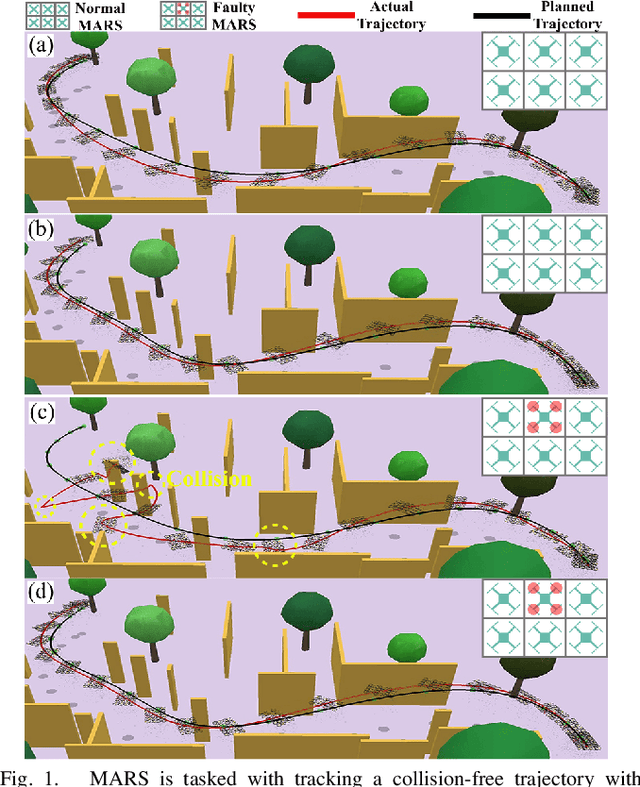
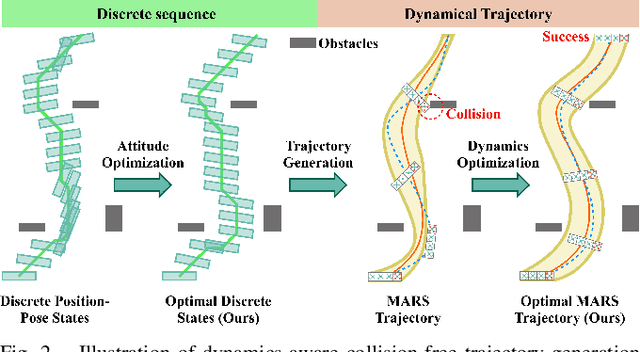
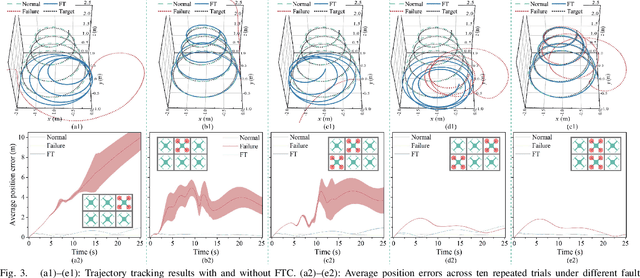
Modular Aerial Robotic Systems (MARS) consist of multiple drone units that can self-reconfigure to adapt to various mission requirements and fault conditions. However, existing fault-tolerant control methods exhibit significant oscillations during docking and separation, impacting system stability. To address this issue, we propose a novel fault-tolerant control reallocation method that adapts to arbitrary number of modular robots and their assembly formations. The algorithm redistributes the expected collective force and torque required for MARS to individual unit according to their moment arm relative to the center of MARS mass. Furthermore, We propose an agile trajectory planning method for MARS of arbitrary configurations, which is collision-avoiding and dynamically feasible. Our work represents the first comprehensive approach to enable fault-tolerant and collision avoidance flight for MARS. We validate our method through extensive simulations, demonstrating improved fault tolerance, enhanced trajectory tracking accuracy, and greater robustness in cluttered environments. The videos and source code of this work are available at https://github.com/RuiHuangNUS/MARS-FTCC/
Robust Self-Reconfiguration for Fault-Tolerant Control of Modular Aerial Robot Systems
Mar 12, 2025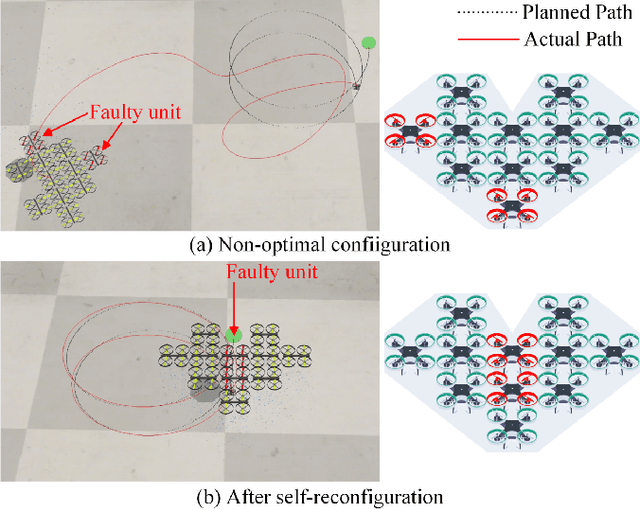
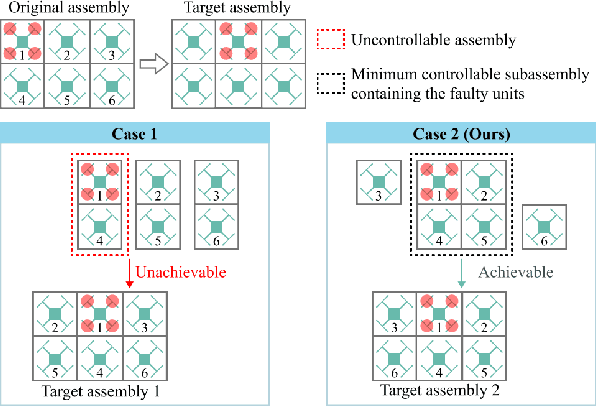
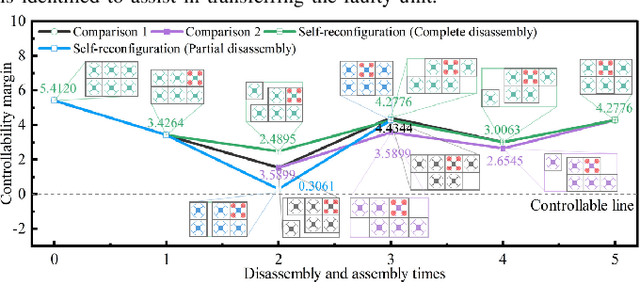
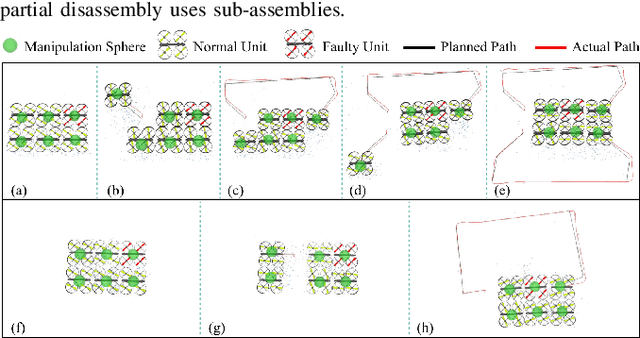
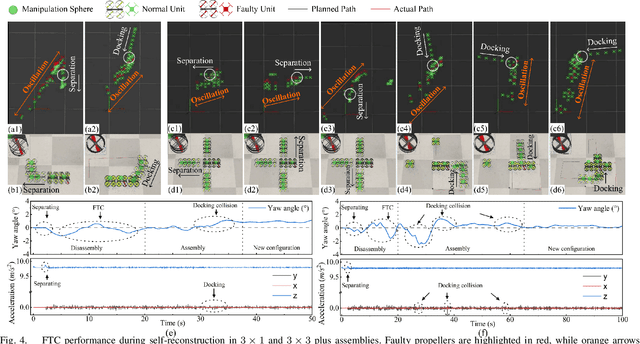
Modular Aerial Robotic Systems (MARS) consist of multiple drone units assembled into a single, integrated rigid flying platform. With inherent redundancy, MARS can self-reconfigure into different configurations to mitigate rotor or unit failures and maintain stable flight. However, existing works on MARS self-reconfiguration often overlook the practical controllability of intermediate structures formed during the reassembly process, which limits their applicability. In this paper, we address this gap by considering the control-constrained dynamic model of MARS and proposing a robust and efficient self-reconstruction algorithm that maximizes the controllability margin at each intermediate stage. Specifically, we develop algorithms to compute optimal, controllable disassembly and assembly sequences, enabling robust self-reconfiguration. Finally, we validate our method in several challenging fault-tolerant self-reconfiguration scenarios, demonstrating significant improvements in both controllability and trajectory tracking while reducing the number of assembly steps. The videos and source code of this work are available at https://github.com/RuiHuangNUS/MARS-Reconfig/