 Add to Chrome
 Add to Firefox
 Add to Edge
Linking Extreme Discourse to Structural Polarization in Signed Interaction Networks
May 12, 2026
Polarization in online communities is often studied through either language or interaction structure, but the two views are rarely connected in a unified measurement pipeline. Prior work links them by building interaction graphs from human judgments of agreement and disagreement, leaving a gap between language as observed text and structure as an engineered representation of that text. We address this gap with a language-grounded signed-network pipeline that derives continuous signed edge weights from LLM stance scores and quantifies structural polarization using two complementary measures: a spectral Eigen-Sign score and a partition-based frustration score. After normalization, the two measures show substantial agreement while retaining important differences in their sensitivity to edge magnitude. Applying the framework to Reddit Brexit discussions, we analyze how window-level discourse signals, including toxicity, extreme scalar claims, and perplexity, relate to temporal variation in structural polarization. Edge-level and ablation analyses show that continuous, confidence-weighted signed edges reveal intensity-sensitive patterns that are muted under sign-only representations. We further report an exploratory one-step-ahead forecasting analysis suggesting that lagged language signals may contain information about future polarization beyond structural persistence. Together, the results demonstrate how discourse and signed-network structure can be connected in a single framework for measuring and interpreting polarization dynamics over time.

Deep FinResearch Bench: Evaluating AI's Ability to Conduct Professional Financial Investment Research
Apr 22, 2026We introduce Deep FinResearch Bench, a practical and comprehensive evaluation framework for deep research (DR) agents in financial investment research. The benchmark assesses three dimensions of report quality: qualitative rigor, quantitative forecasting and valuation accuracy, and claim credibility and verifiability. Particularly, we define corresponding qualitative and quantitative evaluation metrics and implement an automated scoring procedure to enable scalable assessment. Applying the benchmark to financial reports from frontier DR agents and comparing them with reports authored by financial professionals, we find that AI-generated reports still fall short across these dimensions. These findings underscore the need for domain-specialized DR agents tailored to finance, and we hope the work establishes a foundation for standardized benchmarking of DR agents in financial research.
Constructing Composite Features for Interpretable Music-Tagging
Mar 30, 2026Combining multiple audio features can improve the performance of music tagging, but common deep learning-based feature fusion methods often lack interpretability. To address this problem, we propose a Genetic Programming (GP) pipeline that automatically evolves composite features by mathematically combining base music features, thereby capturing synergistic interactions while preserving interpretability. This approach provides representational benefits similar to deep feature fusion without sacrificing interpretability. Experiments on the MTG-Jamendo and GTZAN datasets demonstrate consistent improvements compared to state-of-the-art systems across base feature sets at different abstraction levels. It should be noted that most of the performance gains are noticed within the first few hundred GP evaluations, indicating that effective feature combinations can be identified under modest search budgets. The top evolved expressions include linear, nonlinear, and conditional forms, with various low-complexity solutions at top performance aligned with parsimony pressure to prefer simpler expressions. Analyzing these composite features further reveals which interactions and transformations tend to be beneficial for tagging, offering insights that remain opaque in black-box deep models.
Compositional Fusion of Signals in Data Embedding
Nov 18, 2023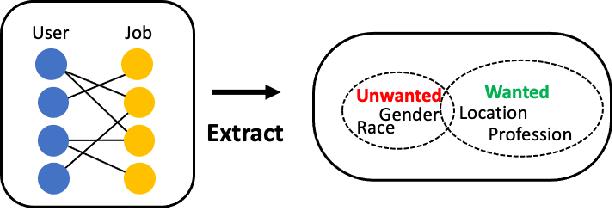
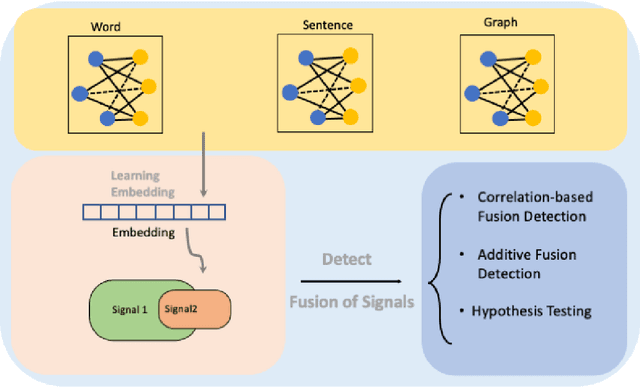
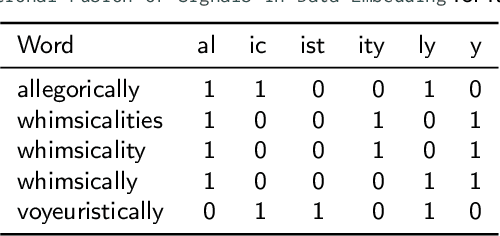
Embeddings in AI convert symbolic structures into fixed-dimensional vectors, effectively fusing multiple signals. However, the nature of this fusion in real-world data is often unclear. To address this, we introduce two methods: (1) Correlation-based Fusion Detection, measuring correlation between known attributes and embeddings, and (2) Additive Fusion Detection, viewing embeddings as sums of individual vectors representing attributes. Applying these methods, word embeddings were found to combine semantic and morphological signals. BERT sentence embeddings were decomposed into individual word vectors of subject, verb and object. In the knowledge graph-based recommender system, user embeddings, even without training on demographic data, exhibited signals of demographics like age and gender. This study highlights that embeddings are fusions of multiple signals, from Word2Vec components to demographic hints in graph embeddings.
EXTRACT: Explainable Transparent Control of Bias in Embeddings
Oct 31, 2023


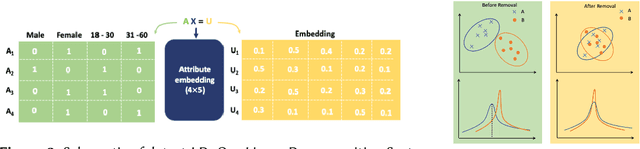
Knowledge Graphs are a widely used method to represent relations between entities in various AI applications, and Graph Embedding has rapidly become a standard technique to represent Knowledge Graphs in such a way as to facilitate inferences and decisions. As this representation is obtained from behavioural data, and is not in a form readable by humans, there is a concern that it might incorporate unintended information that could lead to biases. We propose EXTRACT: a suite of Explainable and Transparent methods to ConTrol bias in knowledge graph embeddings, so as to assess and decrease the implicit presence of protected information. Our method uses Canonical Correlation Analysis (CCA) to investigate the presence, extent and origins of information leaks during training, then decomposes embeddings into a sum of their private attributes by solving a linear system. Our experiments, performed on the MovieLens1M dataset, show that a range of personal attributes can be inferred from a user's viewing behaviour and preferences, including gender, age, and occupation. Further experiments, performed on the KG20C citation dataset, show that the information about the conference in which a paper was published can be inferred from the citation network of that article. We propose four transparent methods to maintain the capability of the embedding to make the intended predictions without retaining unwanted information. A trade-off between these two goals is observed.