 Add to Chrome
 Add to Firefox
 Add to Edge
CycleRL: Sim-to-Real Deep Reinforcement Learning for Robust Autonomous Bicycle Control
Mar 16, 2026
Autonomous bicycles offer a promising agile solution for urban mobility and last-mile logistics, however, conventional control strategies often struggle with their underactuated nonlinear dynamics, suffering from sensitivity to model mismatches and limited adaptability to real-world uncertainties. To address this, this paper presents CycleRL, the first sim-to-real deep reinforcement learning framework designed for robust autonomous bicycle control. Our approach trains an end-to-end neural control policy within the high-fidelity NVIDIA Isaac Sim environment, leveraging Proximal Policy Optimization (PPO) to circumvent the need for an explicit dynamics model. The framework features a composite reward function tailored for concurrent balance maintenance, velocity tracking, and steering control. Crucially, systematic domain randomization is employed to bridge the simulation-to-reality gap and facilitate direct transfer. In simulation, CycleRL achieves considerable performance, including a 99.90% balance success rate, a low steering tracking error of 1.15°, and a velocity tracking error of 0.18 m/s. These quantitative results, coupled with successful hardware transfer, validate DRL as an effective paradigm for autonomous bicycle control, offering superior adaptability over traditional methods. Video demonstrations are available at https://anony6f05.github.io/CycleRL/.

MERG3R: A Divide-and-Conquer Approach to Large-Scale Neural Visual Geometry
Mar 02, 2026Recent advancements in neural visual geometry, including transformer-based models such as VGGT and Pi3, have achieved impressive accuracy on 3D reconstruction tasks. However, their reliance on full attention makes them fundamentally limited by GPU memory capacity, preventing them from scaling to large, unordered image collections. We introduce MERG3R, a training-free divide-and-conquer framework that enables geometric foundation models to operate far beyond their native memory limits. MERG3R first reorders and partitions unordered images into overlapping, geometrically diverse subsets that can be reconstructed independently. It then merges the resulting local reconstructions through an efficient global alignment and confidence-weighted bundle adjustment procedure, producing a globally consistent 3D model. Our framework is model-agnostic and can be paired with existing neural geometry models. Across large-scale datasets, including 7-Scenes, NRGBD, Tanks & Temples, and Cambridge Landmarks, MERG3R consistently improves reconstruction accuracy, memory efficiency, and scalability, enabling high-quality reconstruction when the dataset exceeds memory capacity limits.
Representing Animatable Avatar via Factorized Neural Fields
Jun 02, 2024For reconstructing high-fidelity human 3D models from monocular videos, it is crucial to maintain consistent large-scale body shapes along with finely matched subtle wrinkles. This paper explores the observation that the per-frame rendering results can be factorized into a pose-independent component and a corresponding pose-dependent equivalent to facilitate frame consistency. Pose adaptive textures can be further improved by restricting frequency bands of these two components. In detail, pose-independent outputs are expected to be low-frequency, while highfrequency information is linked to pose-dependent factors. We achieve a coherent preservation of both coarse body contours across the entire input video and finegrained texture features that are time variant with a dual-branch network with distinct frequency components. The first branch takes coordinates in canonical space as input, while the second branch additionally considers features outputted by the first branch and pose information of each frame. Our network integrates the information predicted by both branches and utilizes volume rendering to generate photo-realistic 3D human images. Through experiments, we demonstrate that our network surpasses the neural radiance fields (NeRF) based state-of-the-art methods in preserving high-frequency details and ensuring consistent body contours.
Neural Fourier Filter Bank
Dec 04, 2022We present a novel method to provide efficient and highly detailed reconstructions. Inspired by wavelets, our main idea is to learn a neural field that decompose the signal both spatially and frequency-wise. We follow the recent grid-based paradigm for spatial decomposition, but unlike existing work, encourage specific frequencies to be stored in each grid via Fourier features encodings. We then apply a multi-layer perceptron with sine activations, taking these Fourier encoded features in at appropriate layers so that higher-frequency components are accumulated on top of lower-frequency components sequentially, which we sum up to form the final output. We demonstrate that our method outperforms the state of the art regarding model compactness and efficiency on multiple tasks: 2D image fitting, 3D shape reconstruction, and neural radiance fields.
ETNet: Error Transition Network for Arbitrary Style Transfer
Oct 29, 2019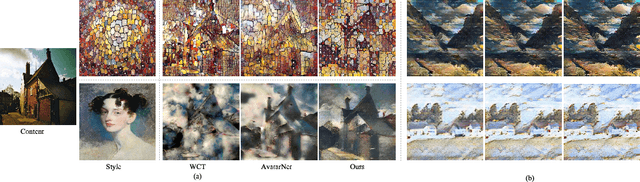

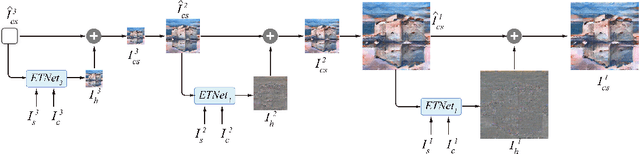

Numerous valuable efforts have been devoted to achieving arbitrary style transfer since the seminal work of Gatys et al. However, existing state-of-the-art approaches often generate insufficiently stylized results under challenging cases. We believe a fundamental reason is that these approaches try to generate the stylized result in a single shot and hence fail to fully satisfy the constraints on semantic structures in the content images and style patterns in the style images. Inspired by the works on error-correction, instead, we propose a self-correcting model to predict what is wrong with the current stylization and refine it accordingly in an iterative manner. For each refinement, we transit the error features across both the spatial and scale domain and invert the processed features into a residual image, with a network we call Error Transition Network (ETNet). The proposed model improves over the state-of-the-art methods with better semantic structures and more adaptive style pattern details. Various qualitative and quantitative experiments show that the key concept of both progressive strategy and error-correction leads to better results. Code and models are available at https://github.com/zhijieW94/ETNet.
Pair-wise Exchangeable Feature Extraction for Arbitrary Style Transfer
Nov 26, 2018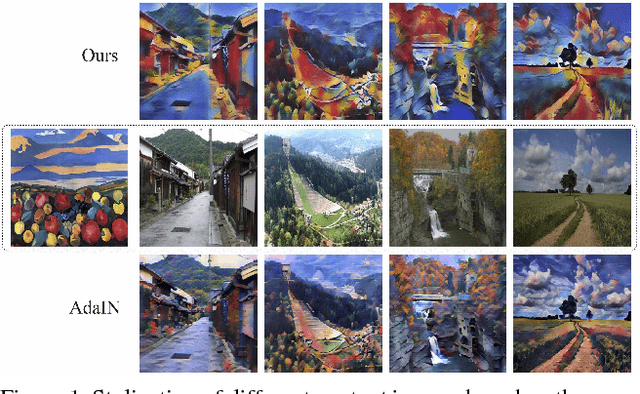
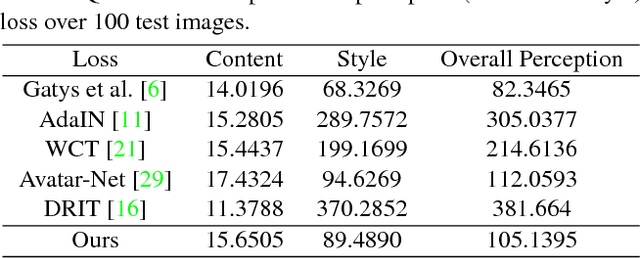
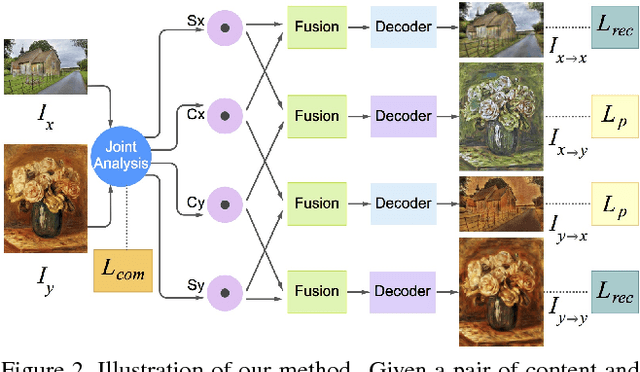
Style transfer has been an important topic in both computer vision and graphics. Gatys et al. first prove that deep features extracted by the pre-trained VGG network represent both content and style features of an image and hence, style transfer can be achieved through optimization in feature space. Huang et al. then show that real-time arbitrary style transfer can be done by simply aligning the mean and variance of each feature channel. In this paper, however, we argue that only aligning the global statistics of deep features cannot always guarantee a good style transfer. Instead, we propose to jointly analyze the input image pair and extract common/exchangeable style features between the two. Besides, a new fusion mode is developed for combining content and style information in feature space. Qualitative and quantitative experiments demonstrate the advantages of our approach.