 Add to Chrome
 Add to Firefox
 Add to Edge
DLGStream: Dynamic Language-embedded Guassian Splatting for Open-vocabulary Enabled Free-viewpoint Video Streaming
Jun 27, 2026
3D Gaussian Splatting~(3DGS) has emerged as a promising paradigm for reconstructing streamable free-viewpoint video~(FVV) from multi-view videos. However, 3DGS-based FVVs typically lack user interaction and editing capabilities, which diminishes the immersive experience. Recent research has integrated language features from CLIP into 3DGS via distillation, enabling open-vocabulary queries and supporting many downstream applications. Nevertheless, the stringent requirements of FVV, low frame size and high FPS, make current language Gaussian representations unsuitable for language-embedded FVV. In this paper, we propose DLGStream, a novel language-embedded FVV representation that streams time-varying language features alongside Gaussian attributes to support 4D environment interaction, scene editing, and spatial intelligence. Specifically, we propose a dual-opacity dynamic language Gaussian representation, which maintains two opacity attributes for color and language features to deal with performance degradation that occurs when colors and features are jointly optimized. Furthermore, we introduce an interpolation-based deformation field to reduce temporal redundancy. This deformation field can also be used for 4D frame interpolation, boosting FVV sequences from low to high FPS. Experimental results demonstrate that DLGStream achieves superior performance in both on open-vocabulary segmentation and reconstruction quality with an average frame size of merely 43 KB. The code is available on \href{https://github.com/kkkzh/DLGStream}{https://github.com/kkkzh/DLGStream}.

StreamSTGS: Streaming Spatial and Temporal Gaussian Grids for Real-Time Free-Viewpoint Video
Nov 08, 2025Streaming free-viewpoint video~(FVV) in real-time still faces significant challenges, particularly in training, rendering, and transmission efficiency. Harnessing superior performance of 3D Gaussian Splatting~(3DGS), recent 3DGS-based FVV methods have achieved notable breakthroughs in both training and rendering. However, the storage requirements of these methods can reach up to $10$MB per frame, making stream FVV in real-time impossible. To address this problem, we propose a novel FVV representation, dubbed StreamSTGS, designed for real-time streaming. StreamSTGS represents a dynamic scene using canonical 3D Gaussians, temporal features, and a deformation field. For high compression efficiency, we encode canonical Gaussian attributes as 2D images and temporal features as a video. This design not only enables real-time streaming, but also inherently supports adaptive bitrate control based on network condition without any extra training. Moreover, we propose a sliding window scheme to aggregate adjacent temporal features to learn local motions, and then introduce a transformer-guided auxiliary training module to learn global motions. On diverse FVV benchmarks, StreamSTGS demonstrates competitive performance on all metrics compared to state-of-the-art methods. Notably, StreamSTGS increases the PSNR by an average of $1$dB while reducing the average frame size to just $170$KB. The code is publicly available on https://github.com/kkkzh/StreamSTGS.
TimeFormer: Capturing Temporal Relationships of Deformable 3D Gaussians for Robust Reconstruction
Nov 18, 2024Dynamic scene reconstruction is a long-term challenge in 3D vision. Recent methods extend 3D Gaussian Splatting to dynamic scenes via additional deformation fields and apply explicit constraints like motion flow to guide the deformation. However, they learn motion changes from individual timestamps independently, making it challenging to reconstruct complex scenes, particularly when dealing with violent movement, extreme-shaped geometries, or reflective surfaces. To address the above issue, we design a plug-and-play module called TimeFormer to enable existing deformable 3D Gaussians reconstruction methods with the ability to implicitly model motion patterns from a learning perspective. Specifically, TimeFormer includes a Cross-Temporal Transformer Encoder, which adaptively learns the temporal relationships of deformable 3D Gaussians. Furthermore, we propose a two-stream optimization strategy that transfers the motion knowledge learned from TimeFormer to the base stream during the training phase. This allows us to remove TimeFormer during inference, thereby preserving the original rendering speed. Extensive experiments in the multi-view and monocular dynamic scenes validate qualitative and quantitative improvement brought by TimeFormer. Project Page: https://patrickddj.github.io/TimeFormer/
DS-NeRV: Implicit Neural Video Representation with Decomposed Static and Dynamic Codes
Mar 23, 2024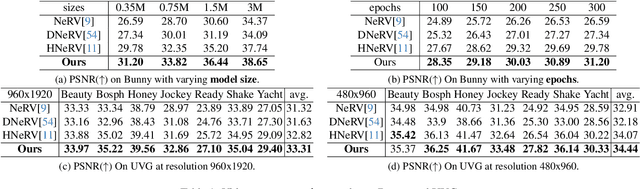
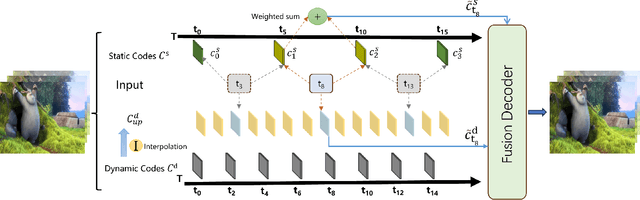

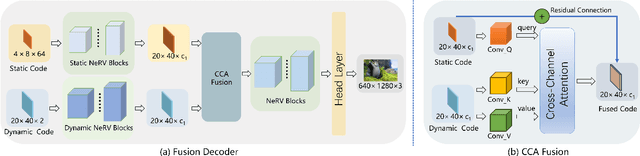
Implicit neural representations for video (NeRV) have recently become a novel way for high-quality video representation. However, existing works employ a single network to represent the entire video, which implicitly confuse static and dynamic information. This leads to an inability to effectively compress the redundant static information and lack the explicitly modeling of global temporal-coherent dynamic details. To solve above problems, we propose DS-NeRV, which decomposes videos into sparse learnable static codes and dynamic codes without the need for explicit optical flow or residual supervision. By setting different sampling rates for two codes and applying weighted sum and interpolation sampling methods, DS-NeRV efficiently utilizes redundant static information while maintaining high-frequency details. Additionally, we design a cross-channel attention-based (CCA) fusion module to efficiently fuse these two codes for frame decoding. Our approach achieves a high quality reconstruction of 31.2 PSNR with only 0.35M parameters thanks to separate static and dynamic codes representation and outperforms existing NeRV methods in many downstream tasks. Our project website is at https://haoyan14.github.io/DS-NeRV.
4D-Editor: Interactive Object-level Editing in Dynamic Neural Radiance Fields via Semantic Distillation
Nov 06, 2023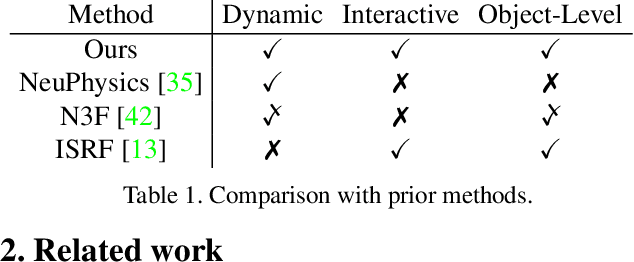
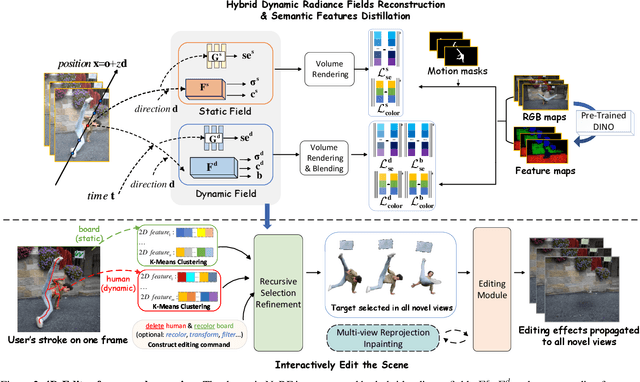
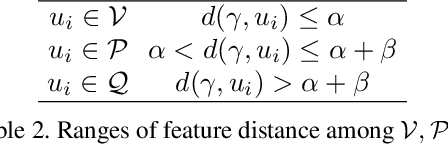
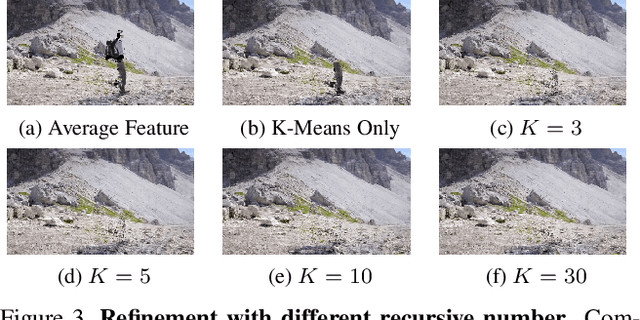
This paper targets interactive object-level editing (e.g., deletion, recoloring, transformation, composition) in dynamic scenes. Recently, some methods aiming for flexible editing static scenes represented by neural radiance field (NeRF) have shown impressive synthesis quality, while similar capabilities in time-variant dynamic scenes remain limited. To solve this problem, we propose 4D-Editor, an interactive semantic-driven editing framework, allowing editing multiple objects in a dynamic NeRF with user strokes on a single frame. We propose an extension to the original dynamic NeRF by incorporating a hybrid semantic feature distillation to maintain spatial-temporal consistency after editing. In addition, we design Recursive Selection Refinement that significantly boosts object segmentation accuracy within a dynamic NeRF to aid the editing process. Moreover, we develop Multi-view Reprojection Inpainting to fill holes caused by incomplete scene capture after editing. Extensive experiments and editing examples on real-world demonstrate that 4D-Editor achieves photo-realistic editing on dynamic NeRFs. Project page: https://patrickddj.github.io/4D-Editor