 Add to Chrome
 Add to Firefox
 Add to Edge
Markov State--Space Modeling and Channel Characterization for DNA-Based Molecular Communication
Mar 24, 2026
In this paper, we study DNA-based molecular communication with microarray-style reception under reversible hybridization, where the bound-state observation exhibits both inter-symbol interference and colored counting noise. To capture these effects in a communication-oriented form, we develop a Markov state-space framework based on a voxelized reaction--diffusion model, in which a block-structured transition matrix describes molecular transport and binding/unbinding dynamics. For the microarray specialization, this representation yields the channel impulse response, the equilibrium gain, and a settling-time-based characterization of the effective channel memory. Building on the resulting symbol-rate observation model for on--off keying, we derive a grouped-binomial counting model and obtain a closed-form expression for the covariance of the counting noise. Based on these statistics, we further develop a differential-threshold detector and a finite-memory decision-feedback equalizer. Numerical results validate the theoretical correlation behavior and show that the relative performance of the proposed receivers depends strongly on the channel-memory regime.

N3H-Core: Neuron-designed Neural Network Accelerator via FPGA-based Heterogeneous Computing Cores
Dec 15, 2021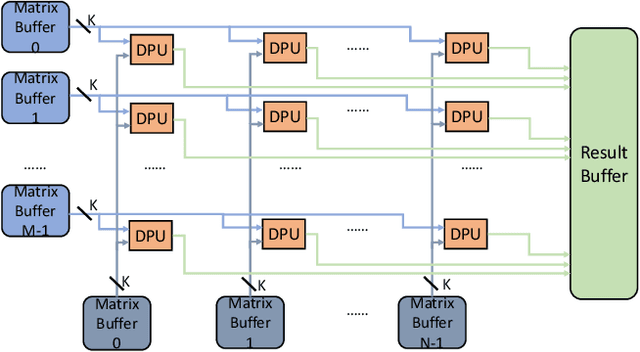
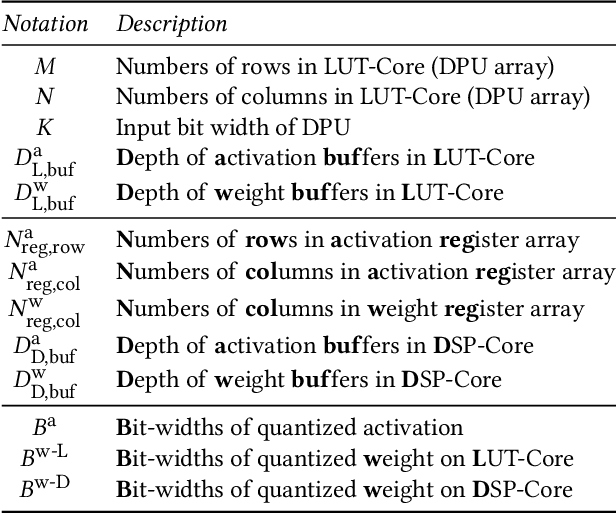
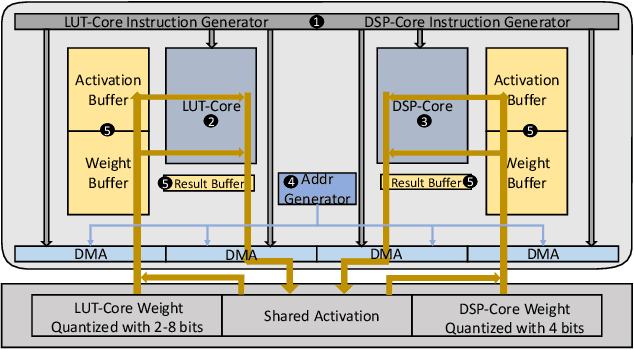
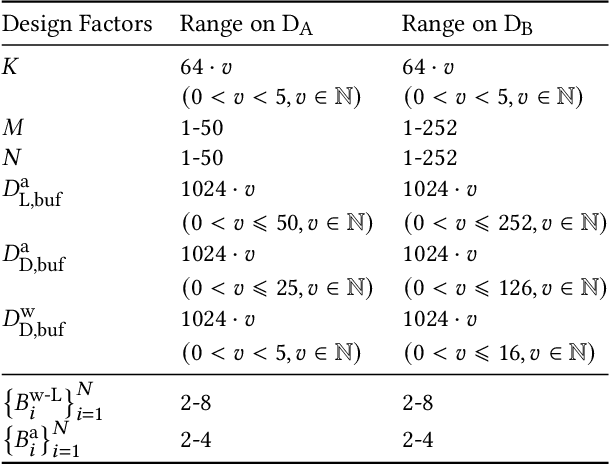
Accelerating the neural network inference by FPGA has emerged as a popular option, since the reconfigurability and high performance computing capability of FPGA intrinsically satisfies the computation demand of the fast-evolving neural algorithms. However, the popular neural accelerators on FPGA (e.g., Xilinx DPU) mainly utilize the DSP resources for constructing their processing units, while the rich LUT resources are not well exploited. Via the software-hardware co-design approach, in this work, we develop an FPGA-based heterogeneous computing system for neural network acceleration. From the hardware perspective, the proposed accelerator consists of DSP- and LUT-based GEneral Matrix-Multiplication (GEMM) computing cores, which forms the entire computing system in a heterogeneous fashion. The DSP- and LUT-based GEMM cores are computed w.r.t a unified Instruction Set Architecture (ISA) and unified buffers. Along the data flow of the neural network inference path, the computation of the convolution/fully-connected layer is split into two portions, handled by the DSP- and LUT-based GEMM cores asynchronously. From the software perspective, we mathematically and systematically model the latency and resource utilization of the proposed heterogeneous accelerator, regarding varying system design configurations. Through leveraging the reinforcement learning technique, we construct a framework to achieve end-to-end selection and optimization of the design specification of target heterogeneous accelerator, including workload split strategy, mixed-precision quantization scheme, and resource allocation of DSP- and LUT-core. In virtue of the proposed design framework and heterogeneous computing system, our design outperforms the state-of-the-art Mix&Match design with latency reduced by 1.12-1.32x with higher inference accuracy. The N3H-core is open-sourced at: https://github.com/elliothe/N3H_Core.