 Add to Chrome
 Add to Firefox
 Add to Edge
Evaluating Encoding Strategies for Closed-Loop Classification in Biological Neural Networks
Jul 15, 2026
Interfacing with Biological Neural Networks (BNNs) requires encoding information into stimulation patterns that can be effectively processed and that enable the underlying system to adapt. Nevertheless, the role of stimulation encoding remains poorly understood. In this work, we compare multiple encoding strategies, including rate-based, phase-based, burst-based, and time-to-first-spike temporal encodings, in a closed-loop neural classification task using cultured BNNs. We encode visual inputs as spatiotemporal stimulation patterns delivered via a Multi-Electrode Array (MEA) and evaluate classification performance for each encoding scheme. We find that burst-based temporal encoding yields the highest observed performance, achieving up to 95.6 % accuracy in a binary classification task, compared to substantially lower performance from rate- and phase-based approaches. We further show that performance is highly sensitive to the spatial distribution of stimulation, with suboptimal electrode selection significantly degrading accuracy. These findings indicate that effective interfacing with biological neural systems requires the joint optimization of temporal and spatial encoding strategies, and highlight temporal encoding as a key design dimension for bio-digital computing.

Molecular ISAC via Markov State-Space Modeling: Joint Distance Sensing and Data Detection
May 03, 2026This paper develops a molecular integrated sensing and communication (ISAC) framework that exploits the same molecular observations for physical-parameter sensing and data detection. As a representative instantiation, we consider a microfluidic molecular communication (MC) channel and study transmitter--receiver (TX--RX) distance sensing, where the distance affects the propagation delay, transient response, and inter-symbol interference structure. A distance-parameterized Markov state--space model is established to obtain distance-dependent channel impulse responses and a block observation model for on-off keying signaling. Based on this model, we design a pilot-assisted low-complexity receiver that combines distance initialization, decision-feedback equalization (DFE), and iterative joint refinement. Numerical results show accurate distance sensing and improved bit error ratio (BER), demonstrating the mutual benefit between sensing and communication and highlighting microfluidic MC as a representative platform for molecular ISAC.
Markov State--Space Modeling and Channel Characterization for DNA-Based Molecular Communication
Mar 24, 2026In this paper, we study DNA-based molecular communication with microarray-style reception under reversible hybridization, where the bound-state observation exhibits both inter-symbol interference and colored counting noise. To capture these effects in a communication-oriented form, we develop a Markov state-space framework based on a voxelized reaction--diffusion model, in which a block-structured transition matrix describes molecular transport and binding/unbinding dynamics. For the microarray specialization, this representation yields the channel impulse response, the equilibrium gain, and a settling-time-based characterization of the effective channel memory. Building on the resulting symbol-rate observation model for on--off keying, we derive a grouped-binomial counting model and obtain a closed-form expression for the covariance of the counting noise. Based on these statistics, we further develop a differential-threshold detector and a finite-memory decision-feedback equalizer. Numerical results validate the theoretical correlation behavior and show that the relative performance of the proposed receivers depends strongly on the channel-memory regime.
Modulation, ISI, and Detection for Langmuir Adsorption-Based Microfluidic Molecular Communication
Jan 16, 2026This paper studies microfluidic molecular communication receivers with finite-capacity Langmuir adsorption driven by an effective surface concentration. In the reaction-limited regime, we derive a closed-form single-pulse response kernel and a symbol-rate recursion for on-off keying that explicitly exposes channel memory and inter-symbol interference. We further develop short-pulse and long-pulse approximations, revealing an interference asymmetry in the long-pulse regime due to saturation. To account for stochasticity, we adopt a finite-receptor binomial counting model, employ pulse-end sampling, and propose a low-complexity midpoint-threshold detector that reduces to a fixed threshold when interference is negligible. Numerical results corroborate the proposed characterization and quantify detection performance versus pulse and symbol durations.
Selective Reviews of Bandit Problems in AI via a Statistical View
Dec 03, 2024
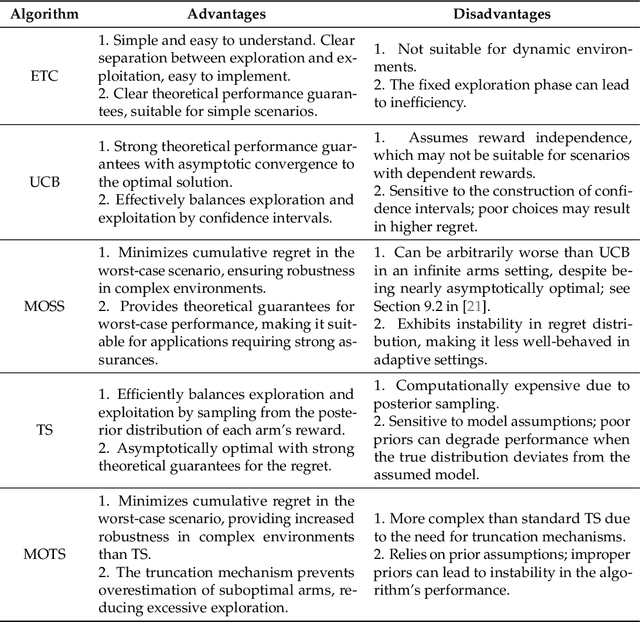
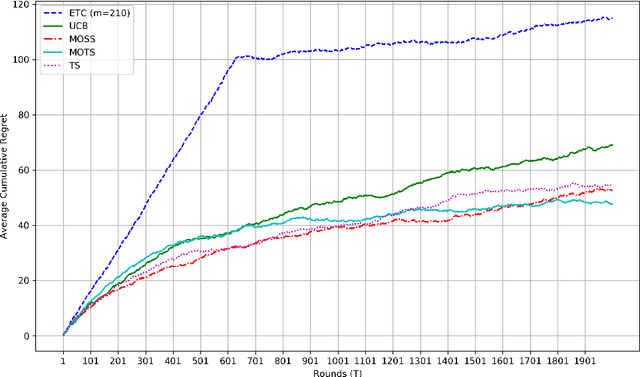
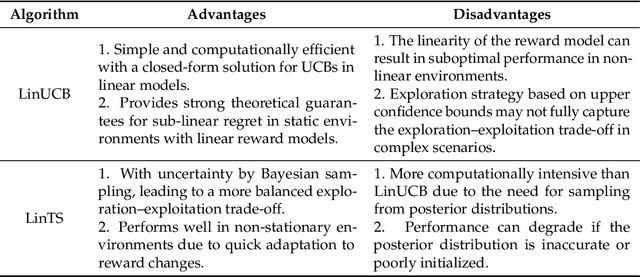
Reinforcement Learning (RL) is a widely researched area in artificial intelligence that focuses on teaching agents decision-making through interactions with their environment. A key subset includes stochastic multi-armed bandit (MAB) and continuum-armed bandit (SCAB) problems, which model sequential decision-making under uncertainty. This review outlines the foundational models and assumptions of bandit problems, explores non-asymptotic theoretical tools like concentration inequalities and minimax regret bounds, and compares frequentist and Bayesian algorithms for managing exploration-exploitation trade-offs. We also extend the discussion to $K$-armed contextual bandits and SCAB, examining their methodologies, regret analyses, and discussing the relation between the SCAB problems and the functional data analysis. Finally, we highlight recent advances and ongoing challenges in the field.