 Add to Chrome
 Add to Firefox
 Add to Edge
LongFlow: Efficient KV Cache Compression for Reasoning M
Mar 12, 2026
Recent reasoning models such as OpenAI-o1 and DeepSeek-R1 have shown strong performance on complex tasks including mathematical reasoning and code generation. However, this performance gain comes with substantially longer output sequences, leading to significantly increased deployment costs. In particular, long outputs require large KV caches, resulting in high memory consumption and severe bandwidth pressure during attention computation. Most existing KV cache optimization methods are designed for long-input, short-output scenarios and are ineffective for the long-output setting of reasoning models. Moreover, importance estimation in prior work is computationally expensive and becomes prohibitive when continuous re-evaluation is required during long generation. To address these challenges, we propose LongFlow, a KV cache compression method with an efficient importance estimation metric derived from an intermediate result of attention computation using only the current query. This design introduces negligible computational overhead and requires no auxiliary storage. We further develop a custom kernel that fuses FlashAttention, importance estimation, and token eviction into a single optimized operator, improving system-level efficiency. Experiments show that LongFlow achieves up to an 11.8 times throughput improvement with 80% KV cache compression with minimal impact on model accuracy.

Where Matters More Than What: Decoding-aligned KV Cache Compression via Position-aware Pseudo Queries
Mar 12, 2026The Key-Value (KV) cache is crucial for efficient Large Language Models (LLMs) inference, but excessively long contexts drastically increase KV cache memory footprint. Existing KV cache compression methods typically rely on input-side attention patterns within a prompt observation window to estimate token importance during the prefill stage. They fail to preserve critical tokens for future generation since these assessments are not derived from the decoding process. Intuitively, an effective observation window should mirror the decoding-stage queries to accurately reflect which tokens the generation process will attend to. However, ground-truth decoding queries are inherently unavailable during inference. For constructing pseudo queries to approximate them, we find that positional information plays a more critical role than semantic content. Motivated by this insight, we propose decoding-aligned KV cache compression via position-aware pseudo queries (DapQ), a novel and lightweight eviction framework that leverages position-aware pseudo queries to simulate the output tokens, thereby establishing an effective observation window for importance assessment. It aligns closely with the actual generation context and enables precise token eviction. Extensive evaluations across multiple benchmarks and LLMs demonstrate that DapQ achieves superior performance, particularly under strict memory constraints (e.g., up to nearly lossless performance 99.5% on NIAH with 3% KV cache budgets).
Alignment-Augmented Speculative Decoding with Alignment Sampling and Conditional Verification
May 19, 2025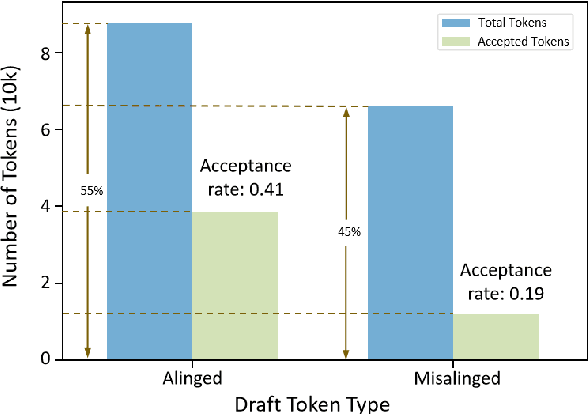
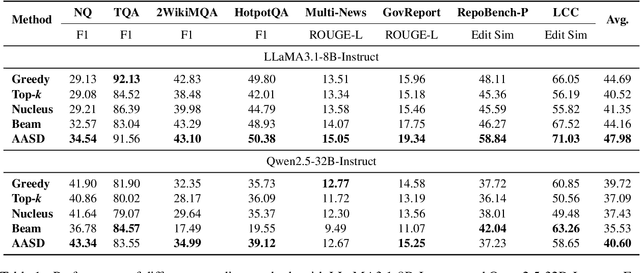
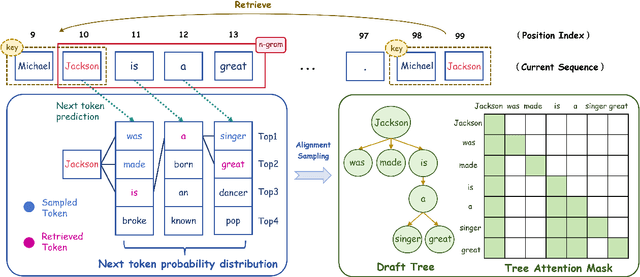
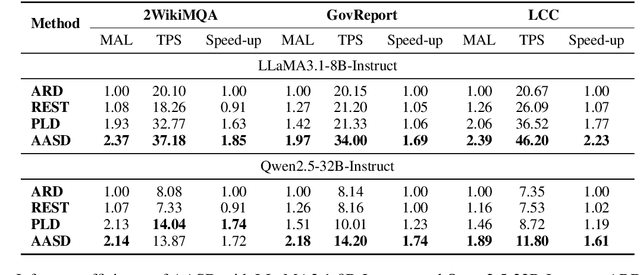
Recent works have revealed the great potential of speculative decoding in accelerating the autoregressive generation process of large language models. The success of these methods relies on the alignment between draft candidates and the sampled outputs of the target model. Existing methods mainly achieve draft-target alignment with training-based methods, e.g., EAGLE, Medusa, involving considerable training costs. In this paper, we present a training-free alignment-augmented speculative decoding algorithm. We propose alignment sampling, which leverages output distribution obtained in the prefilling phase to provide more aligned draft candidates. To further benefit from high-quality but non-aligned draft candidates, we also introduce a simple yet effective flexible verification strategy. Through an adaptive probability threshold, our approach can improve generation accuracy while further improving inference efficiency. Experiments on 8 datasets (including question answering, summarization and code completion tasks) show that our approach increases the average generation score by 3.3 points for the LLaMA3 model. Our method achieves a mean acceptance length up to 2.39 and speed up generation by 2.23.