 Add to Chrome
 Add to Firefox
 Add to Edge
X-Foresight: A Joint Vision-Action Causal Forecasting Network via Predictive World Modeling
May 24, 2026
Physical world knowledge resides mainly in videos. Equipping Vision-Language-Action (VLA) models with such knowledge is fundamental for safe and generalizable planning. Predictive world modeling enables VLA to internalize physical dynamics and long-term causality by predicting future video from past observations. However, naive next-frame prediction faces two challenges: 1) unlike semantically distinct text tokens, video tokens are low-entropy and redundant, causing prediction to degenerate into trivial extrapolation. 2) world modeling poses a temporal dilemma: dense prediction captures instantaneous dynamics, but cannot efficiently model long-horizon causality. To learn world knowledge effectively, we introduce X-Foresight, a predictive world model integrated directly into the VLA architecture to jointly learn world modeling and real-time action control. At its core lies a long-horizon chunk-wise auto-regressive strategy that addresses both challenges: by predicting semantically distant chunks rather than adjacent frames, it escapes trivial extrapolation, while preserving dense intra-chunk frames for instantaneous dynamics and sparse inter-chunk transitions for long-term causality. A curriculum learning schedule progressively extends prediction horizons and stabilizes long-horizon training. To capture long-term causality effectively, we present temporal importance sampling, which concentrates supervision on safety-critical chunks identified by ego-motion and behavioral signals. We further delegate photorealistic synthesis to a diffusion-based multi-view renderer, improving photorealistic appearance. Comprehensive experiments demonstrate that X-Foresight significantly outperforms VLA baselines in planning performance while maintaining strong generative fidelity, establishing a robust paradigm for world-knowledge-driven autonomous systems.

ExFuse: Enhancing Feature Fusion for Semantic Segmentation
Apr 11, 2018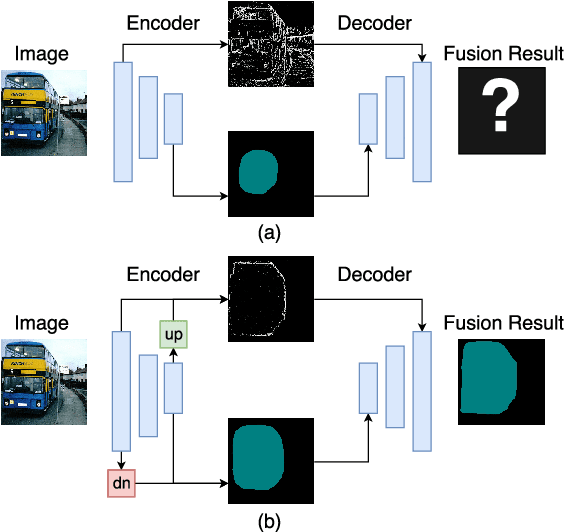
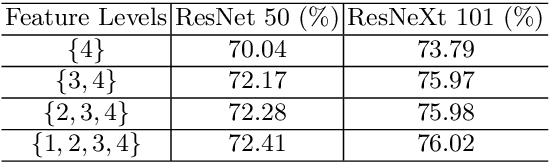
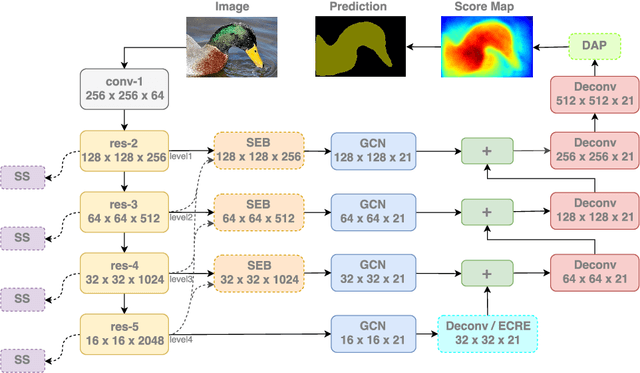
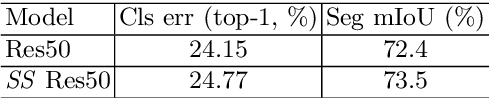
Modern semantic segmentation frameworks usually combine low-level and high-level features from pre-trained backbone convolutional models to boost performance. In this paper, we first point out that a simple fusion of low-level and high-level features could be less effective because of the gap in semantic levels and spatial resolution. We find that introducing semantic information into low-level features and high-resolution details into high-level features is more effective for the later fusion. Based on this observation, we propose a new framework, named ExFuse, to bridge the gap between low-level and high-level features thus significantly improve the segmentation quality by 4.0\% in total. Furthermore, we evaluate our approach on the challenging PASCAL VOC 2012 segmentation benchmark and achieve 87.9\% mean IoU, which outperforms the previous state-of-the-art results.