 Add to Chrome
 Add to Firefox
 Add to Edge
X-Foresight: A Joint Vision-Action Causal Forecasting Network via Predictive World Modeling
May 24, 2026
Physical world knowledge resides mainly in videos. Equipping Vision-Language-Action (VLA) models with such knowledge is fundamental for safe and generalizable planning. Predictive world modeling enables VLA to internalize physical dynamics and long-term causality by predicting future video from past observations. However, naive next-frame prediction faces two challenges: 1) unlike semantically distinct text tokens, video tokens are low-entropy and redundant, causing prediction to degenerate into trivial extrapolation. 2) world modeling poses a temporal dilemma: dense prediction captures instantaneous dynamics, but cannot efficiently model long-horizon causality. To learn world knowledge effectively, we introduce X-Foresight, a predictive world model integrated directly into the VLA architecture to jointly learn world modeling and real-time action control. At its core lies a long-horizon chunk-wise auto-regressive strategy that addresses both challenges: by predicting semantically distant chunks rather than adjacent frames, it escapes trivial extrapolation, while preserving dense intra-chunk frames for instantaneous dynamics and sparse inter-chunk transitions for long-term causality. A curriculum learning schedule progressively extends prediction horizons and stabilizes long-horizon training. To capture long-term causality effectively, we present temporal importance sampling, which concentrates supervision on safety-critical chunks identified by ego-motion and behavioral signals. We further delegate photorealistic synthesis to a diffusion-based multi-view renderer, improving photorealistic appearance. Comprehensive experiments demonstrate that X-Foresight significantly outperforms VLA baselines in planning performance while maintaining strong generative fidelity, establishing a robust paradigm for world-knowledge-driven autonomous systems.

How to Evaluate Monocular Depth Estimation?
Oct 22, 2025Monocular depth estimation is an important task with rapid progress, but how to evaluate it remains an open question, as evidenced by a lack of standardization in existing literature and a large selection of evaluation metrics whose trade-offs and behaviors are not well understood. This paper contributes a novel, quantitative analysis of existing metrics in terms of their sensitivity to various types of perturbations of ground truth, emphasizing comparison to human judgment. Our analysis reveals that existing metrics are severely under-sensitive to curvature perturbation such as making flat surfaces wavy. To remedy this, we introduce a new metric based on relative surface normals, along with new depth visualization tools and a principled method to create composite metrics with better human alignment. Code and data are available at: https://github.com/princeton-vl/evalmde.
OMNI-DC: Highly Robust Depth Completion with Multiresolution Depth Integration
Nov 28, 2024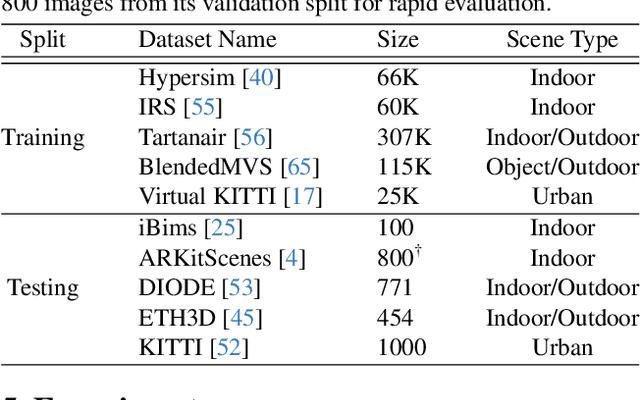
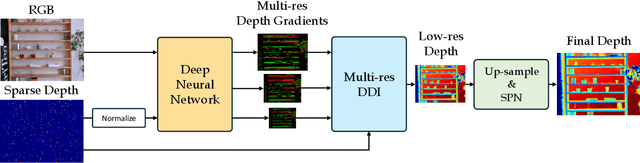
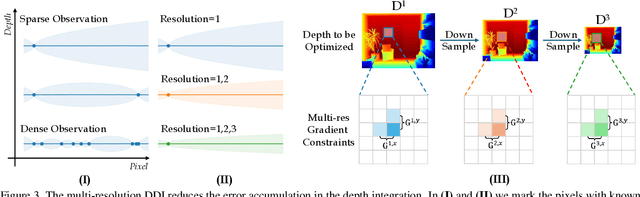
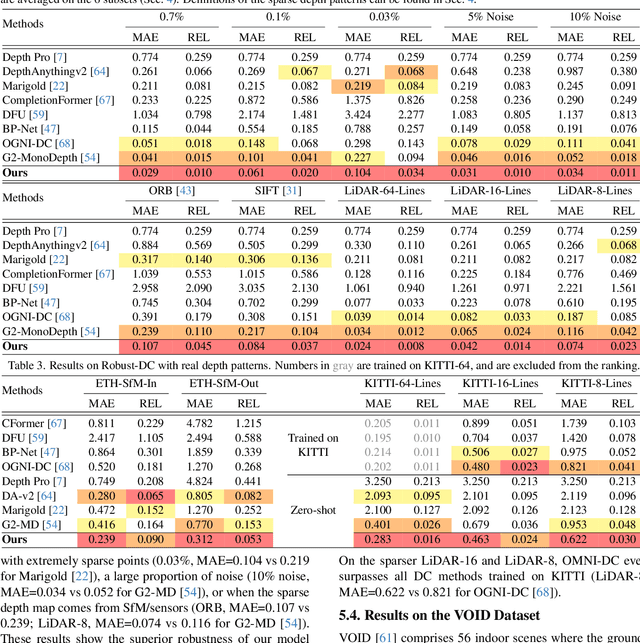
Depth completion (DC) aims to predict a dense depth map from an RGB image and sparse depth observations. Existing methods for DC generalize poorly on new datasets or unseen sparse depth patterns, limiting their practical applications. We propose OMNI-DC, a highly robust DC model that generalizes well across various scenarios. Our method incorporates a novel multi-resolution depth integration layer and a probability-based loss, enabling it to deal with sparse depth maps of varying densities. Moreover, we train OMNI-DC on a mixture of synthetic datasets with a scale normalization technique. To evaluate our model, we establish a new evaluation protocol named Robust-DC for zero-shot testing under various sparse depth patterns. Experimental results on Robust-DC and conventional benchmarks show that OMNI-DC significantly outperforms the previous state of the art. The checkpoints, training code, and evaluations are available at https://github.com/princeton-vl/OMNI-DC.