 Add to Chrome
 Add to Firefox
 Add to Edge
End-to-End Identifiable and Consistent Recurrent Switching Dynamical Systems
May 07, 2026
Learning identifiable representations in deep generative models remains a fundamental challenge, particularly for sequential data with regime-switching dynamics. Existing approaches establish identifiability under restrictive assumptions, such as stationarity or limited emission models, and typically rely on variational autoencoder (VAE) estimators, which introduce approximation gaps that limit the recovery of the latent structure. In this work, we address both the theoretical and practical limitations of this setting. First, we establish identifiability of a broad class of recurrent nonlinear switching dynamical systems under flexible assumptions, significantly extending prior results. Second, we introduce $Ω$SDS, a flow-based estimator that enables exact likelihood optimization using expectation-maximisation. Through empirical validation on both synthetic and real-world data, our results demonstrate that $Ω$SDS achieves improved disentanglement compared to VAE-based estimators and more accurate forecasting of underlying dynamics.

TabRep: a Simple and Effective Continuous Representation for Training Tabular Diffusion Models
Apr 09, 2025Diffusion models have been the predominant generative model for tabular data generation. However, they face the conundrum of modeling under a separate versus a unified data representation. The former encounters the challenge of jointly modeling all multi-modal distributions of tabular data in one model. While the latter alleviates this by learning a single representation for all features, it currently leverages sparse suboptimal encoding heuristics and necessitates additional computation costs. In this work, we address the latter by presenting TabRep, a tabular diffusion architecture trained with a unified continuous representation. To motivate the design of our representation, we provide geometric insights into how the data manifold affects diffusion models. The key attributes of our representation are composed of its density, flexibility to provide ample separability for nominal features, and ability to preserve intrinsic relationships. Ultimately, TabRep provides a simple yet effective approach for training tabular diffusion models under a continuous data manifold. Our results showcase that TabRep achieves superior performance across a broad suite of evaluations. It is the first to synthesize tabular data that exceeds the downstream quality of the original datasets while preserving privacy and remaining computationally efficient.
Differentiable Voxelization and Mesh Morphing
Jul 15, 2024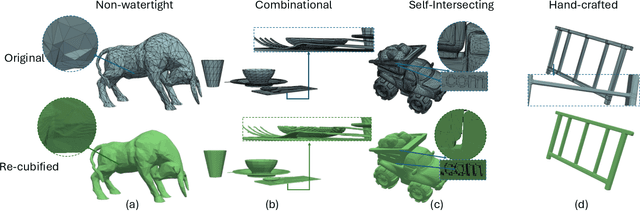
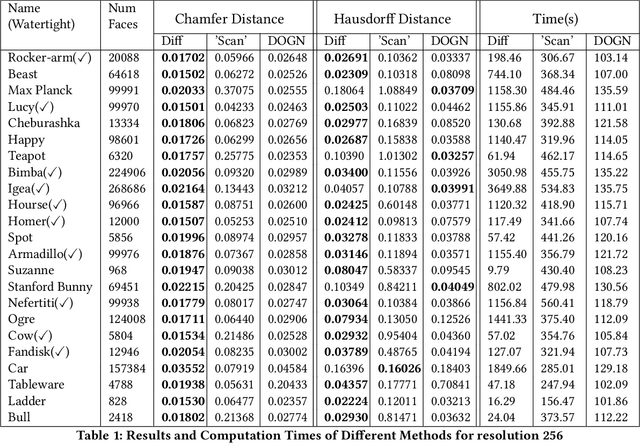
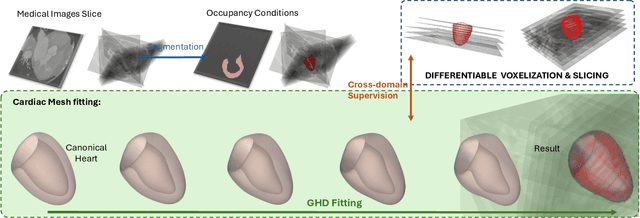
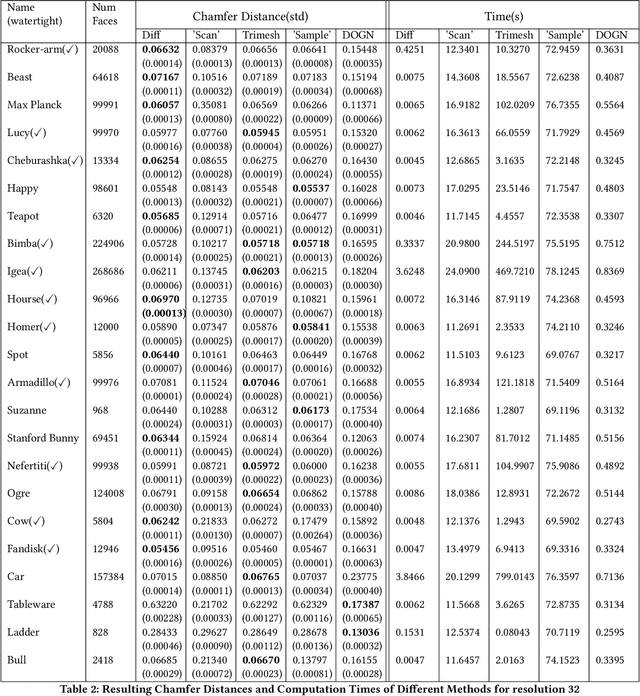
In this paper, we propose the differentiable voxelization of 3D meshes via the winding number and solid angles. The proposed approach achieves fast, flexible, and accurate voxelization of 3D meshes, admitting the computation of gradients with respect to the input mesh and GPU acceleration. We further demonstrate the application of the proposed voxelization in mesh morphing, where the voxelized mesh is deformed by a neural network. The proposed method is evaluated on the ShapeNet dataset and achieves state-of-the-art performance in terms of both accuracy and efficiency.