 Add to Chrome
 Add to Firefox
 Add to Edge
End-to-End Identifiable and Consistent Recurrent Switching Dynamical Systems
May 07, 2026
Learning identifiable representations in deep generative models remains a fundamental challenge, particularly for sequential data with regime-switching dynamics. Existing approaches establish identifiability under restrictive assumptions, such as stationarity or limited emission models, and typically rely on variational autoencoder (VAE) estimators, which introduce approximation gaps that limit the recovery of the latent structure. In this work, we address both the theoretical and practical limitations of this setting. First, we establish identifiability of a broad class of recurrent nonlinear switching dynamical systems under flexible assumptions, significantly extending prior results. Second, we introduce $Ω$SDS, a flow-based estimator that enables exact likelihood optimization using expectation-maximisation. Through empirical validation on both synthetic and real-world data, our results demonstrate that $Ω$SDS achieves improved disentanglement compared to VAE-based estimators and more accurate forecasting of underlying dynamics.

On the Identifiability of Regime-Switching Models with Multi-Lag Dependencies
Jan 06, 2026Identifiability is central to the interpretability of deep latent variable models, ensuring parameterisations are uniquely determined by the data-generating distribution. However, it remains underexplored for deep regime-switching time series. We develop a general theoretical framework for multi-lag Regime-Switching Models (RSMs), encompassing Markov Switching Models (MSMs) and Switching Dynamical Systems (SDSs). For MSMs, we formulate the model as a temporally structured finite mixture and prove identifiability of both the number of regimes and the multi-lag transitions in a nonlinear-Gaussian setting. For SDSs, we establish identifiability of the latent variables up to permutation and scaling via temporal structure, which in turn yields conditions for identifiability of regime-dependent latent causal graphs (up to regime/node permutations). Our results hold in a fully unsupervised setting through architectural and noise assumptions that are directly enforceable via neural network design. We complement the theory with a flexible variational estimator that satisfies the assumptions and validate the results on synthetic benchmarks. Across real-world datasets from neuroscience, finance, and climate, identifiability leads to more trustworthy interpretability analysis, which is crucial for scientific discovery.
Identifying Nonstationary Causal Structures with High-Order Markov Switching Models
Jun 25, 2024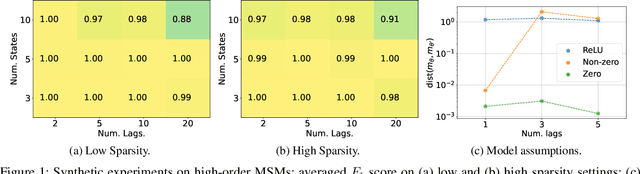
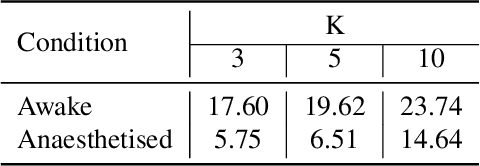
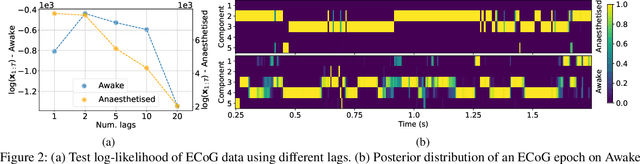
Causal discovery in time series is a rapidly evolving field with a wide variety of applications in other areas such as climate science and neuroscience. Traditional approaches assume a stationary causal graph, which can be adapted to nonstationary time series with time-dependent effects or heterogeneous noise. In this work we address nonstationarity via regime-dependent causal structures. We first establish identifiability for high-order Markov Switching Models, which provide the foundations for identifiable regime-dependent causal discovery. Our empirical studies demonstrate the scalability of our proposed approach for high-order regime-dependent structure estimation, and we illustrate its applicability on brain activity data.
On the Identifiability of Markov Switching Models
May 26, 2023Identifiability of latent variable models has recently gained interest in terms of its applications to interpretability or out of distribution generalisation. In this work, we study identifiability of Markov Switching Models as a first step towards extending recent results to sequential latent variable models. We present identifiability conditions within first-order Markov dependency structures, and parametrise the transition distribution via non-linear Gaussians. Our experiments showcase the applicability of our approach for regime-dependent causal discovery and high-dimensional time series segmentation.