 Add to Chrome
 Add to Firefox
 Add to Edge
End-to-End Identifiable and Consistent Recurrent Switching Dynamical Systems
May 07, 2026
Learning identifiable representations in deep generative models remains a fundamental challenge, particularly for sequential data with regime-switching dynamics. Existing approaches establish identifiability under restrictive assumptions, such as stationarity or limited emission models, and typically rely on variational autoencoder (VAE) estimators, which introduce approximation gaps that limit the recovery of the latent structure. In this work, we address both the theoretical and practical limitations of this setting. First, we establish identifiability of a broad class of recurrent nonlinear switching dynamical systems under flexible assumptions, significantly extending prior results. Second, we introduce $Ω$SDS, a flow-based estimator that enables exact likelihood optimization using expectation-maximisation. Through empirical validation on both synthetic and real-world data, our results demonstrate that $Ω$SDS achieves improved disentanglement compared to VAE-based estimators and more accurate forecasting of underlying dynamics.

On Graph Neural Network Ensembles for Large-Scale Molecular Property Prediction
Jun 29, 2021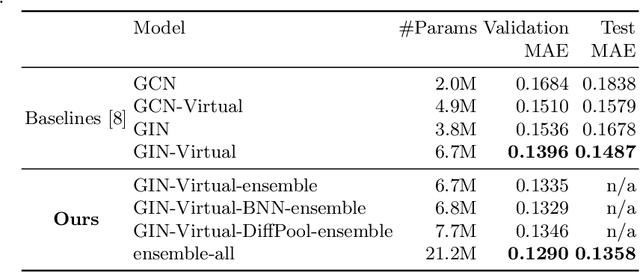
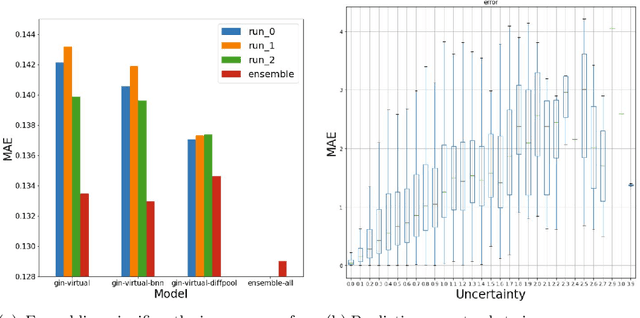
In order to advance large-scale graph machine learning, the Open Graph Benchmark Large Scale Challenge (OGB-LSC) was proposed at the KDD Cup 2021. The PCQM4M-LSC dataset defines a molecular HOMO-LUMO property prediction task on about 3.8M graphs. In this short paper, we show our current work-in-progress solution which builds an ensemble of three graph neural networks models based on GIN, Bayesian Neural Networks and DiffPool. Our approach outperforms the provided baseline by 7.6%. Moreover, using uncertainty in our ensemble's prediction, we can identify molecules whose HOMO-LUMO gaps are harder to predict (with Pearson's correlation of 0.5181). We anticipate that this will facilitate active learning.