 Add to Chrome
 Add to Firefox
 Add to Edge
Diversity of Extensions in Abstract Argumentation
May 13, 2026
Argumentation is an important topic of AI for modelling and reasoning about arguments. In abstract argumentation, we consider directed graphs, so-called argumentation frameworks (AF), that express conflicts between arguments. The semantics is defined by the notion of extensions, which are sets of arguments that satisfy particular relationship conditions in the AF. Usually, standard reasoning in argumentation do not reveal how far apart extensions are. We introduce a quantitative notion of diversity of extensions based on the symmetric difference and provide a systematic complexity classification. Intuitively, diversity captures whether extensions of a framework (accepted viewpoints) differ only marginally or represent fundamentally incompatible sets of arguments. We study whether an AF admits k-diverse extensions, admits k-diverse extensions covering specific arguments, and to compute the largest k for which an AF admits k-diverse extensions. We outline a prototype and provide an evaluation for computing diversity levels.

O2V-Mapping: Online Open-Vocabulary Mapping with Neural Implicit Representation
Apr 10, 2024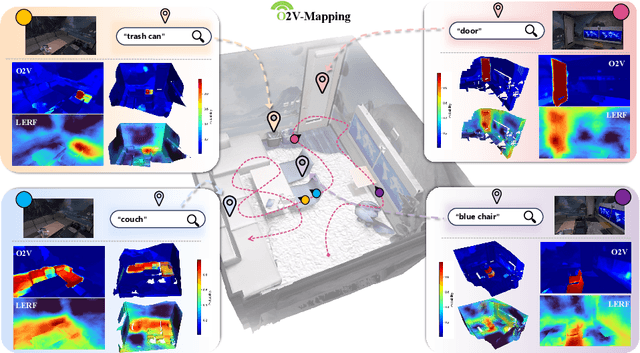
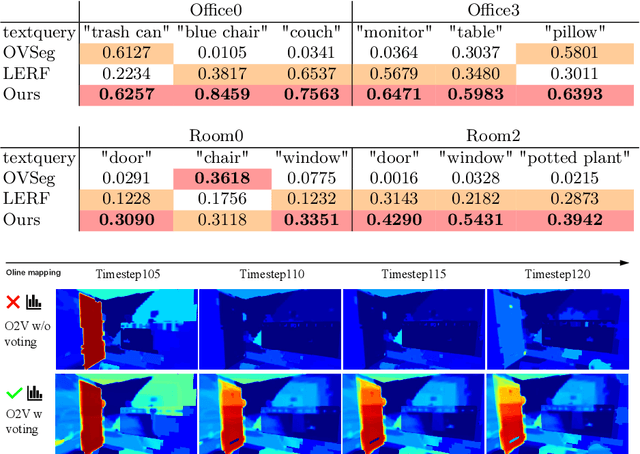
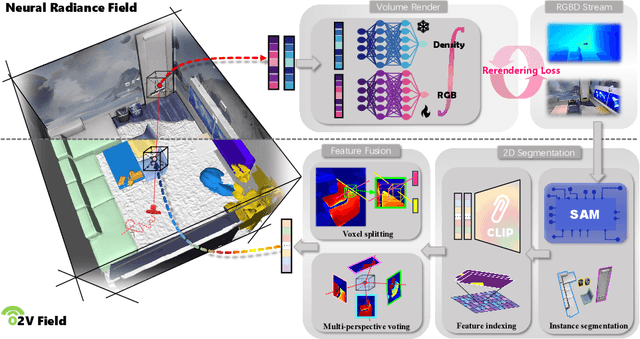
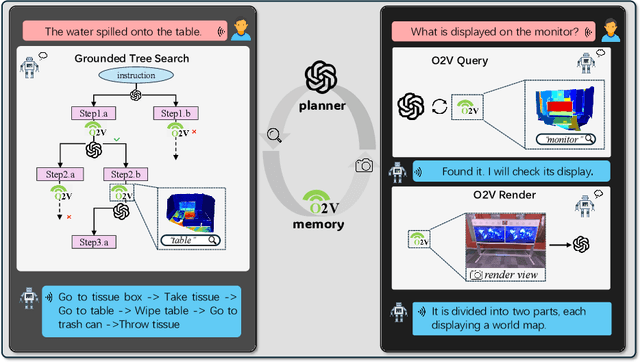
Online construction of open-ended language scenes is crucial for robotic applications, where open-vocabulary interactive scene understanding is required. Recently, neural implicit representation has provided a promising direction for online interactive mapping. However, implementing open-vocabulary scene understanding capability into online neural implicit mapping still faces three challenges: lack of local scene updating ability, blurry spatial hierarchical semantic segmentation and difficulty in maintaining multi-view consistency. To this end, we proposed O2V-mapping, which utilizes voxel-based language and geometric features to create an open-vocabulary field, thus allowing for local updates during online training process. Additionally, we leverage a foundational model for image segmentation to extract language features on object-level entities, achieving clear segmentation boundaries and hierarchical semantic features. For the purpose of preserving consistency in 3D object properties across different viewpoints, we propose a spatial adaptive voxel adjustment mechanism and a multi-view weight selection method. Extensive experiments on open-vocabulary object localization and semantic segmentation demonstrate that O2V-mapping achieves online construction of language scenes while enhancing accuracy, outperforming the previous SOTA method.